






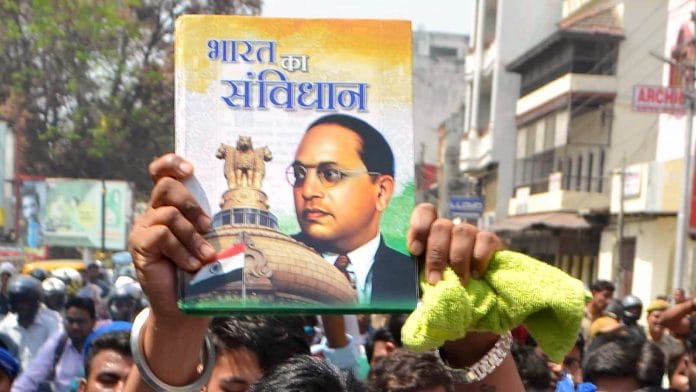


I haven’t made it yet. But my dad, who was a first–generation learner, is a textbook example of a success story. Coming from an illiterate family in a little village, he retired as a deputy secretary to the Maharashtra government. It’s motivating. But the truth is that he has failed to give back to the community. Apart from a little contribution here and there on Ambedkar Jayanti, he hasn’t done anything for the community. And while his story is inspiring, it’s also incomplete because of the burden he carries.
There is a particular kind of praise that comes with being a Dalit who has “made it.” It is warm on the surface, almost generous. People call you resilient, exceptional, inspirational. They hold you up as proof that hard work can overcome anything. They point to your journey as evidence that India is changing, that merit is finally winning, that the system is open to everyone now.
I understand why that praise exists. I, too, have felt its seduction. It is nice, sometimes even necessary, to be seen as someone who survived. To have your struggle recognised after years of being underestimated is not nothing. But I have also learned that success in the private sector, especially for someone from a neo-Buddhist background like me, is never a clean triumph. It is never just a story of arrival. It is also a story of absence and dislocation. Of what you had to leave behind to get there. And of what, in some quiet but permanent way, got left inside you.
That is the part we do not talk about enough.
Dalit mobility
We love the Dalit success story when it is simple. We love it when it is tidy, linear, and motivational. We love the version where someone rises against the odds, reaches the top, and then turns around to say, “See, it can be done.” It makes the dominant imagination comfortable. It allows society to celebrate an exception without confronting the structure. It lets people applaud the individual while leaving the system untouched.
But Dalit mobility is rarely tidy. It is messy, exhausting, and often lonely. And it comes with a strange emotional tax that never really ends. When you enter spaces you were never meant to occupy, the first thing success gives you is not freedom. It gives you hyperawareness.
You become aware of the way you speak. The way you sit. The way you dress. The way your name lands on a page. The way silence itself can sound suspicious. You become aware of the room before you become part of it. You scan it instinctively, not with arrogance but with caution. You notice the names that are easily pronounced, the people who share references effortlessly, the invisible codes of class and caste that move through corporate offices, elite universities, cultural events, and social gatherings, like background music only some people can hear.
And then you begin to understand something painful: success does not erase caste. It often just makes you more visible to it.
There is a cost to being the first, the only, the rare one. You are seen not as an ordinary person but as a symbol. A representative. A proof point. You are no longer allowed the luxury of being incomplete, uncertain, messy, contradictory. Every mistake can become a community mistake. Every achievement can become a collective burden. Every sentence you speak feels like it might be interpreted not just as yours, but as a statement about everyone who came from where you came from. That pressure can be crushing.
Because once you move up, you are expected to carry your success in a very specific way. Not too loudly. Not too humbly. Not too politically. You are allowed to inspire, but not disrupt. You are allowed to speak, but not unsettle. You are allowed to be grateful, but never angry. Most of all, you are expected to justify your presence constantly, as though the room has not yet fully decided whether you belong in it.
I have often felt that success for a Dalit person comes with a strange moral demand: be proof without being inconvenient. That is an impossible assignment.
What makes this even more complicated is that success can also become performative. I do not say this with contempt. I say it because I have seen how survival in elite spaces often requires adaptation so intense that it can begin to feel like self-erasure. You learn how to speak the language of the room. You learn what not to say. You learn to smooth out your edges. You learn which parts of yourself will make others uncomfortable and which parts will be rewarded.
At some point, the performance starts doing more than protecting you. It starts reshaping you. You become polished, strategic, and selective. And sometimes, without intending to, you begin to look down on the very people you once were. Or on the people who remain where you came from. You start confusing distance with maturity and mistaking embarrassment for growth. Ok, I’ll admit — I’m guilty of talking about “mindset” when the issue is structural injustice. I had begun to repeat the language of the spaces that admitted me conditionally, and in doing so might have betrayed something intimate and dangerous: my community’s pain.
This betrayal is not always dramatic, but often quiet. It shows up in the impatience with older relatives, with dialect, with unfinished English, with visible struggle. It shows up when someone who has escaped begins to behave as though escape itself were a moral superiority. It shows up in the subtle rejection of the life that produced them.
I have thought about this often, because success in a casteist world can seduce you into believing that your distance is deserved. That your polishing was self-made. That your old world was only limitation, not memory, labour, tenderness, and truth. But the truth is harsher. If you have climbed out, you did not do it alone. People held you up. Family sacrificed. They made impossible choices so you could have one more chance. And if your new life makes you forget that, then success has become a form of amnesia and that amnesia is dangerous.
Because the goal was never merely to escape. The goal was always liberation with dignity. The goal was not to become acceptable to the same society that once degraded you. It was to create a world in which no one has to edit themselves to survive.
But to hold that ideal while living inside a system that rewards assimilation is not easy. It is emotionally costly and creates a split inside you. One self is grateful for the room. The other knows the room was built to exclude people like you. One self wants to thrive. The other keeps asking what thriving means if it requires silence about the structure that made silence necessary.
This is the double-edged sword of Dalit mobility. The more you move, the more you see. The more you see, the less innocent the world becomes.
Also read: Casteism didn’t disappear in Indian cities. It just learned English
The burden of success
You begin to recognise that upward mobility does not automatically produce solidarity. In fact, it can sometimes produce the opposite. Some people, once they have crossed over, begin to protect their new status by distancing themselves from those still struggling. They become gatekeepers of the very spaces they once longed to enter. They police language, manners, tastes, and ambition. They repeat the same old judgements in a new accent. In a historic speech in Agra in 1956, BR Ambedkar expressed deep pain, stating that the educated class among Dalits betrayed him by failing to help the oppressed, and by prioritising selfish agendas over his movement for emancipation. That is one of the ugliest truths about success: it can make victims into custodians of hierarchy if they are not careful.
I do not say this to shame anyone because caste does not stop working on you once you become successful. It follows you into your achievements. It sits with you in your victories. It asks you to prove, repeatedly, that your rise is not an accident, not a fluke, not a quota, not a token gesture from a system that still prefers you quiet. It asks you to carry the burden of representation while also pretending representation does not matter.
That burden is real. And it is why Dalit success often feels emotionally unstable in a way upper-caste success rarely does. For some, success is inheritance. For others, it is a negotiation with humiliation. For some, it is the continuation of a family trajectory. For people like me, it is a break from a history that was designed to keep them in place. That break is not painless. It can fracture relationships, produce guilt, and create a loneliness that is difficult to explain to those who were never made to feel like guests in their own country.
There are moments, too, when success feels profoundly lonely because you cannot fully belong to either world. You are no longer fully at home in the life you left. But you are also never entirely at ease in the one you entered. You are suspended between places, languages, and expectations. You become a translator of yourself. That translation has a cost.
Sometimes, I think people want Dalit success stories because they want to believe that success is enough. But success is not the same as justice. A person can become visible and still remain wounded. A person can become educated and still carry humiliation. A person can become accomplished and still feel the weight of rooms that do not know how to look at them without casteism in their eyes.
That is why I resist the neat inspirational framing so often attached to our stories. It flattens everything difficult and human about them. It turns lived contradiction into public consumption. It asks us to smile through the pain so others can feel hopeful. It wants the finished product, not the cost.
But I’m less interested in being a polished success story than in telling the truth. And the truth is that some of us become ambitious not because we are above pain, but because pain has taught us how power works. We learn early that the world will not hand us dignity freely. So we build it. We earn it. We force it into existence. And when we do, we should be allowed to say that the process changed us.
Not always in noble ways. Not always in ways we are proud of.
Success can make us gentler, yes. But it can also make us harder, more guarded, and more defensive. It can make us impatient with people who remind us of our past. It can make us ashamed of vulnerability. It can make us forget that the self who made it is also the self that was once hungry, frightened, humiliated, and hopeful. That self deserves compassion too.
And so do the people who have not yet “made it.” They do not need pity. They do not need condescension from those who got out. They do not need to be held up as evidence of failure or lack. They need honest recognition of the structures still working against them. They need a society that stops reading their worth through a caste lens. They need success to be understood not as an individual miracle, but as a possibility that should have been available much earlier, to many more people, under far more equal conditions.
That is what makes these stories incomplete: not because the success is false, but because the system remains intact.
I think that is the most painful part of making it. Not the climb itself, though that is hard enough. Not the sacrifices, though they can be enormous. It is the knowledge that even after all of it, the world may still want to reduce you to exception, token, or lesson. It is the awareness that your arrival does not automatically change the architecture of the room. It is the fear that you may be celebrated by the same world that continues to exclude those who come after you. That fear is earned.
Which is why Dalit success must be spoken about more humanely. Not as a fairy tale. Not as a meritocracy fable. Not as a feel-good narrative for those who want to believe casteism is over because a few of us have entered the gate. But humanely and honestly. With all the pride, mess, guilt, distance, and unresolved ache that come with surviving and rising in a casteist world.
We owe ourselves that much. And maybe, if we are brave enough, we will also admit that success is not the end of the story. It is only the beginning of a more complicated one.
Vaibhav Wankhede is a creative marketer and writer. Views are personal.
(Edited by Aamaan Alam Khan)
He is not doing self pity he is starting a conversation which include experiences we have that doesn’t necessarily mean others don’t have their struggle but coming from these background we have our unique experience and these posts help our people to relate with it just like a poet or shayar expresses himself it relates to people and sometimes people understand what they are feeling after reading this and feel less lonely
As much as I sympathize with you, all I would like to say is, don’t assume, other people don’t have problems. You can easily attribute all your problems to caste, what will an historically forward caste person, blame his problems on?
It’s like that song in 3 idiots, – alpha, beta, gamma H2SO4 ne bachpan jala daala. The system is designed to equally oppress everyone, rather than reduce oppression of those who were historically oppressed.
We cannot change our pasts. But we can only change our future. For that, we all have to do good, and help each other today. Karma works in both forward and backward ways. If karma was used as excuse to justify today’s backwardness, then it can also be used to motivate doing good acts today, to reap a good future.
This piece is self-pitying garbage dressed up as social consciousness.
The guy’s father worked his way up from nothing to a high-ranking job. The author himself is in the corporate world. He’s made it. Real wins. Big ones. But instead of being proud of that, he’s trying to turn his success into some kind of tragedy. It’s honestly exhausting.
His big “burden”? Success feels lonely. People look at him. He feels like an outsider.
Yeah. Join the club. That’s what happens to literally every outsider who moves up in the world. Immigrants, women in a boardroom, poor kids who finally make a buck—they all feel it. Every single one. But he insists his version is special because of his being a Dalit. He doesn’t actually show why it’s different. He just says it is and expects you to feel bad for him.
The hypocrisy is what really gets me. He wants the corporate paycheck and the elite status, but he still wants the “victim” card in his back pocket. He’s basically saying the world did him dirty by letting him win. His family sacrificed everything so he could have this life, and he’s treating their hard work like it’s just another trauma he’s forced to carry.
He even admits he looked down on his own people, learned to talk like the elite, and ditched his roots. Then he has the nerve to blame “the system” for it. No. Those were your choices. Take some accountability.
What does he actually want? Validation. He wants a standing ovation for “surviving” a high-paying career. He wants to keep the money, keep the status, and still play the victim.
This isn’t activism. It’s therapy blogging for the elite.
He should be honoring his father’s struggle. Instead, he’s centering his own “trauma” and demanding we feel sorry for his success. It’s not deep. It’s not insight. It’s just pure, unadulterated ingratitude. Garbage.