




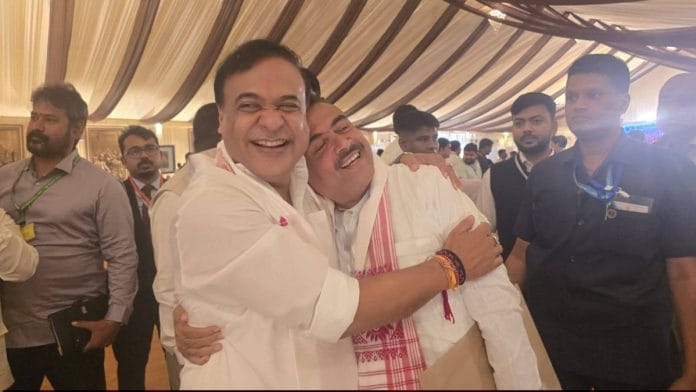

The BJP’s recent victories in the Assam and West Bengal Assembly elections reveal a striking paradox about the party’s expansion. In Assam, the party returned to power under Himanta Biswa Sarma, a leader who began his political career in the Congress before joining the BJP in 2015. In West Bengal, the BJP’s historic entry into power has been led by Suvendu Adhikari, once one of Mamata Banerjee’s most trusted lieutenants in the Trinamool Congress.
This pattern is now increasingly central to the BJP’s model of political expansion. The party that once took pride in patient cadre-building, ideological discipline and the slow labour of the RSS-BJP organisational network is winning states by absorbing powerful regional leaders from rival parties. Scholars of Hindu nationalism have long shown that the BJP’s strength cannot be understood without the organisational depth, ideological training and associational infrastructure of the wider Sangh Parivar.
Sarma and Adhikari are not merely defectors; they bring district networks, caste and community access, organisational habits, financial support systems, media linkages and intimate knowledge of the opponent’s internal weaknesses. Although they are technically “turncoats,” the word reduces a structural political strategy to a moral judgement about individual loyalty. The bigger question is whether the rise of leaders like Sarma or Adhikari changes the nature of the BJP itself.
Using local powers for national ambitions
In Assam, Sarma’s Congress background gave him precisely what the BJP lacked in parts of the Northeast: knowledge of factional politics, access to networks beyond the ideological core, and the ability to translate national Hindutva into regionally effective political language.
In West Bengal, Adhikari knew the TMC from within. He understood its strengths, vulnerabilities, local brokers, patronage circuits and methods of mobilisation. BJP leaders themselves acknowledged that Union Home Minister Amit Shah had been instrumental in bringing Adhikari from the TMC to the BJP in 2020, and Shah presented Adhikari’s chief ministership as the culmination of a long ideological journey from Syama Prasad Mookerjee to BJP rule in Bengal.
The same pattern can be seen elsewhere. In Bihar, Samrat Choudhary became the BJP’s first chief minister of the state after being previously associated with the RJD and JD(U). In Arunachal Pradesh, Pema Khandu’s journey from the Congress, through the People’s Party of Arunachal, into the BJP helped produce a full-fledged BJP government in the state.
This combination of ideology and elite acquisition is crucial. Political researcher Adam Ziegfeld’s work on Indian regional parties reminds us that besides voter sentiment, party systems are also shaped by leaders seeking important positions, clientelism, coalition incentives and state-level factional alignments. Political scientist Kanchan Chandra’s work on patronage democracies similarly shows why parties often need socially embedded intermediaries who can translate broad political claims into local networks of trust, access and expectation. The BJP appears to have learnt this lesson with unusual efficiency.
Also read: Himanta Sarma gun image is now considered acceptable aggression among some Indians
BJP’s genius hides many vulnerabilities
For now, this is electorally formidable. It allows the BJP to expand into states where ideological infrastructure alone may not be enough. A national party cannot always wait for decades of cadre-building to mature. It needs local faces who can speak the language of caste, clan, region, community and grievance. Sarma and Adhikari fit these descriptions seamlessly.
But the party’s adaptability carries risks beyond the familiar worry that loyal workers may feel overlooked. The RSS-BJP ecosystem has historically drawn strength from the belief that discipline, sacrifice and ideological commitment would eventually be rewarded. If top positions and key roles increasingly go to outsiders who bring winnability, it creates a moral disturbance within the party structure.
The deeper vulnerability, however, is ideological dilution. The BJP’s rise has often been narrated as the triumph of ideology over opportunism, organisation over personality, and cadre over dynasty. This narrative was never complete, especially in the Modi era, where leadership charisma has become central to BJP mobilisation. But as authors Pradeep Chhibber and Rahul Verma argue in their book Ideology and Identity: The Changing Party System of India, the BJP’s distinctiveness lies in its ability to present itself as a party with a coherent ideological project rather than just another electoral vehicle. That claim becomes harder to sustain if state-level power is increasingly delivered through leaders whose political formation took place in the Congress, TMC, JD(U) or other opposition parties.
The second vulnerability is dependence on regional brokers. ‘Turncoats’ are useful precisely because they command networks that the BJP did not build. But that also means these networks may remain personally loyal to the leader rather than institutionally loyal to the party. The BJP may win the state, but the inductee may control the local machinery. Over time, this can produce bargaining, factionalism and blackmail: the central unit needs the regional leader, but the regional leader knows their own indispensability.
The third vulnerability is governance contradiction. The BJP often campaigns against alleged corruption, so-called minority appeasement, dynastic politics and purported misrule. But when it wins elections through leaders trained in the very political cultures it attacks, the promise of a clean break becomes harder to maintain. The BJP may replace the ruling party in a state without fully replacing the ruling style.
The fourth vulnerability is reputational. The more the BJP depends on defectors, the easier it becomes for opponents to target its claim of being a “party with a difference”. Opponents have repeatedly mocked the BJP with the “washing machine” metaphor, the suggestion that leaders facing corruption allegations and criminal charges become politically cleansed after joining the party. This may not hurt the BJP immediately. Voters often reward strength over consistency. But over time, ideological parties can suffer when their moral language becomes visibly detached from their methods of acquiring power.
Also read: Where does the law stand on Himanta Biswa Sarma’s video of ‘shooting’ Muslims?
The real challenge: how to remain BJP
Unlike the Congress in its late 20th-century phase, the BJP possesses a strong central command, a disciplined ideological universe and a political communication machine capable of absorbing, repackaging and disciplining new entrants. But the tension remains. The party isn’t simply replacing the Congress or TMC; it is absorbing their leaders, methods and sometimes their political cultures.
This contradiction does not mean that the BJP will collapse. But it does present a challenge for the party.
In India’s difficult regional terrains, national parties do not encounter a homogeneous electorate waiting to be mobilised from Delhi. States such as Assam, West Bengal, Bihar and Arunachal Pradesh are dense political societies with their own histories of linguistic identity, caste coalitions, ethnic anxieties, religious demography, borderland politics, and local patronage systems. A national party entering such terrains cannot rely only on ideological message, central charisma or booth management. It must learn the region’s power structure: who mediates access to the state, which community grievances generate talking points, how local factions are organised, and where the ruling party’s networks are vulnerable. Acquisition of top leaders helps the BJP solve this problem quickly.
But that is also where the hubris lies. National parties often imagine that they are incorporating regional elites into a larger ideological project; in practice, they may also become dependent on the very regional logics they claim to subordinate. In difficult terrains, the acquired leader is not simply a local messenger of a national ideology; he is often the translator, broker and gatekeeper without whom the national party’s project remains shallow. This makes expansion faster, but also less controllable. The BJP’s challenge, then, goes beyond winning states such as Assam or West Bengal. It must also convert regional acquisition into durable institutional control without allowing the acquired political culture to redefine the party from within.
The BJP is not just a cadre party anymore. Nor is it simply a machine of defectors. It is becoming something more complex: an ideological party with a highly pragmatic appetite for elite incorporation. Its success in Assam and West Bengal shows how powerful this formula can be. Victory may silence the contradictions for now. But over time, the party may discover that its most effective instruments of expansion are also the figures who test the limits of its ideological discipline.
The BJP’s future challenge will not be whether it can win with outsiders. It already can. The harder question is whether it can remain recognisably itself after winning through them.
The author is Senior Lecturer and Researcher, Department of Cultural Sciences, Linnaeus University, Sweden; and affiliated researcher, University of Oslo, Norway. Views are personal.
(Edited by Prashant Dixit)