



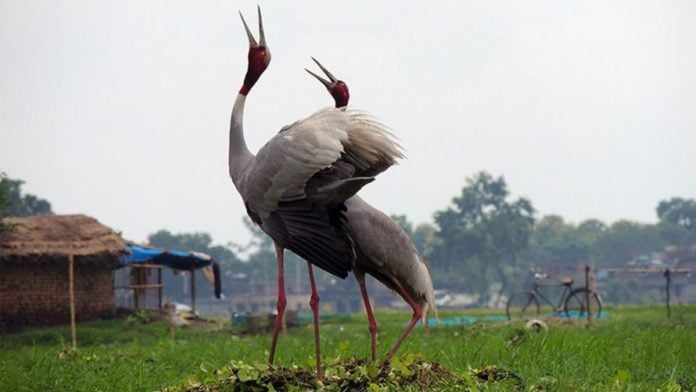
We were driving out of Lucknow, on our way back to Delhi, when my father pulled over on the outskirts, a few hours from the city. He pointed towards the fields and reached for his camera. Two Sarus cranes stood with their wings outstretched, moving in what looked like a graceful dance.
Each bird let out a quivering cry before leaping into the air, wings outstretched. As it rose, its long, slender legs lent it the grace of a dancer. For several minutes, the pair continued their performance, each responding to the other in a slow, measured rhythm. It beat ballet.
I am unable to find my father’s photos, and I am no longer five years old, but the magnificent dance of the Sarus cranes is a sight that has stayed with me ever since. What I saw then was the mating dance that these birds undertake, a ritual that implies mating for life. After that, they remain, by all scientific accounts, unattracted to other Sarus cranes.
Besides, they begin a life not only together, but one of togetherness, living like a unit. Kill one, and the other is besieged with horror and grief, refusing to leave its side. It is a sight best not seen, because it fills one with unmitigated sadness and months of worry about the bereaved partner.
Bird that loves for life
If you did want to see this bird, your best bet in India is Uttar Pradesh, which also embraces this as its state bird. You could also see it in Gujarat. Their distribution is more limited in parts of eastern India, including Assam and West Bengal, while sightings in Bihar are less well documented.
Rice fields-with shallow, steady water are one of its favourite habitats, although it also enjoys croplands with wet areas.
This is where it gets almost all of its omnivorous diet from. If you travel in a train through its habitat, you would be smart to sit by the window and gaze out at the fields. You cannot miss it-pale grey with a rich red upper neck, throat and head. It stands out tall in the fields and, at just under six feet, it is also the tallest flying bird we know.
You cannot confuse it with anything else, because there isn’t another bird like it. You can also look for it in other wetlands with shallow water areas. It needs those to build its nest, a heap of vegetation into a gentle mound, protected by water.
So far so good. The farmers, often frustrated by other species, including peacocks, seem to share a benign, loving camaraderie with this bird. I find this quite extraordinary, because the bird does cause some damage to the farmer by digging out the plants to make a nest and consuming some of the crop.
Also read: India’s glass buildings are killing birds. We know how to stop them
Farmers and cranes share the land
A 2001 study by CK Borad and others, from the Gujarat Agricultural University in Anand, estimates farmer damage from the Saras Crane activities ranges between 0.2 per cent and 13.6 per cent, the latter being quite a lot for an individual farmer.
The authors suggest that the love between farmer and bird is diminishing. But farms are themselves diminishing, and more and more land in rural and semi-rural areas is being built upon. This threatens the birds’ habitat and ability to breed. Besides, feral dogs also attack their young. As climate change continues to manifest, these behaviours can turn into fault lines. Water shortage, lowered crop yields might already be a concern for the farmer, who could reconsider the current sharing economy with this tall avian.
The Sarus Crane was named Antigone antigone in a long and endless 19th-century naming game, where its current Latin name was one amongst many proposed and discarded by a slew of scientists. Although Linnaeus, the great Swedish classifier, described the Eastern subspecies of the Sarus Crane in 1760, according to a literature review by Sarus expert Gopi Sunder and Crane and Aquatic wildlife expert BC Chaudhury, the Latin name was given only around 1854.
You could say the naming of the bird started soon after the Battle of Plassey and continued till the era of the earliest railways in India. But Antigone itself derives from a tragic character in Greek mythology, whose entire family dies eventually as a chain of unfortunate events unfolds.
The name Sarus, which suggests a lake, offers a more hopeful ecosystem framing of the bird. Which name the species’ life veers toward is a question of how this bird, of which between 13,000 individuals are left in Uttar Pradesh, is rapidly conserved. To get this right, the plan will have to join hands with and support our foundational environmentalists, the Indian farmers.
Bharati Chaturvedi is an avid birder. She is the founder of the environmental non-profit organisation, Chintan India. She tweets at @Bharati09. Views are personal.
(Edited by Saptak Datta)