



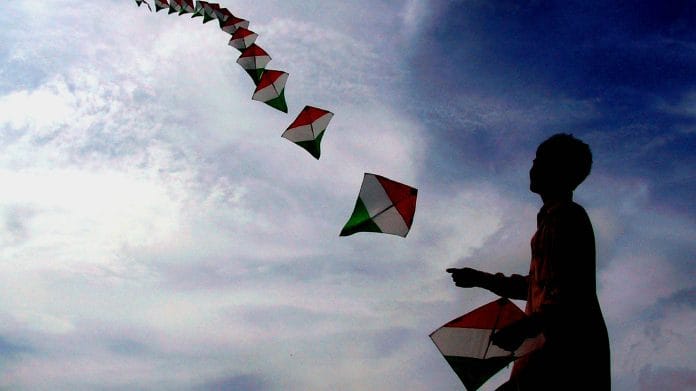
Imagine if the skies around you were full of flying daggers, and you were moving through them. Scary, but unfortunately, this is the current reality for thousands of birds across the country.
Look up at the skies, especially in the old cities, where people are flying kites. The manja — strings, often coated with glass — becomes a biannual crisis in India, on Makar Sankranti in the spring and on Independence Day in August. That is when kite flying peaks. Many of them continue to use the banned Chinese manja, without much consideration for what this sport means to birds.
For the next fortnight, thousands of people will fly kites across North India, watching their beloved toys flying on the gentle, late monsoon breeze. The fliers hope their kites stay up with ease, and enjoy watching it soar. If they are more competitive, they take down other kites in the sky, cutting their string with their own, using rapid slashes. The glass coating on the manja works like a knife, reinforced by speed. Sometimes, they lose their own kites because of the opponent’s stronger, sharper manja. The strength of the string should not be underestimated — many incidents over the years have been reported of a manja slitting a biker or a pedestrian’s throat.
Taut in the sky, this string kills birds in two ways: instantly, as they fly, or slowly, by injuring their wings, so they can’t fly and are either attacked by other animals or starve to death. You might have seen electric wires with lengths of manja hanging from them. They injure perched birds well after the kite flying season is over. In 2024, Mumbai reported that around a thousand birds were left injured during the Makar Sankranti season. A few years ago, at the Okhla Bird Sanctuary in Noida, I was surprised to see the Eurasian hobby — a bird of prey that visits the Delhi region only for a few weeks, — sitting on the ground, as if it was stranded. Its wings were outstretched. It had become entangled in manja caught on low-hanging wires and had to be rescued.
In January 2017, considering the safety of both birds and humans, the Delhi government issued a ban on polyester or nylon threads, also called Chinese manja. Not only did they ban usage, but also the sale, storage, production or import of such threads. Moreover, the notification made it clear that only cotton threads, without any glass or metallic coating, were legally allowed. Sadly, law enforcers still often find significant amounts of these dangerous manjas during raids on shops. Typically, the thin, polyester string is imported from China and, sometimes, made lethal with powdered glass in clandestine workshops in India. It is no secret that this is banned. So why do people privilege their own leisure over the lives of other species?
Also read: The Sind woodpecker is abundant in Pakistan, rare in India. It’s also a reminder of Partition
The need of the hour
I’ve spoken to friends who love kite-flying across India. I’ve even joined kite-flying groups on two occasions. They argue it’s a question of a few days in the entire year. Several of them angrily point out that it is also a tradition that should not be crucified for animal rights. The folks I hung out with on a weekend at the end of August some years ago said they were fed up with being vilified. “What about the long road trips people take, polluting the air?” one of them asked.
India is not the only country that uses manja for kite-flying. Japan’s Hamamatsu festival also involves aggressive kite-flying, sometimes using glass-coated manja. But it is held along the Pacific coast. The understanding is that the choice of location minimises bird injuries.
In Pakistan’s Lahore, kite-flying during the festival of Basant was fiercely debated and banned in 2007 — mainly because of injuries people experienced, including falling off rooftops. It was allowed this year for three days. Those advocating for bird safety point out that simple cotton — once the only string used — is entirely acceptable. Even if it hangs from trees and wires, it eventually degrades.
That this shift to safer manjas needs to be enforced at all is telling. We feed pigeons, we offer water to birds all summer. But we also tolerate manja more than we tolerate our neighbours parking their cars in “our place.” For a long time, we fought hunting to protect birds. Now, we need to tackle manja through a social behaviour change campaign to make kite-flying safer for everyone. Without widespread public agreement, the birds will keep dropping to the ground.
Bharati Chaturvedi is an avid birder. She is the founder of the environmental non-profit organisation, Chintan India. She tweets at @Bharati09. Views are personal.
(Edited by Aamaan Alam Khan)