




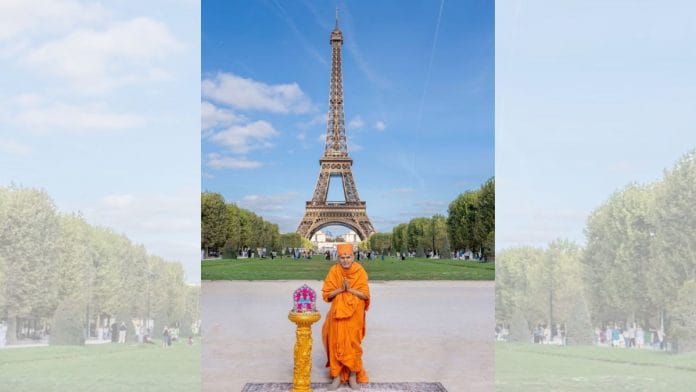

The recent uproar over barring female staff at the Eiffel Tower during a visit by monks of BAPS, the most powerful branch of the Swaminarayan sect, has spotlighted not only the sect’s controversial practice of separating monks from women by restricting women’s presence but also their influence far beyond India.
From its inception, the Swaminarayan sect enforced strict separation from women. Founded by Ghanshyam Pande of Uttar Pradesh, who later took monastic vows as Swami Sahajanand, the sect claimed to serve the so-called lower castes (though not Dalits) and quickly drew a mass following.
The sect and its founder soon faced fierce criticism from Swami Dayanand Saraswati, founder of a Hindu reform movement, Arya Samaj. Swami Dayanand accused Sahajanand of deceiving the masses and openly denounced sects such as Swaminarayan, Vallabh, and Ramanuja.
In one fiery discourse near Surat, his attack provoked such outrage that the gathering pelted bricks at him.
Like many flourishing sects, the Swaminarayan tradition splintered into rival factions, each claiming its own gadi (seat of authority). One such rupture occurred between the Vadtal temple and one of its saints, Shashtri Yagnapurushdas, who founded a new branch in the nearby village of Bochasan, hence the name Bochasanvasi Akshar Purushottam Sansthan (BAPS).
Many Patels of Charotar, a fertile region in central Gujarat, were among the earliest devotees, at a time when Patels were ranked as Shudras and denied parity with higher castes. Sardar Patel’s father, Jhaverbhai, was a devoted follower of Shashtri Yagnapurushdas.
When the feud escalated to the courts and a warrant was issued against Shashtri Yagnapurushdas, Jhaverbhai turned to his lawyer son for help. Sardar obliged, but not without his trademark bluntness:
“A warrant against Maharaj? He is the incarnation of God Purushottam, powerful enough to free us from worldly bonds. How dare anyone think of arresting him? … You ought to give up these sadhus. Those who intrigue, quarrel, and rush to the courts will not help us in this world, and even less in the next.”, according to an excerpt from Patel’s biography, Rajmohan Gandhi’s Patel: A Life.
The question of exclusion
Even in his final years, Sardar remained critical of the sect’s exclusionary practices. At a felicitation in his native Karamsad on 6 April 1947, he recalled:
“I came from Bochasan yesterday. The Maharaj invited me to the temple, citing old family ties, but admitted he had no courage to allow Dalits inside.”, according to Navjivan Prakashan’s Sardarnaan Bhashano.
The temple-entry controversy cast the entire Swaminarayan sect in a harsh light when its leaders claimed the right to bar Dalits from their temples. Gandhi addressed the issue just three days before his assassination, affirming Dalits’ right to enter Swaminarayan temples according to the Collected Works of Mahatma Gandhi.
In the Ahmedabad trial court, the sect argued that it was not connected to the Hindu religion and that its temples were therefore exempt from laws governing Hindu places of worship. It also argued that it was free to restrict entry to those who were not its devotees. The court rejected the first claim but upheld the exclusion of Dalits because they were not “Satsangis”, or sect devotees, according to Manoj Mitta’s Caste Pride.
To counter this, the Bombay Government enacted the Bombay Hindu Places of Public Worship (Entry Authorisation) Act, 1956, ensuring Dalit access to Swaminarayan temples. The law was challenged in the Supreme Court, but in 1966 a five-judge Constitution Bench rejected the sect’s renewed claim that it had no connection with Hinduism and upheld temple entry for Dalits.
The exclusion of women, however, remained untouched. There were separate temples for women, with no male monks allowed.
How BAPS became a global power
Five years later, in 1971, Pramukh Swami succeeded Yogiji Maharaj (himself the successor of Shastriji Maharaj) as BAPS’s head and presided over an era of extraordinary expansion.
Under his leadership, BAPS amassed wealth, political influence, and a reputation for discipline and technological sophistication. Its monks included highly educated young men adept in modern science, and the sect staged dazzling events with cutting-edge technology.
As a kid, I recall witnessing a breathtaking film projection in the 1980s, at Swaminarayan Nagar, a temporary township built in Ahmedabad for a grand celebration. The images covered half the dome, creating an immersive spectacle that seemed unlike anything I had seen at the time.
IMAX had not yet entered public imagination, but the scale and innovation of that display felt like a glimpse of the future. Unlike the chaos typical of mass religious gatherings, BAPS events were meticulously organised.
Pramukh Swami also drove an ambitious temple-building campaign, acquiring vast tracts of land in India and abroad, sometimes sparking controversy. The Akshardham temples at Gandhinagar and Delhi stand as monumental proof of BAPS’s scale, architectural ambition, and the political clout it commands.
Overseas, BAPS even converted old churches into temples. Other Swaminarayan subsects tried to emulate this zeal at home and abroad but never matched BAPS’s scale.
Over time, BAPS became a cultural powerhouse and a hub for Gujarati NRIs, offering free food to newcomers and weaving a global network of satsangis who supported one another in business and employment.
That network of religious and social solidarity produced not only a devoted following but also a constituency that foreign political leaders increasingly found worth courting.
Also Read: New BAPS Swaminarayan Temple to be Nestled in Krisala Land of Dreams’s Perimeter
From temples to political influence
In 2002, Pramukh Swami and BAPS secured three entries in the Guinness Book of World Records. In the “Influential People” section, he was recognised as the spiritual master who consecrated 386 temples across 11 countries between April 1971 and May 2001.
In the “Food and Drink” section, the BAPS temple at Neasden, London, displayed 1,247 vegetarian dishes as an Annakut offering for the Hindu New Year. And in “Buildings and Structures”, the Neasden temple was listed as the largest traditionally built Hindu temple outside India, covering 6,071 sq m.
Pramukh Swami’s stature eclipsed that of many other prominent godmen and godwomen in Gujarat for more than three decades. His distinctive style of blessing was a gentle pat on the back, dhabbo in Gujarati. To receive a personal audience and a dhabbo was considered a privilege, akin to meeting royalty.
Audiences were carefully choreographed, with disciples briefing visitors beforehand. A famous photograph of A.P.J. Abdul Kalam seated at Pramukh Swami’s feet alongside images of Narendra Modi seeking his blessings as Chief Minister and later Prime Minister testified to his extraordinary clout.
Modi made it a point to attend Pramukh Swami’s funeral in 2016, and today the main road along the western bank of Ahmedabad’s riverfront bears his name.
The unanswered questions
In 2021, a lawsuit filed in a US court claimed that 200 Indian workers from India were brought to the US on religious visas by the BAPS to build a temple in New Jersey, where they were forced to work for 12 hours a day for $1.20 per hour.
In February 2025, retired IPS officer Ramesh Savani published a scathing Gujarati book titled ChhalKapat (The Fraud, Manav Vikas Trust, Ahmedabad). The book, however, failed to generate the wider debate that Savani might have hoped for or a strong reaction from the sect
Its back cover carried a striking image: a “visa to Akshardham (heaven)” issued by Mahant Swami, Pramukh Swami’s successor.
That image now carries an added resonance. Mahant Swami recently posed against the Eiffel Tower, just as BAPS found itself at the centre of a global controversy over female staff reportedly being barred during the monks’ visit.
The episode is striking not simply because of what happened in Paris.
It highlights how a sect whose practices have involved strict separation from women, and whose history includes controversies over caste-based exclusion, has evolved into a globally influential institution, commanding political and cultural attention across borders.
BAPS’s global reach is undeniable. The more difficult question is what happens to the practices and ideas at its core as that reach expands.
Urvish Kothari is a columnist and writer based in Ahmedabad. He tweets @urvish2020. Views are personal.
(Edited by Maryam Hassan)