






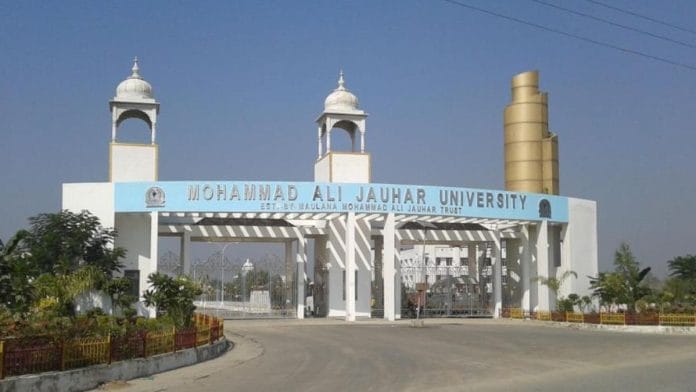


I have never agreed with Azam Khan’s politics. Nor am I writing to defend him. I am writing to defend an idea that should transcend politics: education.
The controversy surrounding Mohammad Ali Jauhar University in Rampur, Uttar Pradesh, has once again polarised public opinion. The Rampur Development Authority (RDA) has ordered the demolition of 38 of the university’s 40 buildings, citing construction without approved building plans, and has given the university 15 days to remove the structures voluntarily before the demolition begins. The university administration has stated that it submitted the required documents and was given a personal hearing before the order was passed and is now expected to pursue legal remedies. Reports also suggest that counselling arrangements are being put in place to reassure anxious students that their education, degrees, and future remain secure while the matter plays out.
The law must undoubtedly take its course. If violations have occurred, accountability is essential. No politician, institution or citizen should be above the law.
As someone who has spent a significant part of my life in Rampur, and who still has family and close friends there, I can say with confidence that Mohammad Ali Jauhar University has become far more than just a campus. Over the years, it has emerged as one of the region’s most significant centres of higher education.
For thousands of students from Rampur and neighbouring districts, many from villages and economically modest backgrounds, it has expanded access to professional and higher education close to home. Not every family can afford to send a child to Lucknow, Delhi, Noida or other major cities. Tuition fees are only one part of the expense; accommodation, travel, and daily living costs often place higher education beyond the reach of ordinary families.
For many first-generation learners, studying closer to home is not a matter of convenience, it is the only realistic option. Institutions like Mohammad Ali Jauhar University make that possible.
That reality cannot be ignored.
‘Don’t punish the students’
As I spoke to people in Rampur over the past few days, one conversation stayed with me.
One resident, known as Khan Sahab, who has lived in the city all his life, told me:
“Azam Khan’s years in public life were marked, in the minds of many people here, by arrogance and allegations of land grabbing. Today, he is in jail and facing the consequences of his actions. Let the law take its own course. But demolishing a university where so many students study is simply not right.”
“If the government no longer wants it to function under its present management, then take it over. Bring it under Mahatma Jyotiba Phule Rohilkhand University, convert it into a state university, or let it function as an independent state university. If the government wishes, it can even rename it, call it Jai Shri Ram University. But don’t demolish an educational institution that has become a centre of learning for thousands of young people,” he added.
Amanpreet, a former student of the university now working in Dubai, put it more personally: “I had an ailing father. With this university close by, I could study and look after him at the same time. This place helps a lot of children like me pursue our dreams. We don’t care who runs it, punish whoever has done wrong, bring in new people if you must, but don’t punish the students, please.”
Babu Bhai, an old soul of the city, asked a simpler question: “Will they build another university for our children after demolishing this one?”
These conversations stayed with me because they reflected a distinction many people in Rampur appear to be making. They are not asking for immunity for an individual. They are asking that an educational institution be viewed separately from the alleged actions of its founder.
Educational institutions are not merely bricks and mortar. They are repositories of dreams, aspirations, and opportunity. They belong not only to their founders but to every student who walks through their gates believing education can change the course of life.
If violations in land acquisition, construction or administration have indeed taken place, then let that responsible face the full force of the law. Investigate thoroughly. Recover public losses. Prosecute those found guilty.
But does justice necessarily require the destruction of an institution that continues to educate thousands?
Also read: Why is CJP talking more about Rahul Gandhi’s absence than Dharmendra Pradhan’s ouster?
A contradiction
The state has alternatives. If the alleged violations are ultimately established, the government could assume administrative control, appoint an independent governing body, restructure the institution under appropriate legal provisions, or ensure compliance while allowing academic activities to continue uninterrupted. Individuals can still be prosecuted. Public losses can still be recovered. Accountability can still be enforced without turning a campus of thousands of students into the price of that accountability.
India today speaks of becoming a global knowledge economy. The National Education Policy envisions expanding access to higher education, particularly beyond metropolitan India. Governments across political parties repeatedly speak about empowering youth, reducing educational inequality, and ensuring that quality institutions reach underserved regions.
Those aspirations sit uneasily beside the prospect of dismantling an institution that already serves those very communities.
This debate is bigger than Mohammad Ali Jauhar University.
Across India, educational institutions have been established by politicians, industrialists, charitable trusts, and religious organisations. If tomorrow allegations arise against the founder of another university, should we demolish that institution too? Or should we preserve what serves the public while holding individuals accountable for their actions?
The precedent we establish today will shape how India treats educational institutions tomorrow.
As students are being reassured that admissions and academics will continue despite the uncertainty, we are reminded of what is truly at stake. Behind every classroom is a young person hoping to become the first graduate in the family. Behind every degree is a parent who has sacrificed savings, mortgaged assets or taken loans in the hope of giving their child a better future.
Their aspirations deserve protection.
The rule of law and the right to education are not competing ideals. A mature democracy should be capable of protecting both simultaneously.
I have never agreed with Azam Khan’s politics, and I am not asking anyone to overlook the law.
I am asking that we distinguish between an individual and an institution.
Punish the guilty, wherever guilt is established.
But preserve institutions that continue to educate India’s future.
Because on the one hand, we speak of uplifting communities through education, encouraging young people in every district of India to dream bigger and study further. On the other, we contemplate dismantling an institution that has expanded access to higher education for thousands who otherwise might never have had the opportunity.
That contradiction deserves not celebration, but serious national reflection.
Ambreen Zaidi is an award-winning military author and activist, honoured by the President of India, for her work on war widows and disabled soldiers. Views are personal.
(Edited by Aamaan Alam Khan)
These destructive, hateful, impotent and sterile people know only how to kill loot burn and destroy people and property – the world knows now that the the sangh parivar is nothing but the greatest terrorist orgn of the world. however they will soon learn a lesson which the people of the country will teach them.