






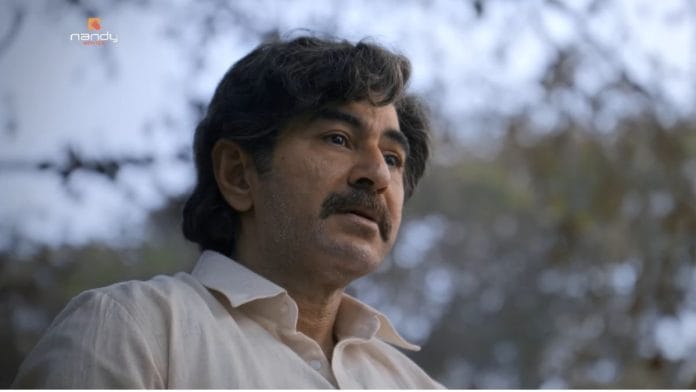

Amra ki sotti herey gelam Masterda? Ei swadhinota toh amra chaini (Did we really lose the battle, Masterda? This is not the freedom we fought for)”.
An exhausted Ananta Lal Singh quietly poses this question as he watches policemen demand bribes, bullet-riddled bodies of students lie on Calcutta streets following anti-unemployment demonstrations, and bureaucrat-laden corridors turn away freedom fighters seeking their rightful pensions. The former revolutionary, helpless and hopeless in equal measure, walks around the corridors of power requesting financial support while the strains of Vande Mataram play in the background.
Watching these scenes set in the Bengal of 1950s-60s, one feels less like they are watching a historical biopic and more like they are scanning today’s front-page headlines. Masterda Surya Sen, hanged by the British in 1934, reappears in Pathikrit Basu’s film Keu Bole Biplobi, Keu Bole Dakat (Some Call Him a Revolutionary, Some Call Him a Dacoit) as Ananta’s conscience, reminding him that while the British may have left, the nature of the ruling class remains unchanged: post-Independence elites continue a politics of exploitation and injustice, making a fresh wave of resistance imperative.
Ananta Lal Singh was one of the key architects of the 1930 Chittagong Armoury Raid led by Surya Sen. Involving coordinated attacks on British garrisons, the cutting of telegraph and telephone lines, and the declaration of a provisional revolutionary government, the raid remains one of the most audacious chapters of India’s armed freedom struggle. This Independence Day, the episode gained a fresh lease of public life through Basu’s film. Co-produced by and starring Tollywood megastar Jeet, the movie borrows its title directly from Singh’s autobiography.
The return of the radical outlaw
Keu Bole Biplobi, Keu Bole Dakat (KBBKBD) is not an isolated experiment. It joins a growing pantheon of big-budget, action-packed biopics on Bengali freedom fighters backed by A-list stars with loyal fan bases. In 2023, actor-politician Deepak Adhikari (popularly known as Dev) similarly produced and starred in Bagha Jatin, portraying the legendary revolutionary Jatindranath Mukherjee. Mukherjee was one of the key leaders of the 1915 Indo-German Conspiracy, and had died fighting the British in the Battle of Buribalam in September 1915.
However, Basu’s film differentiates itself at a crucial historical juncture. Unlike conventional biopics that conclude at the dawn of Independence or with the martyrdom of the revolutionary, it follows Singh beyond his incarceration in Cellular Jail into his controversial post-colonial life. In 1960s Calcutta, Singh founded a radical far-Left group, the Revolutionary Communist Council of India (initially known as Man-Money-Gun), which carried out a series of high-profile bank dacoities, including at the Park Street Post Office, the National & Grindlays Bank, and the State Bank of India.
The film depicts these heists using a Robin Hood-esque trope: Singh leaves posters declaring “Kranti Asche (Revolution is Coming)” at robbery sites and redistributes the looted wealth to famine victims and opens schools for underprivileged children. Ananta Lal Singh who was also a transport entrepreneur and a film producer responsible for Bengali classic comedies truly presents a complex, multi-layered persona that makes his delayed cinematic debut all the more striking. The film reaches a crescendo when, after pulling off yet another heist, Jeet as Singh breaks the fourth wall to ask the audience whether they think he is a revolutionary or a dacoit?
Yet, Singh’s cinematic battle against state corruption hits closest to home when viewed through the lens of contemporary Bengal. During the film’s climax, Singh drags the state home minister into court, demanding accountability for starvation deaths, jailed student protesters, and systemic financial insolvency. In a state recently rocked by the West Bengal School Service Commission (SSC) teacher recruitment scam, the arrest of Education Minister Partha Chatterjee and widespread public anger over financial frauds such as the Sarada financial scandal, the film’s political resonance is unmistakable. As one audience member noted upon leaving the theatre:“Every minister in this state should be forced to sit and watch this film.”
Sub-national identity and contemporary anxieties
Beyond its commentary on state corruption, KBBKBD drops several socio-political Easter eggs that reflect contemporary Bengal’s identity debates. A central flashpoint in the 2026 West Bengal Legislative Assembly election has been the discourse over “outsider vs. insider” identity, with political parties frequently weaponising Bengali sub-nationalism against non-Bengali political forces. The film directly engages with this political anxiety through Ananta Lal Singh’s lineage, as his grandparents were Punjabi-speaking Rajputs who migrated from Agra to Chittagong. In one scene, his father, Gulab Singh, questions Ananta’s participation in the Chittagong Armoury Raid, reminding him that he is not technically a Bengali like his comrades. Ananta brushes this off, asserting that their collective identity as Indians fighting British rule transcends regional boundaries.
Primary oral history accounts gathered by our oral history project, Agnijug Archive, reveal that Singh himself identified fiercely as a Bengali, taking deep personal offence in his later life if his “Bengali-ness” was ever called into question. Having been severely traumatised by the 1947 Partition of Bengal, his post-colonial radicalisation was deeply tied to the socio-economic displacement of the region. Yet, the film conspicuously omits any mention of Partition throughout its runtime, a striking erasure in a narrative set against post-1947 Calcutta. By circumventing the trauma of Partition while simultaneously depicting Singh’s resistance against non-Bengali identity tropes, the movie highlights how commercial biopics continue to selectively filter historical memory to serve contemporary screen narratives.
Also read: Ted Lasso is reusing Chak De! India plot in 2026. It is 20 years too late
Pop culture as living memorialisation
As oral historians, we have often struggled to watch period dramas, especially on the subject of our research: the Indian revolutionaries. This can be largely attributed to the outright falsehoods often propagated in such movies, which reflect a glaring lack of research and not necessarily creative liberties, as is often claimed. While KBBKBD also displays enough of those distortions, including messy timelines and fictional events in the protagonist’s life, these seem to have been added to pander to the superstar’s fanbase and focus on the ‘entertainment’ element, as the crew has claimed in several interviews; rather than a lack of knowledge about the actual events.
The movie includes familiar tropes such as the ‘good cop-bad cop’ with the righteous but fictional Durga Roy (played by Tota Roy Chowdhury) presented as a foil against Rathindra Niyogi, a character with shades of Runu Guha Niyogi, the infamous cop of the 1970s, still remembered for brutally torturing young Naxalites in Calcutta. The way the film treats Singh’s involvement in the Naxalite movement without explicitly naming the movement to avoid obvious political controversies is also interesting to watch, because by focusing on the basic issues of food security, unemployment, and corruption that inspired the original youth-led movement, it has made itself even more relevant in contemporary political light, prodding one to ask whether anything has really changed in the past 55 years.
What remains to be seen is to what extent movies such as these inspire audiences to look past stylised blockbusters and explore the forgotten events of India’s armed freedom struggle. By resurrecting figures who challenged both the Raj and the post-colonial state, commercial biopics operate as devices of kinetic memorialisation: moving history off static archive shelves into active public discourse. This cinematic disillusionment mirrors what martyr families repeatedly echo in our primary research.
In one interview recorded for Agnijug Archive, Shivshankar Ghosh, son of revolutionary Kalikinkar Ghosh, recalled an interaction with Ananta Singh’s comrade Lokenath Bal, whose 14-year-old brother Tegra was killed fighting the British in Chittagong. Tormented by the state of post-independence India, Bal had asked: “Ei swadhinotar jonnye ki amar bhai praan diyechilo? (Did my brother sacrifice his life for this freedom?)”.
Ultimately, Singh’s journey on screen forces viewers to confront a society using its revolutionary past as a mirror: asking whether the free nation ever truly delivered the freedom its martyrs fought for, to either the ones who fought for it or the ones who came after.
Oyeshi Ganguly is a Berlin-based oral historian, archivist, and the founder of the Agnijug Archive. Her work focuses on anti-colonial movements, cultural history, and environmental history. Shriya Dasgupta is a doctoral student of History at Purdue University, USA, and the co-founder of Agnijug Archive. Views are personal.
(Edited by Aamaan Alam Khan)