





People forget. MK Gandhi was never opposed to rich capitalist entrepreneurs. He was very friendly with industrialists like GD Birla, Jamnalal Bajaj, Ambalal Sarabhai and Kasturbhai Lalbhai, among others. He was thrilled when The Scindia Steam Navigation Company Ltd., or the Scindia Shipping, launched an Indian ship on the high seas.
Additionally, Gandhi was actually a guest of Birla on that fateful day in January 1948. He referred to Bajaj as his son. Many of our left-leaning politicians, journalists and academics have conveniently forgotten all this about Gandhi.
An American president quite openly said that the interests of General Motors and the US coincided. The Japanese state has openly supported its Mitsubishis and Hitachis. The Zaibatsu are interwoven into Japanese public life and government policy. South Korea, under different governments, has made sure that Samsung, Hyundai and other Chaebols are encouraged. Incidentally, this is despite legal action against some Chaebols for wrongdoing.
When industrialists become villains
In India’s post-Mahatma world, things have been different. In the 1950s, 1960s and 1970s, dozens of MPs poured vitriol on the Tatas and Birlas. This was not just from the socialist Congress benches (to this day, I am confused about the difference between Congress’ socialist position and simple unalloyed socialism).
It included not just the expected Communists, but also the comical characters of the Praja Socialist Party and the Samyukta Socialist Party. When the Swatantra Party made some modest gains in 1962, then Prime Minister Jawaharlal Nehru referred to them as the Tata-Birla-Maharaja party. Indira Gandhi went further. She said publicly that the Tatas would not get a licence for a fertiliser plant in Mithapur because it would make the Tatas too big.
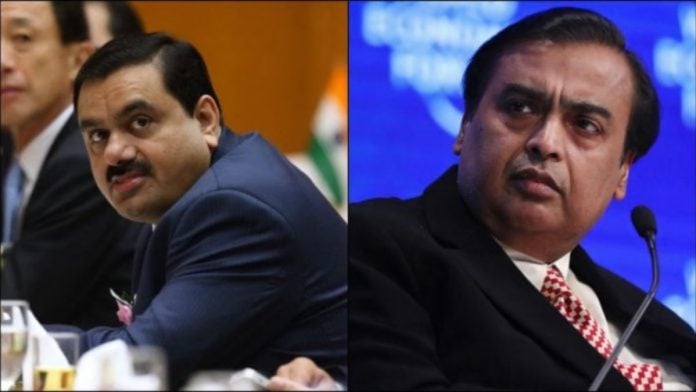
Now the ire is directed against the Ambanis and the Adanis. If you are an Indian “intellectual” writer and foreigners admire you, that is a great accolade. But if foreigners admire an Indian businessperson, then it really irritates the jealous denizens of the left. US Secretary of State Marco Rubio’s meeting with the global refining super-magnate is not a source of pride but of extreme discomfort for the leftist nitwits of India. The fact that Rubio met the heads of three Indian conglomerates irritated leftists, more, not less.
I have a personal recollection of Dhirubhai Ambani. I was a junior officer in a bank which in the early 1970s had disbursed a one crore term loan to a small company called Reliance. I was most definitely not involved in approving the loan. I was too junior. I merely reported it in the MIS reports. But to this day I feel proud that even if only indirectly, I was involved right at the beginning of a great Indian business story.
I am fully aware of the noise in sections of the Indian press about the duty exemptions given for the import of Reliance’s petroleum refining equipment. I personally believe that this so-called loss of notional revenue was one of the best investments that this country ever made. Today, in Jamnagar, we have the biggest, the most versatile and the best-in-class refinery in the world.
Years later, I was a director of a company which was a vendor to the Reliance refinery. I remember talking to one of our engineers who told me that Reliance’s RFPs, Tender Documents and Project Management processes were world-class and in many cases, better than those emanating from our best foreign customers. And when quality work was done on time, the payments were prompt, which was unusual in India.
Reliance has set the benchmark. Other Indian refiners, including our Public Sector firms, have not lagged too far behind. That is why today, we are referred to as a “refining superpower”. As a conglomerate, Reliance has branched out and has created a telecom venture. Our telephone and data costs are the lowest in the world. This is significant for us as ordinary customers and for our businesses who are burdened with high land costs and electricity costs.
Also read: Look beyond ease of doing business. Economic freedom is India’s real path to Viksit Bharat
Adani and India’s strategic interests
And now to switch to the Adanis. Let us just look at one metric. The turnaround time in the Adani ports. The Adani ports achieve turnarounds which are a fraction of a day and are quite comparable to Shanghai and Singapore. In other words, they are world-class. And then let us talk about the fact that the Adanis control one half of the Haifa port in Israel.
The Indian Left will point out that this just shows that our government, which is close to the Adanis, is pro-Israel and anti-Palestine. Let me just point out that the other half of Haifa port is controlled by a Chinese company. Has any Indian communist accused China of being pro-Israel and anti-Palestine?
Adani’s interests in Australia and Israel add to the strategic power of India. Just think of how Mitsubishi adds to the power of Japan, and you can figure out the picture.
In our country, we need to restate the obvious. So here goes:
- No country can be rich or strong if it has no rich people. A country of uniformly, socialistically poor people will remain a poor country.
- No country can progress if its business enterprises do not prosper. Such enterprises need to be encouraged and supported. If they indulge in wrongdoing, it is fine to litigate against them (cf.South Korea). But it is not correct to vilify them and carry on a vicious campaign against them. Given our over-complex laws and rules, wrongdoing is almost inevitable. This is something that all Indian citizens know.
- Other countries are not stupid. When Japan supports Mitsubishi, when South Korea supports Samsung, when Taiwan supports TSMC, when China supports Huawei, they know what they are doing.
- Companies and conglomerates can become strategic assets for a country. They need to be nurtured and not attacked all the time.
- Whatever else his personal faults may have been, MK Gandhi was not stupid. He made friends with Birla, Bajaj, Sarabhai and Lalbhai because he knew that such networks constituted a national strength.
It is difficult to hope that the leftists in our country will be persuaded by logic. They will continue to hold forth like ineffectual birds beating their wings in the void. But one can surely hope that ordinary thinking citizens will realise the importance of the country championing business champions.
Jaithirth ‘Jerry’ Rao is a retired entrepreneur who lives in Lonavala. He has published three books: ‘Notes from an Indian Conservative’, ‘The Indian Conservative’, and ‘Economist Gandhi’. Views are personal.
(Edited by Saptak Datta)