







On the eightieth Independence Day, the Prime Minister, speaking from the ramparts of the Red Fort, argued that Bharat can no longer afford to rely on other countries. The concept of Aatmanirbhar Bharat, or self-reliant India, has been central to economic policy for a decade, with its emphasis on reducing dependence, developing indigenous capacity and preventing external actors from controlling India’s essential resources. The argument is compelling at the national level. However, it becomes more complex at the state level.
Even as less dependence on the rest of the world is championed, on the domestic front India’s states have become increasingly dependent on Delhi over the past decade. Seventeen years of Union Budget data reveal when that dependence deepened, and why.
Bigger share for states — but a shrinking pool
India’s fiscal framework was established with an inherent mismatch that the framers of the Constitution acknowledged and accepted as a necessary compromise. The states are responsible for expenditures related to health, education and policing — services that directly impact citizens — while the Centre retains control over elastic and buoyant taxes, such as income tax, corporate tax and the Union share of Goods and Services Tax (GST).
American economist Richard Musgrave’s classic framework for federal finance explains this arrangement: allocation functions, like education, are best managed at a level close to the citizenry, whereas stabilisation — the job of managing the economy during crises — requires centralised control over monetary supply and borrowing. Wallace Oates later made the case for decentralising spending to local levels of government.
The idea, essentially, is that revenue should closely follow expenditure, which is a principle that India’s Finance Commission was designed to uphold as well. However, this alignment has not always been achieved.
India’s vertical fiscal imbalance, or the gap between state expenditures and revenues, has persisted for decades. Some estimates have put this gap at as much as 60 per cent of combined government revenue — meaning states spend far more than they can raise themselves. This has been a structural characteristic of Indian federalism since the inception of the First Finance Commission.
The mechanism intended to address this gap is devolution, which, in theory, has been progressing. The Fourteenth Finance Commission increased the states’ share of the divisible pool from 32 per cent to 42 per cent in 2015, a significant milestone celebrated as the beginning of a new era of cooperative federalism.
In essence, it represented a fiscal form of self-reliance: the states’ income was less contingent on Delhi’s annual discretion and more assured as a constitutional right. However, the effectiveness of a devolution rate depends upon the integrity of the pool to which it is applied.
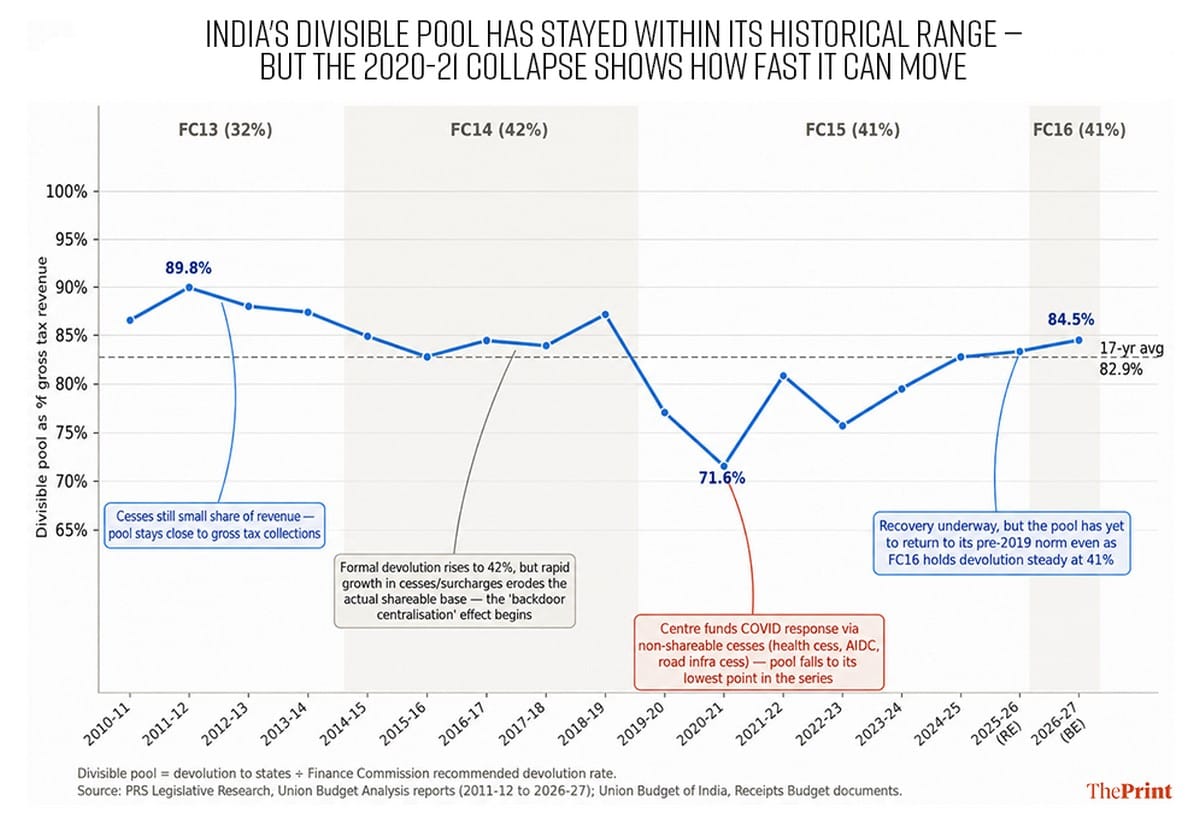
The catch has been that a smaller share of the Centre’s tax revenue has been going into the pool over time.
In the early 2010s, the share going into this pool averaged nearly 87 per cent, before the Fourteenth Finance Commission’s increased devolution rate came into effect. At that time, cesses and surcharges, which are constitutionally exempt from sharing with the states, made up only a small part of the total tax collections.
However, as reliance on these instruments increased, the shareable pool diminished despite the rise in the headline devolution rate. Notably, the pool fell to 71.6 per cent in the fiscal year 2020-21, marking the most substantial annual decline in the series. This reduction occurred as the Centre utilised non-shareable cesses to finance the Covid-19 response, thereby avoiding the divisible base.
Ironically, while the nation was encouraged to embrace self-reliance, the fiscal framework on which states depend shifted toward greater reliance on the Centre’s annual discretionary decisions. Although there has been a partial recovery, with projections indicating a rise to 84.5 per cent by 2026-27, the situation underscores a critical point: the pool upon which states rely is subject to rapid changes, governed by the Centre’s discretion.
Also Read: GrapeNet to US tariffs—India can win the export race by making compliance easy
The number that inverts the story
An additional, entirely independent series of data further complicates the analysis by introducing an opposing perspective.
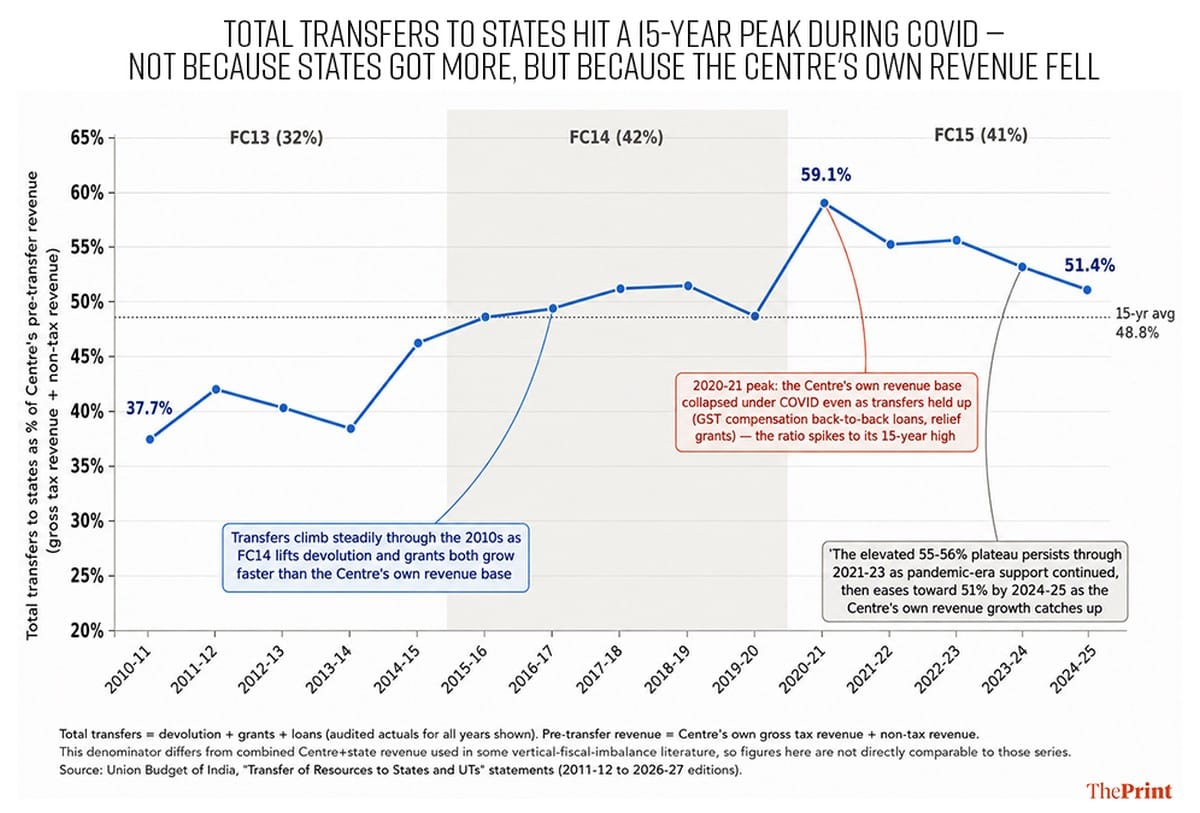
Total transfers to states, encompassing devolution, grants and loans, reached their peak in 2020-21, constituting 59.1 per cent of the Centre’s pre-transfer revenue. This was the highest ratio observed in fifteen years of audited data. A superficial interpretation might suggest increased generosity. However, a deeper analysis shows that the rise was largely a mathematical outcome.
During that year, the Centre’s tax and non-tax revenues declined significantly because of the pandemic, while GST compensation, back-to-back loans and relief grants continued to be disbursed to states, which were at the forefront of the health crisis. The ratio increased not because Delhi allocated more funds in absolute terms compared to typical years, but because its own revenue diminished more rapidly than the funds it distributed. This elevated ratio persisted through 2021-23 as pandemic-related support continued, before gradually declining to approximately 51 per cent by 2024-25 as the Centre’s revenue growth recovered.
Placing the two charts side by side reveals a significant but underreported trend. The divisible pool, to which states are constitutionally entitled, contracted precisely when states needed it most. Conversely, the total transfer ratio, which encompasses discretionary grants controlled annually by the Centre, increased over the same period.
This increase occurred because Delhi opted to address the shortfall using mechanisms not formally required to be shared. Consequently, states received assistance, but it was provided under the Centre’s terms and discretion, rather than through the automatic, rules-based channel envisioned by the Constitution’s framers. This distinction between entitlement and discretionary aid underscores the fundamental difference between federalism and generosity.
It is not a matter of individual culpability. Since the 1980s, successive governments have resorted to cesses when fiscal constraints arose. Notably, the Fifteenth and Sixteenth Finance Commissions have maintained the devolution rate at 41 per cent rather than allowing it to decline. However, the issue lies not with the headline rate but with the pool to which it is applied.
Fiscal self-reliance for states parallels national self-reliance for a country. It entails a reduction in dependencies on external goodwill and an increase in entitlements that cannot be redefined without notice. Addressing this would enable devolution to function as the Constitution intended, providing states with a reliable basis for planning. If left unaddressed, future crises will continue to be funded through mechanisms that the Centre is not obligated to share.
The Seventeenth Finance Commission faces a critical decision: whether to continue negotiating the rate or to establish a fixed base. The Prime Minister has called on states to match the Centre’s pace on reform. But reform requires resources, and right now the Centre decides how many resources states get to work with: this year’s rate, this year’s pool, this year’s grants. That is not a partnership of equals. It’s a partnership where one side sets the terms and asks the other to keep up.
The progress India has made since its independence is evident. It is imperative for a Finance Commission to investigate the reasons behind the states’ delay in advancing reforms.
Bidisha Bhattacharya is ThePrint Consulting Editor (Economics) and an Associate Fellow, Chintan Research Foundation. She tweets @Bidishabh. Views are personal.
(Edited by Asavari Singh)