




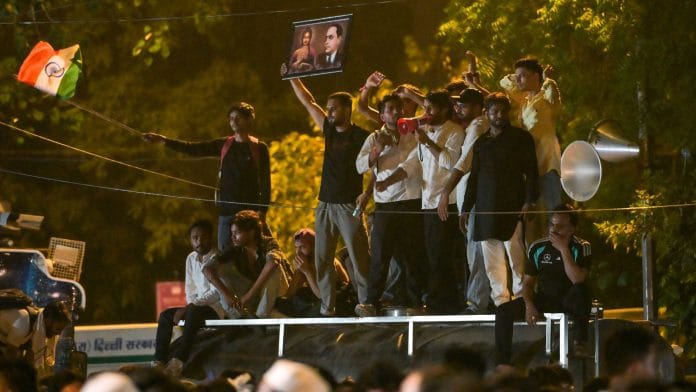

The students at Jantar Mantar are told, in effect, to wait for the ballot box. But a free people speak between elections too and “wait”, as Dr Martin Luther King Jr knew, has almost always meant “never”.
For weeks, students protesting the NEET-UG paper leak have fasted and chanted at Jantar Mantar, many carrying copies of the Constitution, demanding that Union Education Minister Dharmendra Pradhan accept political responsibility for an examination failure that forced more than two million candidates to sit the test again. The government’s answer has been the language of patience: investigations are underway, the courts are open, the ballot box will come round in its own time. Keep to law and order and ‘wait’.
India’s history seems, for a moment, to take the government’s side. On November 25, 1949, not far from where those students were lathi-charged this week, BR Ambedkar gave the Constituent Assembly his last great speech. He warned that once constitutional methods of redress were available, there could be no place for the “bloody methods of revolution”, civil disobedience, non-cooperation or satyagraha, the road he called the “Grammar of Anarchy”.
That line is often quoted to send crowds home. It should not be. Ambedkar was warning that extra-constitutional coercion could not become a substitute for constitutional government. He was not abolishing the citizen’s voice. The Constitution adopted the next day expressly protected speech and peaceful assembly. The students at Jantar Mantar were not carrying torches. They were carrying his book.
So, the answer is plain and needs no hedging. No one has to wait for the ballot box to be heard. Peaceful protest is not a favour the State grants between elections; it is a right the Constitution recognises, with an honoured and load-bearing place in the life of a free people. The Republic does not adjourn between elections.
‘Wait for 2029’ — an answer or an alibi?
The tidiest defence for the Education Minister runs like this: in a democracy, ministers are made and unmade at the ballot box, so to unmake one through the pressure of a crowd is to let the street overrule the electorate.
It sounds like principle. It is usually an alibi. It rests on two assumptions seldom examined: that the ballot is the only democratic voice, and that every injustice can wait five years for the wheel to turn. Where either assumption fails, “wait for the vote” becomes an alibi dressed as patience.
Consider the hardest case. In April 1963, eight clergymen in Birmingham, Alabama, called Martin Luther King’s protests “unwise and untimely” and urged him to wait — the courts were open, they should be patient. King answered from a jail cell that to those who had lived under injustice, “wait” had almost always meant “never.” The Fifteenth Amendment had formally protected Black men’s right to vote since 1870; that right was then denied in practice for very nearly a hundred years by the poll tax, the literacy test, the grandfather clause and, where paper failed, the rope.
Told to simply out-vote their tormentors at the next election, they would have been waiting still. It was not patience that broke that century. It was the long discipline of Montgomery, the lunch counters and, finally, the bridge at Selma, unarmed and unrelenting, that pried the ballot open and produced the Voting Rights Act of 1965. The vote was the prize at the end of the marching, not a substitute for it.
Some wrongs are urgent and some irreversible. A year stolen from the young cannot be handed back at a later poll.
Also read: Dharna was sacred even in medieval India. BJP is following the path the British created
A right older than the ballot
Beneath all this lies the root of the matter. The rights to speak, assemble and petition do not descend from the ballot; they are what made the ballot worth having.
The American Declaration spoke of “unalienable” rights; the First Amendment later placed speech, assembly and petition beyond ordinary governmental favour. The Indian Constitution speaks the same language of guarantee, not of gift. To silence a citizen until polling day is to treat an inalienable right as a licence, renewable at the pleasure of the very power it exists to check.
Asking is not anarchy
Nor is the demand itself alien to Indian constitutional culture. Resignation on moral responsibility is among its oldest instruments.
Article 75(3) makes the Council of Ministers collectively responsible to the Lok Sabha. One of its finest expressions came voluntarily: in 1956, after the railway disaster at Ariyalur took more than 140 lives, Lal Bahadur Shastri resigned as Railway Minister. He had not been at the signals, but a man who holds an office owns its failures. Jawaharlal Nehru accepted the resignation because, he said, it would set an example in constitutional propriety, not because Shastri was personally responsible for the accident.
The right to press that demand is written into the same constitutional text. Articles 19(1)(a) and 19(1)(b) guarantee speech and peaceful assembly, and the Supreme Court has held, in a case concerning Jantar Mantar itself, that the authorities may regulate demonstrations but cannot extinguish them altogether. The Court described peaceful protest as a fundamental right and a crucial means by which an informed citizenry participates in governance.
To say that the rule of law forbids the demand is to turn the Constitution inside out.
The table, not the gate
What, then, was the march by protesting students for? A march to Parliament, is a petition with feet: its object is the table, not the gate. Which is why the graver breach this week was not the students’. It was the state that met a hunger strike with a baton charge, dragged a fasting man from a protest ground, sealed the metro, cut the internet around the seat of the nation’s democracy, and folded young people holding the Constitution into police vans.
There is a line a protest may not cross, a single bright line, and it is the sword. Lift a stone to burn and seize, and the Constitution is left behind; lift a book to be heard, and one stands in its very heart.
Also read: TV news showed the CJP protest live. Then it rewrote the story on primetime
The cost of waiting
The cost is not abstract. The cancellation of the NEET-UG examination following the paper leak required more than two million candidates to sit it again. The movement has also carried the names of students whose deaths by suicide have been linked, in public reporting and by protesters, to the leak and its aftermath. Causation in each case demands care. Grief does not.
These were young people who gave years to a single morning and could not bear what was done to it. No later election can return that year, or those lives. That is the true cost of that word.
And so, the students keep their vigil, a book in their hands and the Republic’s own promise on their lips. The least the Republic owes the young people who carry its Constitution to its door is not a baton or a sermon on patience, it is an answer, and it has not yet had the grace to give one.
Pratik Patnaik is a Partner at Samvad Partners. His X handle is @ChiefDissenter. Views are personal.
(Edited by Prashant Dixit)
2029 is far away. By then, freebies, a conflict with a neighbour, supplicant media’s praises and the general public’s gold fish-like attention span will ensure everything will have been forgotten. One just needs to look at the last ten years: demonitisation, the sudden Covid lockdown and ensuing incompetence, way protesters (CAA, olympic wrestlers, farmers, students, unemployed) have been treated, Covid deaths from UP assembly election duty and Mahakumbh, electoral bond scam, falling bridges, leaking temples, stolen donations, compliant Election Commission, ED raids… Nothing seems to stick. They still end up victorious.