







New Delhi: The proposal to raise the pecuniary jurisdiction of Delhi’s district courts from Rs 2 crore to Rs 10 crore has sparked strong opposition from intellectual property (IP) lawyers, who say the move lacks empirical backing, was pushed through without consultation, and risks overwhelming district judiciary while dismantling a specialised system at the Delhi High Court.
While the proposed change will affect all civil litigation, IP lawyers say they have the most at stake. A substantial share of high-value copyright disputes is currently heard by the Delhi HC for the technology and facilities available, and also due to the nuanced understanding of the benches there. They would shift to the district judiciary if the proposal is implemented.
Every court hearing civil matters can adjudicate cases within a certain defined monetary value. This monetary value is referred to as a court’s “pecuniary jurisdiction”—defined under the Civil Procedure Code, 1908. The value differs from state to state.
For example, a civil judge of the junior division may have the jurisdiction to hear cases worth up to Rs 5 lakh, while a district court judge may be hearing suits worth Rs 20 lakh and above.
Also Read: What is pecuniary jurisdiction & why Delhi bar associations are pushing hard for enhancing it
The proposal and the protest
The strike in the Delhi High Court was triggered by the HC’s recent administrative resolution to increase the pecuniary jurisdiction of the district judiciary from Rs 2 crore to Rs 10 crore.
A sequence of events preceded this proposal. In May last year, the District Courts Bar Association had sent a representation to the Union Minister for Law and Justice, Arjun Ram Meghwal, requesting an increase in the pecuniary jurisdiction of the subordinate judiciary.
This was followed by Chief Justice DK Upadhyay’s move to constitute a committee of the seven senior-most judges of the Delhi HC.
Unhappy with this move, various lawyers’ bodies filed petitions in the Delhi HC, opposing the decision to set up the panel. But on 10 July, a bench of justices Anil Kshetarpal and Tejas Karia dismissed the plea that sought to halt the process of changing the courts’ pecuniary jurisdiction.
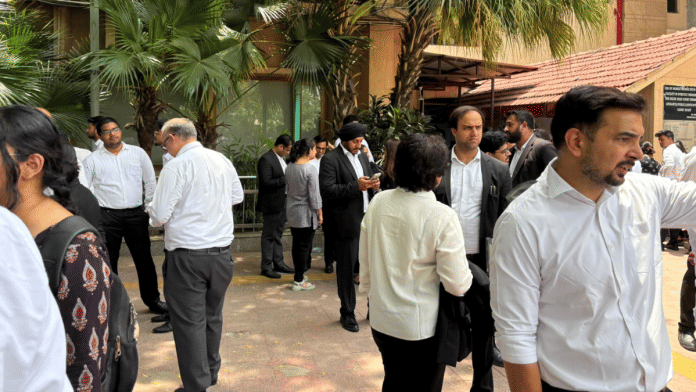
Three days later, the HC’s full court approved the panel’s proposal to raise the pecuniary jurisdiction of district courts from Rs 2 crore to Rs 10 crore. The full court’s resolution prompted the Delhi High Court Bar Association (DHCBA) to call a strike the next day i.e., Tuesday. The strike extended for two more days.
On Thursday, for the first time, lawyers engaged in IPR litigation came out in large numbers to protest against the “sudden and arbitrary increase”.
Sudeep Chatterjee, Senior Partner at Singh & Singh Law Firm and Secretary at Asian Patent Attorneys Association (Indian Group), warned that diverting an overwhelming majority of intellectual property and commercial disputes to the district courts undoes years of progress made in the field of IPR.
“The Delhi High Court has painstakingly developed a reputation for being the best in the field of IPR by carving out specialised rules, expertise, proficiency, and technology to handle complex IP litigation, which litigants will now be barred from accessing. In fact, the Delhi HC was the first court in the country to have its own IP division. Other states like Madras, Shimla and Kolkata also tried to replicate similar models and follow suit,” Chatterjee told ThePrint.
How does this affect IPR cases
Intellectual property law is governed by specific statutory enactments, and these statutes contain special provisions requiring certain disputes to be adjudicated exclusively by HC, the APAA secretary said, claiming raising the pecuniary threshold would severely fracture IPR adjudication.
He even claimed the proposed enhancement would actively incentivise forum shopping, multiplicity of proceedings, and the tactical filing of invalid defenses merely to trigger transfers back to the HC.
Lawyers also said no empirical or scientific assessment was undertaken before finalizing the proposal. The proposal, they claimed, would lead to stripping the Delhi HC of over 90 percent of its IP suits.
This, they added, will not solve the root causes of judicial pendency. Instead, it will simply overwhelm district courts and dismantle a highly efficient, specialised IP framework in the HC.
Managing Partner at Sahadeva Law Chambers and Advocate-on-Record Archana Sahadeva, also the Secretary of the Intellectual Property Attorneys’ Association (IPAA), said there was no consultative process or copies of any material shared with the lawyers before the HC finalised the proposal.
Although the objective behind this move is to purportedly decongest the Delhi HC, its corresponding impact on the district judiciary has not been adequately addressed, lawyers complained.
An increase in district courts’ pecuniary jurisdiction would burden the courts that already lack infrastructure and administrative support, they say.
An equally concerning aspect, lawyers say, is the long-standing issue of irregular recruitment to the Delhi Judicial Service and Higher Judicial Service, where examinations have often not been conducted for years, or the recruitment processes still remain incomplete, resulting in persistent vacancies.
Senior advocate Rajshekhar Rao said he did not doubt the talent in trial courts, but wondered if they were well equipped to handle such complex matters.
“I mean, especially at the IP level, and especially for the technology and AI-related matters we are looking at. Has anybody done that exercise?” Rao said while cautioning against treating the entire exercise as an “experiment”.
‘Why replace a system that works’
Pointing to two major concerns that arise if such a system is brought into effect, Rao told ThePrint, “The first concern is that the increased amount is too high. Secondly, if it has to be implemented, it should not happen haphazardly in one go. Instead, it should be done in a staggered or phased-out manner, if at all”.
Delhi-based IPR lawyer Ayush Samaddar also pointed out that most litigants and IP lawyers prefer to file cases in the Delhi HC for high-value commercial matters, not just due to the technology and the facilities available, but also due to the nuanced understanding of the benches there.
“In fact, there is a lot of pendency in district courts, particularly with IP suits, whereas the DHC closes cases considerably faster than district courts. In the plea before the bench, reports had been filed to evidence that the IP division of HC had a much higher rate of disposal than the district courts,” he added.
District bar associations welcome move
However, district court bar associations have backed the proposal.
Speaking to ThePrint, Narveer Dabas, honorary secretary of the Karkardooma Court Bar Association, said the recommendation was made after consulting all stakeholders and reflected the system followed in most parts of the country.
“The upper limit has been fixed at Rs 10 crore, though we were hoping for an even higher threshold,” Dabas said. “Original civil suits are ordinarily filed before district courts in most states, except Bombay, Delhi, Calcutta, Himachal Pradesh and Madras.”
Dabas said the Full Court’s recommendation would now be forwarded to the government for further action.
“The recommendation given by the High Court now goes to the government. There is naturally a lot of political pressure around such decisions, but we welcome this move,” he said.
(Edited by Ajeet Tiwari)
Also Read: What is Delhi HC proposal on pecuniary jurisdiction & why Bar association called strike against it