





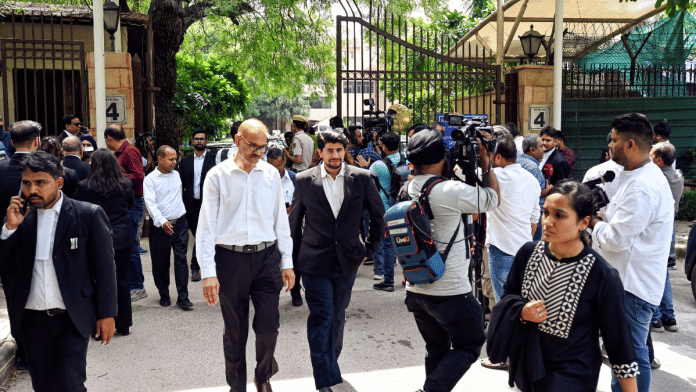


New Delhi: The Delhi High Court Bar Association (DHCBA) abstained from work Tuesday in protest against the HC’s administrative proposal to raise the pecuniary jurisdiction of district courts from Rs 2 crore to Rs 10 crore, a move the association said would affect the professional interests and livelihoods of advocates practising in the HC’s Original Side—that is, cases instituted directly before the HC.
At present, civil suits valued at Rs 2 crore or more are instituted before the Delhi High Court, while those below that threshold are heard by district courts. If the proposal is implemented, district courts would be empowered to hear civil suits valued up to Rs 10 crore.
While the DHCBA has termed the proposal detrimental to the justice delivery system and lawyers’ livelihoods, district court bar associations have welcomed it, saying it aligns Delhi with the practice followed in most other states.
The DHCBA’s Executive Committee called the strike after an emergency meeting Monday evening after the Delhi HC Full Court—an administrative meeting of all judges of the HC—expressed its view in favour of increasing the pecuniary threshold.
In a resolution issued late Monday, the association unanimously resolved to abstain from work on 14 July, saying the proposed enhancement would have “far-reaching ramifications” on the justice delivery system and substantially affect the practice, livelihood and professional interests of its members.
Member Executive Shrey Sharawat told ThePrint, the strike would continue on Wednesday as well.
Advocate and former DHCBA joint secretary Naginder Benipal told ThePrint the proposal to raise the pecuniary jurisdiction would shift nearly 70 to 80 percent of the HC’s Original Side work to district courts.
The original civil jurisdiction of a HC is its power to hear cases in the first instance, rather than on appeal. While most civil cases begin in subordinate courts, specific HCs try high-value suits and specialised matters directly.
“The matters that would now go to district courts include civil suits, intellectual property disputes, property matters and civil defamation cases,” Benipal said, while urging all lawyers practicing in the Delhi High Court to stand united.
He added that the change would force lawyers to appear across different district court complexes instead of practising primarily before the High Court.
“District courts are already heavily burdened and have higher pendency. This will only add to delays. Our members are adversely affected by this proposal,” he said.
Meanwhile, the strike affected the judicial work at the HC today, as DHCBA members went from court to court, urging lawyers to stand united.
Benipal told ThePrint on Tuesday, “The Executive Committee met at around 4.30 pm yesterday and only after that was the decision taken. As of now, most lawyers are cooperating with the call.”
According to the DHCBA’s resolution, the association believes the enhancement of the pecuniary jurisdiction of the district courts would reduce the Original Side jurisdiction of the Delhi High Court by nearly 70 percent, adversely impacting a large section of lawyers practising before it.
However, district court bar associations have backed the proposal.
Speaking to ThePrint, Narveer Dabas, honorary secretary of the Karkardooma Court Bar Association, said the recommendation was made after consulting all stakeholders and reflected the system followed in most parts of the country.
“The upper limit has been fixed at Rs 10 crore, though we were hoping for an even higher threshold,” Dabas said. “Original civil suits are ordinarily filed before district courts in most states, except Bombay, Delhi, Calcutta, Himachal Pradesh and Madras.”
Dabas said the Full Court’s recommendation would now be forwarded to the government for further action.
“The recommendation given by the High Court now goes to the government. There is naturally a lot of political pressure around such decisions, but we welcome this move,” he said.
Also Read: What is pecuniary jurisdiction & why Delhi bar associations are pushing hard for enhancing it
Judges’ committee
One of the main reasons for the DHCBA calling the strike was that the HC decision, they said, could have serious and adverse consequences for lawyers practicing at the Delhi HC, due to the number of cases going down before the HC.
The strike is not a standalone measure. It comes after the DHCBA filed a plea before the Delhi HC, challenging the full court’s decision itself to set up a committee of judges to examine the proposal to increase the monetary or pecuniary jurisdiction of Delhi’s district courts.
In May last year, the Coordination Committee of All District Courts Bar Association wrote to the Law Commission of India and the Law Minister Arjun Ram Meghwal, seeking an increase in the pecuniary jurisdiction of district courts. The committee had sought an increase from Rs 2 crore to Rs 20 crore.
Subsequently, a committee of judges was set up to examine this proposal, and the change was announced after consulting stakeholders. The committee included Justices Kameswar Rao, Nitin Wasudeo Sambre, Dinesh Mehta, Prathiba Singh, Navin Chawla and Vivek Chaudhary.
Challenging the constitution of the committee, the DHCBA approached the Delhi HC earlier this month, challenging the tabling of the committee’s report before the full court, on grounds that the representation was addressed to the Union Ministry of Law and Justice and not to the Chief Justice of the Delhi HC.
Neither the Centre nor the Law Ministry had sought the HC’s opinion on the matter, they said. A bench of Justices Anil Kshetarpal and Tejas Karia turned down the Bar Association’s request to halt the process of changing the courts’ pecuniary jurisdiction.
In doing so, the court said it would not restrain the seven-judge committee from placing its report before the full court. The court also said the petitioners had failed to establish the three essential requirements for grant of interim relief, such as a prima facie case, balance of convenience and irreparable injury.
The two-judge bench of the Delhi HC, however, had also made clear that the committee lacked adjudicatory powers or legislative authority, and hence, the pecuniary jurisdiction of the district courts could only be changed by the Parliament amending the Delhi High Court Act, 1966.
(Edited by Ajeet Tiwari)
Also Read: Delhi Bar Council has rarely had women members before. This time, the mould is ready to break