





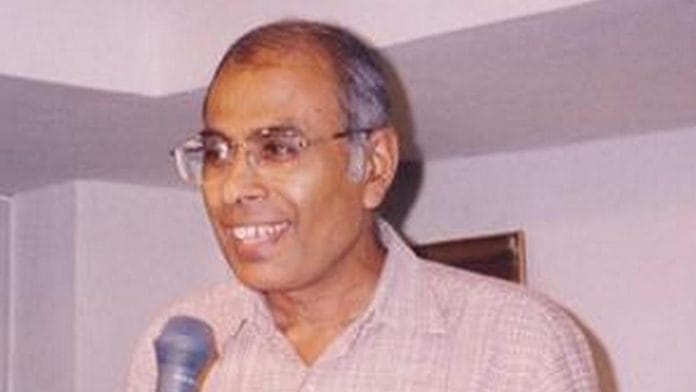


Mumbai: Suspending the sentence of life imprisonment delivered by a special court, the Bombay High Court Tuesday granted bail to Sachin Andure, convicted in the 2013 murder case of rationalist Dr Narendra Dabholkar.
Andure had filed an appeal in the High Court, challenging his conviction by a special Unlawful Activities (Prevention) Act court. In an interim application, he had sought bail and suspension of his life sentence. The High Court allowed this application Tuesday.
Andure is the second convict in this case to have secured bail. Earlier, in April this year, co-convict Sharad Bhausaheb Kalaskar was also granted bail.
In granting bail, the court relied on the defence argument that a Test Identification Parade (TIP) was not held to enable identification of suspects. Photographs of Andure and his co-accused were shown to the witness instead.
“That vitiates the identification. After about ten years from the incident, for the first time, they identified the accused in the court. This identification hardly carries any weightage,” the court noted. “There was no reason as to why TIP was not conducted. There is no clear identification, as far as the applicant is concerned,” the court said.
The court also said that the evidence of extra-judicial confession is weak. “There is no corroboration to the witness’s evidence after five years from the disclosure and significantly after the arrest of Andure,” the court said.
Dabholkar, 67, the founder of the Maharashtra Andhashraddha Nirmoolan Samiti, an anti-superstition organisation, was shot dead by two motorcycle-borne assailants while on a morning walk in Pune on 20 August 2013. Dabholkar’s murder was the first in a chain of similar killings of three other rationalists and activists—Govind Pansare in Kolhapur in February 2015, Kannada-language scholar M.M. Kalburgi in Dharwad in August 2015, and journalist Gauri Lankesh in Bengaluru in September 2017.
Andure, who is also facing trial in connection with the Pansare murder, can walk out of jail now as he has secured bail in both cases.
The Dabholkar case was first probed by the local police, but following a petition filed in the high court by his daughter Mukta Dabholkar, the investigation was handed over to the Central Bureau of Investigation (CBI) in 2014.
The prosecution had claimed that Andure was one of the shooters. On 10 May 2024, a sessions court convicted Andure and Sharad Kalaskar for Dabholkar’s murder, sentencing them to life in prison. They were, however, acquitted of charges under the stringent UAPA and Arms Act.
Also Read: Tardy progress in criminal cases against MPs, MLAs despite SC orders; amicus flags concern
‘Long test of memory’
The main circumstances against the applicant are the evidence of the eyewitnesses and the extra-judicial confession of an eyewitness, who was then serving as a sweeper in the Pune Municipal Corporation.
On the day of Dabholkar’s killing, he attended to his work between Omkareshwar Temple and Khatri Vadapao place. Reporting for work at about 6.30 am, this witness said that he heard a firecracker-like sound some 45 minutes later. He said that he saw that two boys were firing on an aged person. Those two boys went towards the motorcycle which was parked near the police post and fled; the old man fell down, the testimony ran.
He later deposed in the court that Sachin Andure and co-accused Sharad Kalaskar were the two men he had seen. He was shown photographs of the accused by the CBI. During cross-examination, however, this key eyewitness revealed that the photographs were shown to him by a CBI officer only in 2018.
He had identified one of them, whose name was Kalaskar. Importantly, he had stated that he had not seen the other person committing the murder. He was told by the police that the name of that person was Andure.
“His substantive identification in the court was in March 2022, that was almost after about eight years and seven months. That is a long period to test his memory,” the court noted.
“He had told the police that he had not seen that person committing the murder. In any case, he was shown the photographs in December 2018. There was no reason as to why TIP was not held instead of showing the photographs of the suspects.”
The court also dismissed the evidence-based theory of the prosecution of the second witness Vinay. He deposed that he used to go for morning walk and jogging every day. On the day of murder, he returned home at around 7 am from his morning walk and went to his balcony. At that time, he said saw an aged person. Within one to one-and-a-half minute, Vinay said he heard the sound of gunshots.
He looked at the place from where he heard the sound. He saw that the aged person was lying on the ground.
Two boys who had followed him were running in the opposite direction and they came towards his house. Both of them went towards the police post, started a motorcycle parked there and went away. He saw the motorcycle number and informed the police.
Again in 2018, Vinay was shown a dozen-odd photographs, and he identified two photographs which were of the same person in 2022, nine years later. That, too, was Sharad Kalaskar. “Again, this was a long test of memory,” the court said.
The court did not accept the extra-judicial confession of another witness, Somnath Dhayade. This witness used to run a restaurant and also attend Hindutva programmes besides having subscribed to Sanatan Prabhat weekly. It was at one such programme in 2012 that he met Andure and another person called Rushikesh Devdikar; both of them used to discuss Hindutva with Dhayade. He deposed that, for about six months before the incident, the applicant and Rushikesh Devdikar had not met him.
After about 15 days from the incident, the witness said that Andure came to his restaurant looking disheveled and unhappy. This witness sat beside him and enquired with him as to why he was unhappy. Andure later confessed before this witness whether he could disclose something.
This witness told the CBI about this extra-judicial confession in 2018, again five years after the alleged confession, the court said. “There is nothing to show that the applicant was so close to him that he would confess his crime before this witness. There is no connecting piece of evidence to show as to how the CBI officer got to know that the applicant had made a confession to this witness. His evidence thus is a very weak piece of evidence,” the court noted.
(Edited by Nardeep Singh Dahiya)
Also Read: How Supreme Court’s electoral crime verdict seeks to curb money power and political impunity