





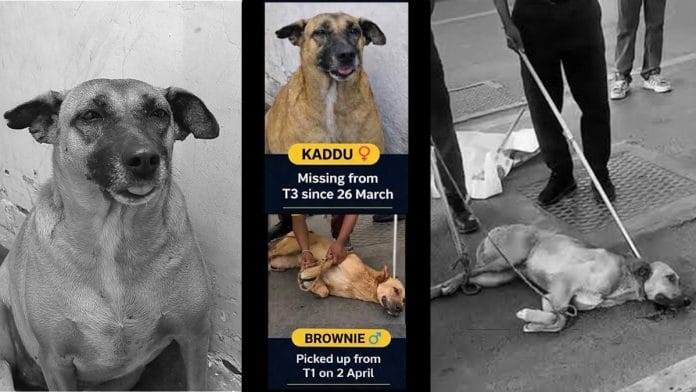


New Delhi: A Delhi court has criticised the police investigation into the disappearance of two community dogs from Delhi’s IGI Airport. Finding the inquiry to be lacking “serious efforts”, the court has directed the Joint Commissioner of Police (Transport Range) to conduct a fresh investigation into the case of the missing dogs.
Additional Chief Judicial Magistrate (ACJM) Pranav Joshi of Patiala House Courts delivered a strongly-worded order on 29 April, highlighting lapses in the conduct of the inquiry. The court criticised Delhi Police for failing to locate the dogs.
The case arises from a complaint filed by social workers about alleged illegal relocation and cruelty relating to two dogs, Kaddu and Brownie. Both are vaccinated and sterilised community dogs living at Delhi airport. According to the complaint, Kaddu lived at Terminal 3, and Brownie at Terminal 1. The complaint also cites CCTV footage of the dogs’ capture.
The court had earlier directed the station house officer (SHO) of the IGI airport police station and the area DCP to file a comprehensive report and preserve CCTV footage of the removal of the dogs from the airport premises. The police failed to do so, resulting in the court taking exception to “the approach made by the police officials in this matter”.
The police, it said, did not apply its mind to the facts, and the incidents were not inquired into in a holistic manner. Further, it noted that instead of investigating the complaint the police instead questioned the complainants on locus and veracity.
“This approach of the police reflects their apathy towards the noble cause for which the complaint has been made,” the court said in its order.
Referencing videos circulating on social media of the ‘inhuman nature’ in which Brownie was captured from Terminal 1, the court said both incidents of relocation seem to be part of the “same transaction” and could not have been possible without involvement of airport ground staff. It further said that if the court could obtain vaccination, sterilisation and feeding data from the complainants within a week, it was unclear why the police had failed to gather the same information despite repeated station visits by the complainants.
Noting the gravity of the situation and time elapsed, the court directed the Joint Commissioner of Police (Transport Range) to conduct an inquiry into both the Terminal 3 and Terminal 1 incidents “in a holistic manner” and listed the matter for 11 May.
This case of forced relocation comes in the midst of a larger conversation about how India treats its community animals. Animal welfare advocates have long contended that although sterilisation and vaccination are the recognised global standard for street dog management, illegal relocations are often carried out informally, without records, transparency or compliance with the statutory framework governing street dogs.
Also Read: A Delhi couple keeps climbing Ghazipur landfill to feed 400 dogs. Chicken, rice & dahi
Intervention by Supreme Court
The Supreme Court’s suo motu intervention in the matter of street dogs in August 2025 intensified the debate surrounding street dog management.
The single-judge bench’s initial order mandating relocation of all Delhi street dogs was modified by a three-judge bench following widespread protests.
A later order of permanent relocation of dogs from ‘institutional areas’ was also met with backlash, highlighting infrastructure and budget constraints amongst the larger issue of animal cruelty and ineffectiveness of relocation. Subsequently, the Supreme Court heard extensive arguments, and reserved its order in January 2026.
The prevailing law is an amalgamation of constitutional mandate, statutory code, court precedent, and national guidelines. In the context of street dogs, this means any capture or relocation must still be tested against the statutory regime and the broader anti-cruelty principle.
The Animal Birth Control (ABC) Rules 2023 are the current national framework for the humane management of street dog population. The ABC Rules are built around sterilisation, vaccination and release of dogs back to the area from where they were picked up. These rules mandate and specify ‘humane methods’ for the capture of any dog, and also forbid arbitrary relocation.
Article 51A(g) of the Constitution mandates compassion for living creatures as a fundamental duty of every citizen. The governing statute is the Prevention of Cruelty to Animals (PCA) Act, 1960. The Act was formulated to prevent the infliction of “unnecessary pain or suffering” on any living creature other than a human being.
While the Act criminalises various forms of abuse, animal welfare advocates and the Supreme Court have advised amending dated penalties to modern standards.
In 2026 the fine for animal cruelty, according to the Act, remains Rs 50.
In Animal Welfare Board of India vs A Nagaraja (2014), the Supreme Court recognised five freedoms for animals: freedom from hunger, thirst and malnutrition; freedom from fear and distress; freedom from physical and thermal discomfort; freedom from pain, injury and disease; and freedom to express normal patterns of behaviour.
It held that the PCA Act confers statutory rights on animals, but “penalty for violation of those rights are insignificant, since laws are made by humans”.
The two-judge bench of Justices K.S. Radhakrishnan and Pinaki Chandra Ghose had said then, “Court has also a duty under the doctrine of parens patriae to take care of the rights of animals, since they are unable to take care of themselves as against human beings.”
Saumya Sharma is an alum of ThePrint School of Journalism, currently interning with ThePrint.
(Edited by Amrtansh Arora)