



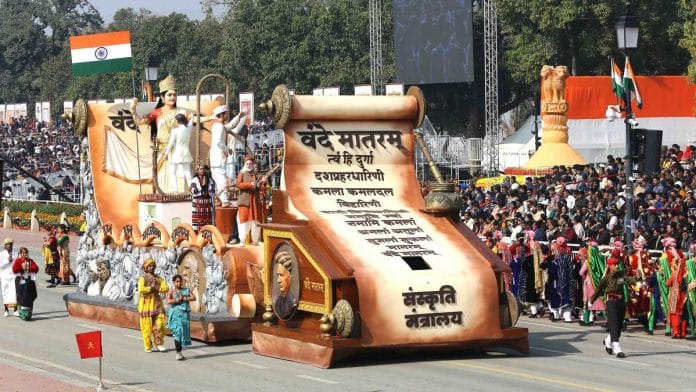
New Delhi: Hearing a challenge to the legal mandate requiring all six stanzas of Vande Mataram to be sung at public gatherings, the Supreme Court observed Tuesday that it expected the precedent set by its 1986 Bijoe Emmanuel judgement would be followed, and a person who does not sing the song for religious reasons should not face penal consequences.
Justice Joymalya Bagchi made the observation as part of a bench with Chief Justice of India Surya Kant and Justice V. Mohana, while hearing the petition filed by Carnatic vocalist T.M. Krishna, which argues that the last four of the six stanzas of Vande Mataram contained explicit reference to Hindu deities and making citizens sing them mandatorily would be contrary to the secular nature of the Indian Constitution.
At the end of the hearing that also saw a heavy exchange—between Solicitor General Tushar Mehta, and senior advocate and retired high court judge S. Muralidhar, who appeared for the petitioner—over the use of the term “Naxalite”, the top court issued a notice seeking the Centre’s response.
At the heart of this case is the Supreme Court’s 1986 landmark decision in Bijoe Emmanuel & Others vs State of Kerala & Others, in which it was established that forcing students to sing the National Anthem against their genuine religious convictions violates their fundamental rights.
The top court had held that forcing students to utter words contrary to their conscientious beliefs violates Article 19(1)(a), which guarantees freedom of speech and expression, a right that inherently encompasses the freedom to remain silent.
The Bijoe Emmanuel case had begun in July 1985, when three school children belonging to the Jehovah’s Witnesses sect were expelled from their school in Kerala.
Adherents of this faith worship Jehovah exclusively and believe that participating in rituals, like singing national anthems, runs into conflict with their religious tenets.
Crucially, the children did not show any disrespect. Every morning during assembly, they stood up in “respectful silence”, while ‘Jana Gana Mana’ was sung. An inquiry commission appointed to investigate the matter reported that the children were “law-abiding” and demonstrated no disrespect whatsoever. Nevertheless, under departmental instructions, the school headmistress expelled them.
They went to the Kerala High Court. When a single bench and a high court division bench did not allow the entry of the three children back into their school, they went to the Supreme Court.
The top court set aside a Kerala High Court order and directed school authorities to readmit the three children, who had been expelled for remaining silent while standing respectfully during the daily anthem.
Addressing allegations of disrespect, the court held that proper respect is accorded to the National Anthem simply by standing up in silence. “There is no provision of law which obliges anyone to sing the National Anthem nor do we think that it is disrespectful to the National Anthem if a person who stands up respectfully when the National Anthem is sung does not join the singing,” the bench said.
Furthermore, regarding Section 3 of the Prevention of Insults to National Honour Act, the court concluded had that “standing up respectfully when the National Anthem is sung but not singing oneself clearly does not either prevent the singing of the National Anthem or cause disturbance to an assembly engaged in such singing”.
Also Read: Inside SC hearing on Vande Mataram plea. Religious freedom, penal action & a ‘Naxal’ exchange
Freedom of speech & executive limitations
The state authorities had relied upon two departmental circulars issued by Kerala’s Director of Public Instruction that mandated morning assembly participation.
However, the Supreme Court clarified that departmental guidelines carry no statutory force and cannot restrict fundamental rights.
The judgement noted that the circulars “have no statutory basis and are mere departmental instructions. They cannot, therefore, form the foundation of any action aimed at denying to citizens Fundamental Right under Art. 19(1)(a)”.
Protection of conscience under Article 25
Evaluating the fundamental right to freedom of conscience under Article 25(1), the court emphasised that judicial evaluation must not depend on personal sentiments or majority views.
The bench noted that “the question is not whether a particular religious belief or practice appeals to our reason or sentiment but whether the belief is genuinely and conscientiously held as part of the profession or practice of religion”.
In a striking defense of pluralism, the judgement highlighted that Article 25 is “an article of faith in the Constitution, incorporated in recognition of the principle that the real test of a true democracy is the ability of even an insignificant minority to find its identity under the country’s Constitution”.
(Edited by Sugita Katyal)
Also Read: 3 things that are wrong with BJP’s Vande Mataram politics