





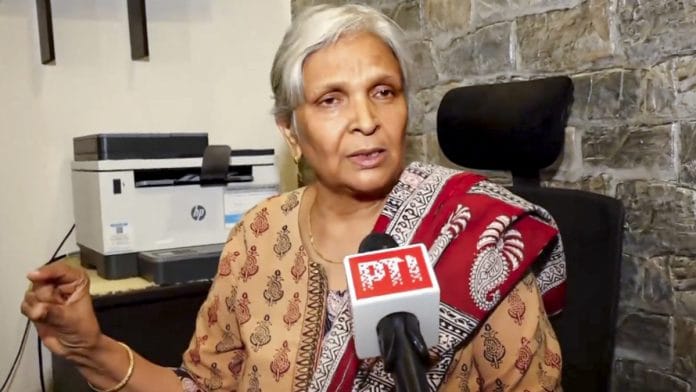

New Delhi: Late Wednesday, and just days after a trial court granted retired judge Giribala Singh pre-arrest bail in the case of the death of her daughter-in-law Twisha Sharma, the Madhya Pradesh High Court quashed the anticipatory bail order.
In a 17-page order, Vacation judge Justice Devanarayan Mishra observed, “There are clear allegations against the respondent and her son. From the WhatsApp chats also, it cannot be said that the allegations are only against Samarth Singh, but the trial court did not consider all these facts.”
Twisha was found dead in their Katara Hills, Bhopal, house on 12 May. Her husband Samarth Singh is in custody of the Central Bureau of Investigation (CBI) which has taken over the case from Bhopal Police.
The 33-year-old actor-model’s Greater Noida-based family has alleged foul play in the death, after months of what they call harassment and abuse over dowry.
Also Read: Twisha Sharma’s husband taken into custody from Jabalpur, lawyer claims he wanted to surrender
WhatsApp chats, post-mortem report under scanner
Deputy Solicitor General of India Suyash Mohan Guru, appearing for the CBI, and Madhya Pradesh Advocate General Prashant Singh laid out the facts of the case, saying that Samarth Singh and Twisha Sharma got married on 9 December, 2025 as per Hindu rituals, in which the father of the deceased gave dowry and gifts.
On 17 April 2026, “upon discovering that the deceased became pregnant, some dispute arose among the family members, following which the deceased left her matrimonial home and went back to Noida”, they added. “It is alleged that the deceased’s husband and her mother-in-law doubted her character when she was found to be pregnant and forced her to undergo abortion”. This fact is supported by the relevant WhatsApp chats dated 30 April, 7 May, 5 May, and 11 May.
On 30 April, Twisha returned to Bhopal. On 5 May, she asked her mother to take away her from Bhopal. On 12 May, the deceased called her mother on WhatsApp, alleging that her husband was shouting at her, after which the call was disconnected.
On the same day, it is alleged that around 10.37 pm the mother-in-law answered a call of the parents of the deceased. On the same day, the deceased was found hanging at her matrimonial home, and declared dead. On 13 May, the first postmortem was conducted at the All India Institute of Medical Sciences, Bhopal.
The post-mortem report says multiple injuries were found on the body of the deceased, simple in nature but caused by blunt force.
Relying on previous judgements, the counsel submitted that custodial interrogation of Giribala Singh is required in the case “as she left no stone unturned to malign the character of the deceased by giving multiple interviews even though the investigation of the case is going on”.
During investigation, the police seized the CCTV footage from the respondent’s house on 13 May. However, Giribala Singh had the footage of the incident and “she leaked the selective short clip of the video recording on social media with the intention of tampering with the evidence”.
They further argued that Giribala Singh’s sister Dr Rajbala Singh Bhadoriya and Dr Yashveer J.K. are senior doctors in Bhopal and “were allegedly present at the time of first post-mortem”.
“Mystery revolving around the death of the deceased, possible involvement of the influential accused and non-cooperation shown during ongoing investigation… it indicates that the matter is at the initial stage, therefore, custodial interrogation of the respondent may be required and to support their contention,” they said, relying on previous judgements.
They further submitted that from the query report submitted by AIIMS, “it is clear that the injuries suffered to the deceased cannot be caused during taking out the body from the ligature”.
“The deceased in a telephonic conversation had informed her parents that the respondent and her son were scuffling with her and demanding dowry… in these circumstances, the bail order deserves to be quashed.”
On behalf of the prosecution, Solicitor General of India Tushar Mehta submitted that “the manner in which anticipatory bail was obtained creates doubt that the trial court did not consider the aspect relevant for granting anticipatory bail”.
“After granting bail, the respondent was holding press conferences and making allegations against the deceased and flouting the law. In such a serious matter, when the girl is aged about 33 years has lost her life, the respondent has no remorse and has not tried to cooperate with the investigating agency. The trial court did not consider a single line of the prosecution witnesses and totally believed in the defence documents.”
“Except the WhatsApp chats in which there are allegations regarding only the husband Samarth Singh, there is none that the respondent was anyhow involved in harassing the deceased or questioning her character. In compilation, various photographs and letters have been submitted in which the deceased has clearly submitted that the respondent was taken care of,” said Nitya Ramkrishnan and Enosh George, appearing on behalf of Giribala Singh.
What the court observed
Justice Devanarayan Mishra said that the trial court considered the fact that the anticipatory bail application cannot be dismissed only on the basis of the death occurring within seven years of marriage, and further that the respondent/accused has transferred money to the deceased daughter-in-law.
The trial court also considered the prescription of Bansal Hospital and held that the allegations are of “formal nature”, concluding that from WhatsApp chats, it appears that the deceased had complaints against her husband but not mother-in-law Giribala Singh.
Singh, who is 63 years old, is a resident of Bhopal, hence there are no chances of her absconding. On that basis, it had granted her anticipatory bail.
The deceased, as per the prosecution, committed suicide on 12 May. The autopsy was conducted on 13 May.
The court observed the post-mortem report, and said that “the death was due to ante-mortem hanging by ligature” but from the post-mortem, “it is also clear that six other injuries were found in the body of the deceased in which four injuries were on the left arm, one in ring finger and one on the head, and that was ante-mortem”.
It said that from the query report, it is “also clear that these injuries were not caused due to taking out the body from the ligature or carrying out to the hospital”.
The court also admitted the fact that Twisha got pregnant, and it was terminated within two months. “The complainant party has alleged [this happened because of the] respondent whereas the respondent has submitted that the deceased herself was interested in terminating the pregnancy.”
Drawing from the statements of Twisha’s family—Rekharani Sharma, Meenakshi Sharma, Navnidhi Sharma, Harshit Sharma and Rashi Abrol—the court said it is clear that from the first date on 13 May, they have clearly stated that Giribala, along with her son Samarth, was harassing Twisha, and creating pressure to abort the pregnancy, the court said.
It also mentions how on 14 and 15 May, further statements were recorded and in all the statements, “there are clear allegations against the respondent and her son. From the WhatsApp chats also, it cannot be said that the allegations are only against Samarth Singh but the trial court did not consider all these facts.”
Further, the court said that while Giribala got anticipatory bail, she was “not cooperating with the investigation agency though several notices were issued to her for recording her statement and cooperating with the agency”.
On the claim of money transactions in the account of Twisha by Giribala Singh, the court mentions that while the marriage was solemnised on 9 December 2025, there were multiple monetary transactions that were made on 9 October and 16 December last year, and 14 January, 12 February, 25 January, 1 March and 26 February this year.
Regarding the monetary transactions, the court stated that these were made during the marriage and when the deceased went out of India, “but it cannot be said that the money was transferred in the account of the deceased near her death, and on that basis it cannot be said that the respondent has transferred much money in the account of the victim, by that, it could be presumed that there was no demand of dowry”.
Finally, the court said, “The anticipatory bail order by 10th Additional Sessions Judge, Bhopal for the offence punishable under Sections 80(2), 85, 3(5) of Bharatiya Nyaya Sanhita, 2023 and Sections 3 & 4 of Dowry Prohibition Act, 1961, is hereby quashed.”
(Edited by Nardeep Singh Dahiya)
Also Read: Twisha Sharma’s death became another public trial of a modern Indian woman