





A dead woman is on trial again in India.
The accused this time is a 33-year-old actor-model. Twisha Sharma, the former Miss Pune with an MBA, had appeared in campaigns for Dove and L’Oréal. She was found hanging on the terrace of her matrimonial home in Bhopal on 12 May. It had only been five months into her marriage with Samarth Singh, an advocate, and son of a retired district judge, Giribala Singh.
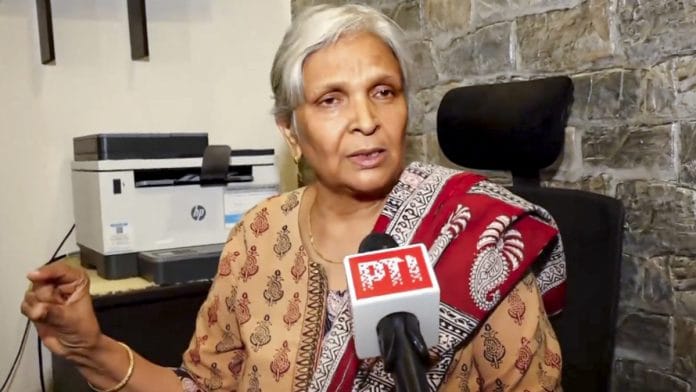
Sharma is in no position to defend herself. She cannot explain herself, enter a plea, or undergo an interrogation. But this has hardly slowed her prosecution. In the days following what the Supreme Court has since called an “unnatural death”, the case against Sharma was laid out in painstaking detail by her mother-in-law.
Over the last week, Giribala Singh, who is out on anticipatory bail, has vended interviews to every possible media channel. According to her, Sharma was schizophrenic, had a “dual personality” and there was “a fourth person in her mind”. She has insinuated that her daughter-in-law abused drugs, including marijuana, even while pregnant.
In one interview, with a well-timed sniffle, she accused Sharma of terminating the pregnancy and “denying” the family the joy of a grandchild. But she has also described a daughter-in-law so distressed by that same pregnancy that, according to her, the child was “killing [Sharma] from inside” – offering this, too, as evidence of a disordered mind. It is evidence, for sure, just not of the kind Singh likely imagines.
Even as her own son was absconding — the Madhya Pradesh police had to announce a reward of Rs 10,000 for information on his whereabouts — Giribala Singh’s sustained campaign of allegations against her daughter-in-law continued. Sharma had apparently spent Rs 7-8 lakh in five months and carried “mysterious keys” to an unidentified car and a house in Noida. Sharma’s parents, she claimed, had pushed her into the glamour industry as a child, fed her weight-loss pills, and exploited her financially before disowning her. Her father was a “strange man” working in the pharmaceutical industry and might have been involved in plying his own daughter with drugs. For her closing argument, Giribala sounded the sharpest dog whistle: Sharma had “liberal views” and did not pray.
Also read: BJP wants to be the party of Nari Shakti. Here’s a list to make that happen
Character study of a modern Indian wife
It is a remarkable amount of information about a woman who has been dead barely a fortnight. But let’s take a look at the kind of information this is. Every one of these claims is about who Sharma was: her mind and mental state, her habits, her money, her parents, her faith or the lack of it. Not one explains how she died, or tells us anything about the house she died in.
Those questions remain unanswered. Sharma’s family had to fight to get an FIR registered at all, and has asked repeatedly that the case be moved out of Madhya Pradesh, where the Singhs’ influence runs deep. Giribala has answered none of it. Until three days ago, her standard-issue response to questions about her absconding son’s whereabouts was: “He has a right to exhaust all legal remedies.”
There is another recording doing the rounds, reportedly from the time Twisha was still alive. On it, Giribala is explaining to Twisha’s brother, Major Harshit Sharma, that she had questioned her daughter-in-law about her sexual history before the wedding. A strident Giribala is heard asking whether Twisha had had relationships “for favours” and whether that would continue. At one point, she observes, “Promiscuity can be a habit.” When that line of questioning is challenged by Harshit, she doubles down with, “This is my right to ask my daughter-in-law.”
Giribala is not the only one to have felt entitled to make humiliating insinuations about her daughter-in-law. The trial of a dead woman, especially an independent one, is a public proceeding, and the public has rights too.
The profile Giribala has built of Twisha — an unstable, addicted, promiscuous spendthrift — is not one family’s grievance. It is a character study of the modern Indian wife straight from the playbook of men’s rights activists (MRAs). In that overheated discourse, any woman who does not conform to some musty ideal of a compliant, demure domestic goddess is one who has set out to destroy her husband and his family.
Giribala described Twisha in the language of the movement, and within days, her name sat beside Atul Subhash’s – the Bengaluru engineer who died by suicide in December 2024, leaving a 90-minute video note detailing the extortion and harassment he said he had suffered from his wife and her family. The two cases share almost nothing aside from a death, but for online MRAs, it was proof enough that Indian laws for women’s protection are a racket, and the husband is the perpetual victim no matter the situation.
That pesky discourse continues unabated. In that universe, questions about the ligature marks or the abrasions found on Twisha’s body, or how the home’s eight CCTV cameras developed a sudden technical defect, are frivolous.
Also read: Meta wants everyone to create AI images. Indian men chose misogyny
Dead women and the trial against them
There is the trial that a court will someday hold, and there is the trial with the dead woman already in the dock. It has run many times before Twisha Sharma, and it scarcely changes.
Think of Sunanda Pushkar, dead at a Delhi hotel in 2014, a day after a lurid Twitter scandal involving a Pakistani journalist and her husband, politician Shashi Tharoor. Pushkar was cast within a day as a manic, jealous woman who had overdosed on her own anti-anxiety pills, a theory that survived the AIIMS findings that suggested her death was due to poisoning. So intense was the voyeuristic scrutiny in the years after her death that the Delhi High Court had to step in and ask Republic TV to dial down the rhetoric.
But the damage was already done. Pushkar’s death will forever be riddled with conspiracy theories. An editorial had then pointed out: “In India, the conspiracy theory is the mainstream. Here, speculation is treated with the authority of fact, while the official report is relegated to the margins, invariably dismissed as a pathetic cover-up not worth the paper it is printed on. Gossip is our currency, and it is always in a state of runaway inflation.”
Gossip does its best work on a victim who is easy to mould, and few are easier than a young actress. When actor Jiah Khan died in 2013, her boyfriend Sooraj Pancholi’s family produced the narrative of a depressed, failed starlet undone by a stalled career. His mother volunteered that Jiah had attempted suicide four times before they ever met. Khan’s own six-page letter, describing abuse and a forced abortion, barely drew any notice from a media that was busy making sensational graphics with borrowed clips from her movies. Acquitting Pancholi a decade on, even the court called her “a victim of her own sentiments”.
The dead need not even be wives or girlfriends. Aarushi Talwar was only 13 when she was murdered in 2008. It is hard to describe the collective mania that had gripped the Indian media then. A senior police officer used a press conference to suggest her father had killed her over an “objectionable” closeness to their domestic helper Hemraj (who was later found murdered in another part of the house). The macabre nightmare followed her mother, who was faulted, on air, for not grieving correctly. The Talwars were then accused of being “swingers”, and their supposed lifestyle was used to justify the unsolved death of their child.
Across the decades, the vocabulary barely shifts. She was unstable, she was difficult, she was oversensitive, she was promiscuous, she had “marriage trouble.”
Offered often and loudly enough, these armchair pop-diagnoses turn into verdicts: If the victim wasn’t complicit in her own death, she at least deserved it. The great convenience of trying the dead is that they never have a chance to object.
Karanjeet Kaur is a journalist, former editor of Arré, and a partner at TWO Design. She tweets @Kaju_Katri. Views are personal.
(Edited by Prashant Dixit)