



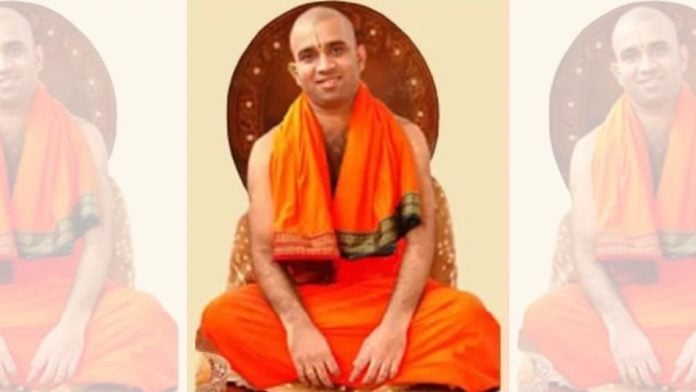
New Delhi: For more than two decades, the Sree Kashi Math Samsthan in Kerala has been embroiled in a complex legal dispute—one that emerged from the sacrosanct relationship between guru Sudheendra Tirtha and his disciple Raghavendra Tirtha and culminated in a protracted litigation over who is the math’s rightful head and the recovery of sacred valuables.
It began in 2000 with Raghavendra Tirtha, then expelled from the math, staking his claim before a court in Tirupati, as the ‘mathadipathi’, but losing the case. A decade later, he got embroiled in another court case. This time it was Sudheendra Tirtha who filed execution proceedings in Kerala’s Ernakulam court for recovery of gold and other precious articles of the math that were in possession of Raghavendra Tirtha.
A third leg of litigation started when Sudheendra Tirtha attained samadhi in 2017. Raghavendra Tirtha initiated a challenge when the pontiff who succeeded Sudheendra Tirtha asked the Ernakulam court to implead him as a party in the execution proceedings. Swamy Samyameendra Tirtha claimed succession to the office of ‘mathadipati’ and, consequently, to the rights of his guru Sudheendra Tirtha.
However, Raghavendra Tirtha raised an objection to the new mathadipathi’s plea and contended that the Ernakulam court lacked jurisdiction to decide the matter. According to him, Samyameendra Tirtha would need the permission of the Tirupathi court which decided the issue of who is the rightful mathadipathi of the math, before becoming a party in the execution proceedings.
While the Ernakulam court decided in Raghavendra Tirtha’s favour, the Kerala High Court ruled against him, prompting him to approach the Supreme Court.
On Tuesday, a top court bench led by Justice Aravind Kumar paved the way for Swami Samyameendra Tirtha to pursue execution proceedings in the Ernakulam court. The bench affirmed the Kerala HC order, permitting the substitution of Samyameendra Tirtha as the decree-holder in the execution proceedings.
Lawyers for Samyameendra Tirtha, who appeared for him in the Supreme Court, told ThePrint that the SC order would now hopefully expedite the execution proceeding that is pending in the Ernakulam court since 2009.
Advocate Lakshmeesh S. Kamath said: “The execution proceedings got stalled due to this litigation on whether Samyameendra Tirtha needs permission from the Tirupathi court before being named as a petitioner in that case. With the SC ruling in our favour, the proceedings will resume in the Ernakulam court.”
How the Kashi Math dispute began
The litigation has its genesis in a dispute concerning headship and administration of the math. As per custom, the office of the mathadhipathi devolves upon a disciple who is chosen by the reigning guru depending upon several factors such as analysing horoscopes and securing ‘deivanischayam’ (will of God).
In 1994, the matadhipati handed over certain idols, ornaments and other articles to Raghavendra Tirtha as his successor.
Following differences between them, Raghavendra Tirtha was expelled from the math in 2000. This subsequently led to a dispute over the rightful mathadhipathi of the Kashi Math. Immediately, thereafter, Raghavendra Tirtha filed a suit in a Tirupati court, seeking a declaration that he was the lawful 21st mathadhipathi of the Sree Kashi Math Samsthan. He also sought a permanent injunction restraining his guru from interfering with the affairs and administration of the math.
On 28 January 2009, this suit was dismissed and Raghavendra Tirtha was permanently restrained from interfering with the math’s administration. By way of this order, he was also directed to personally hand over all deities, religious articles and other properties of the Samsthan to the mathadhipathi. Therefore he was under personal obligation to return all the religious articles that were in his possession as the successor of Sudheendhra Tirtha. In a June 2015 order, the Andhra Pradesh High Court dismissed Raghavendra’s appeal and affirmed the trial court judgement.
Meanwhile, in 2009, Sudheendra Tirtha filed an execution proceeding before the Tirupathi trial court to ensure implementation of the trial court order against Raghavendra Tirtha, who raised an objection on the ground he was residing outside the territorial jurisdiction of the court. In 2011, the execution proceeding was transferred to the Ernakulum court. Raghavendra Tirtha challenged this too, but lost in the high court.
Later, Raghavendra Tirtha, filed his objections to the execution petition, which too were dismissed by both the trial court and high court.
Finally, Sudheendra Tirtha urged the trial court for police assistance in aid of the execution. This plea was disallowed, but upon an appeal, the high court permitted the same. In subsequent proceedings, the investigation came to be entrusted to the CBI.
In 2017, Sudheendra Tirtha attained samadhi, prompting Samyameendra Tirtha, nominated as the next mathadhipati, to pursue the execution proceedings against Raghavendra Tirtha.
Upon the contention of Raghavendra Tirtha, the Ernakulam trial court in 2019 asked the new mathadipati to seek permission from the Tirupathi court for becoming a party to the execution proceedings.
However, this was overturned by the high court last month, which held that Samyameendra Tirtha was entitled to participate in the execution proceedings without obtaining substitution or recognition from the court.
In its order, the high court chastised Raghavendra Tirtha for deliberately concealing his whereabouts and frustrating the execution process, compelling the court to describe him, in an earlier proceeding, as an “elusive Swamiji” who had rendered himself inaccessible to the process of law. It required the high court to ask the CBI to trace him.
The high court said it found it ironic that an erstwhile “shishya”, one divested of all authorities and responsibilities relating to the math, was resisting the functions assumed by his own guru’s “shishya” who, the court said, seeks to fulfil the wishes of his revered guru.
(Edited by Gitanjali Das)
Also Read: Why Ram Temple Trust chose a military veteran as its first CEO & who are its 3 new members