





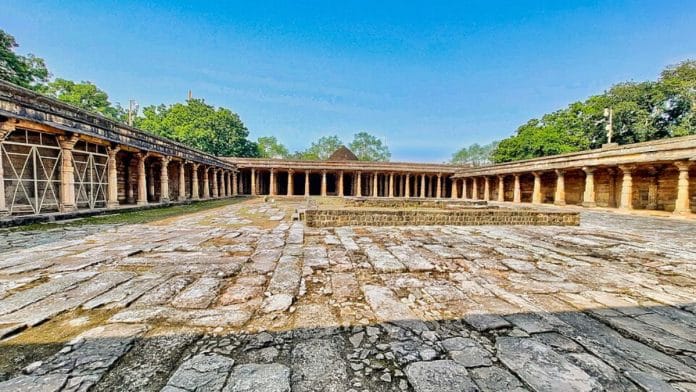


New Delhi: Declaring the disputed Bhojshala-Kamal Maula Mosque complex in Dhar a temple dedicated to Vagdevi (Goddess Saraswati), the Madhya Pradesh High Court Friday ruled that the site, which had been protected since 1904 under colonial-era monument preservation law, remains in the purview of Ancient Monuments and Archaeological Sites and Remains Act, 1958.
Consequently, the statutory freeze under Places of Worship Act, 1991 on the religious character of places of worship, as on 15 August 1947, did not apply to the site at all, the Bench said.
This was in response to the argument by the mosque committee’s counsel that since Muslim prayers were being offered at the site in 1947, the site’s character as that of a mosque would be sealed. But the court said that since it is governed by a different law, the provisions of the 1991 law would not apply.
Effectively ending the complex’s shared worship status—as both a temple and mosque—the high court rooted its decision in the 10 principles laid down by the Supreme Court in its Ayodhya verdict, treating the 2019 ruling as a “lodestar”. It ruled that archaeological findings showing religious motifs and pre-existing structures possess “high probative value” in determining subsisting religious rights.
The Madhya Pradesh High Court held that in such cases, the standard of proof is not “mathematical certainty”, but the “preponderance of probability”. Citing the Ayodhya verdict, it said, “Enquiry of Modern Courts cannot be to ascertain Theological Perfection… but to ascertain Evidence of Faith and Belief”.
However, this comes after multiple counsel placed heavy reliance on the distinction between the present proceedings and the Ayodhya litigation—where evidence had been recorded after a full-fledged civil trial, examination of witnesses and documentary evidence, and the matter had reached the apex court in appellate jurisdiction. It had been submitted that the Ayodhya judgement cannot become a licence for every disputed religious claim to be raised directly in writ jurisdiction under Article 226.
Contrary to the arguments, the high court ruled that the Bhojshala case was not a traditional “title dispute”, but a matter of protecting the fundamental “right of worship” guaranteed under Articles 25 and 26 of the Constitution. It held that the “extraordinary and wider power” of Article 226 allowed it to intervene when fundamental rights were at stake.
Additionally, it concluded that because the case could be decided based on “existing material” (such as gazetteers, historical records and the new ASI scientific survey) rather than oral testimony, a full-fledged civil trial was not a prerequisite for adjudication—like in the Ayodhya dispute—essentially allowing it to use the Ayodhya judgement principles, but not the same modus operandi.
Also Read: Brand wars to inheritance feuds, India’s mediation space is now a stomping ground for retired judges
The current conflict
The dispute is centred around a complex, which the Hindu community claims is Saraswati Sadan—an 11th-century centre for Sanskrit learning and worship established by King Bhoja of Parmar dynasty—but is called the Kamal Maula mosque by the Muslim community, where, it says, namaz has been offered for centuries.
The immediate legal trigger for Friday’s judgement was a batch of petitions filed in 2022, led by an outfit called Hindu Front for Justice, which challenged a 2003 Archaeological Survey of India (ASI) order that allowed Hindus to worship at the site on Tuesdays and during Basant Panchami, while allowing Muslims to offer prayers every Friday. They had argued that this arrangement infringed upon their fundamental right to religion under Article 25 of the Constitution, claiming that the entire protected monument should be reserved “exclusively” for Hindu worship.
A Bench of Justices Vijay Kumar Shukla and Alok Awasthi, after an in-person visit to the the site, opined that there was “no reason to disbelieve” that the disputed area was Bhojshala, with “a temple of Maa Saraswati”—effectively transforming the site from a “monument of communal strife” into a fully recognised Hindu religious and educational centre, ending the century-old legal ambiguity over its identity.
What both sides argued
The lawyers for Hindu Front for Justice and others argued that the site has possessed “trappings of a Hindu temple” since its construction in 1034 AD, with their primary legal contention being that “once the property vested in a deity, the same continues to be the deity’s property”, regardless of subsequent damage or demolition by “invaders”.
Historical accounts were presented to claim that the temple was dismantled by Islamist rulers to construct a mosque using the same materials. They further pointed to “Yantras and Sanskrit shlokas inscribed on the floor”, carved pillars, and “mutilated idols” found within the premises as proof that the structure’s original and true character was never that of a mosque. It was also argued that a mosque cannot legally exist on non-Waqf land, and since the property belonged to the deity, no valid Waqf property could ever have been created.
On the other hand, the counsel for the mosque committee contended that the site had been in “continuous, peaceful, and uninterrupted possession” of mosque authorities for several centuries. They relied heavily on a 1935 notification by the Dhar state authorities, which, they argued, legally deemed the structure as a mosque.
Anchored in the Places of Worship (Special Provisions) Act, 1991, which “freezes” the religious character of any place of worship as on 15 August, 1947, they argued that since namaz was being offered at the site on that date, its character as that of a mosque could not be challenged. Additionally, they asserted that the presence of idols or architectural remains was not determinative of current title, as many medieval structures utilised materials from older ruins without changing the building’s religious intent.
The ASI scientific survey
The critical point in this case came when the high court directed the ASI to conduct a “complete scientific investigation, survey and excavation” using modern techniques like GPR (Ground Penetrating Radar) and carbon dating. The 10-volume report, submitted in 2024, provided the evidentiary foundation for Friday’s decision.
At this juncture, ASI’s findings were categorical in noting that the existing monument was built directly over a “pre-existing large structure”, dating to the Paramara period of the 10th–11th century. The survey recovered 94 sculptures and fragments, including depictions of Vishnu, Ganesha, Brahma and Narasimha. The report also noted the strict prohibition of such human and animal figures in mosque architecture.
With the discovery of more than 150 Sanskrit and Prakrit inscriptions, including literary texts specifically mentioning “Sharada Sadan (or the home of Sharada/Saraswati)”, the ASI had concluded that mosque features, such as the Mihrab, were subsequent insertions into a pre-existing temple structure.
The court noted that the present structure was essentially “made from the parts of earlier temples”. In order to “secure the religious rights of the Muslim community and to ensure complete justice between the parties”, the court disposed of six cross-petitions.
Also Read: A recusal after refusal to recuse: Why Justice Sharma framed contempt charges against Kejriwal & co
How court interpreted the Places of Worship Act
A major question was if Places of Worship Act, 1991 could hold the high court from declaring the site a temple. But the court resolved the issue by applying Section 4(3) of the 1991 law, which explicitly excludes any monument covered under Ancient Monuments and Archaeological Sites and Remains Act, 1958.
The court observed that Bhojshala had been a protected monument since 18 March, 1904, and was carried forward under the 1958 Act. Therefore, the “statutory bar under the 1991 Act” did not apply to the case. This led the court to adjudicate based on the site’s “true” historical character, rather than its 1947 usage.
Orders for the govt
The high court explicitly quashed the 7 April, 2003 ASI order that permitted namaz on Fridays and Hindu worship on Tuesdays. It set aside the permission granted to Muslim community to offer prayers within the complex, holding that the description of the site as a mosque in 20th century records was an administrative error that failed to discharge the “statutory duty… to ascertain the character of the place” under Section 16 of the 1958 Act.
Declaring the site a Hindu temple, the two-judge Bench directed that it be treated as such for purposes of management. While the specific “daily” schedule for puja is to be finalised by the administration, the ruling effectively removes the restrictions that had prevented Hindus from performing rituals daily.
The court issued directives to the central government to “take a decision for the purpose of administration and management of the affairs of the Bhojshala temple and Sanskrit learning” within the property.
Furthermore, it directed the Government of India to “undertake every effort to bring back the Pratima of Goddess Saraswati from the London Museum”, and re-establish it within the complex. The ASI, meanwhile, has been directed to continue the overall management and protection of the site in accordance with the Ancient Monuments Act of 1958.
(Edited by Mannat Chugh)
Also Read: Disputed Bhojshala site is Saraswati temple, rules MP HC; directs Centre, ASI to manage affairs