





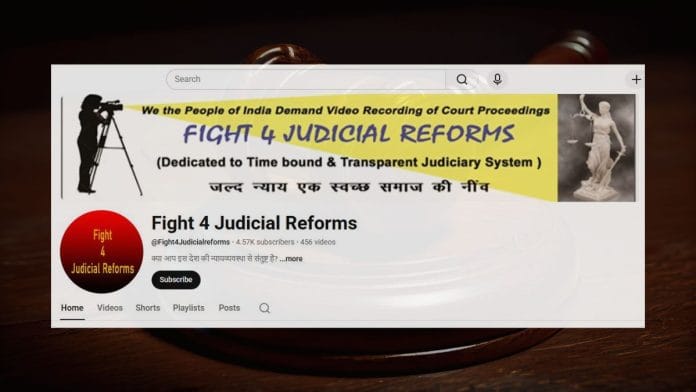


New Delhi: The Delhi High Court Tuesday convicted YouTuber Gulshan Pahuja of criminal contempt, ruling that his videos–which told viewers to abandon hope of justice if their cases came before specific judges–were a malicious attempt to scandalise the courts and lower the authority of the judiciary.
The bench of Justices Navin Chawla and Ravinder Dudeja held that Pahuja, who runs the channel ‘Fight 4 Judicial Reforms’, had produced content specifically designed to create “distrust against named judicial officers”.
Pahuja’s videos were not a genuine campaign for judicial reforms and his public-interest defence under Article 19(1)(a)—right to freedom of speech and expression—of the Constitution could not be sustained, the bench ruled.
The banners that triggered the case
The case stemmed from complaints by three district judges—Charu Asiwal, Ajay Narwal and Ajay Singh Parihar—after Pahuja uploaded videos and banners on his YouTube channel naming them.
In the banners and videos published between January to March 2025, Pahuja told viewers they should give up hope of justice if the case comes up before the judges mentioned above.
The court found that when an initial video, dated October 2024, failed to gain traction, Pahuja uploaded a second version with a more “scandalous” banner, which quickly drew around 13,000 views.
The bench noted that an attack on a judicial officer must be supported by evidence, which wasn’t done in Pahuja’s case.
“If one has to attack a Judicial Officer on his integrity or competence, it must be done with cogent evidence; it cannot be made lightly. We must remember that such an attack, if made without any basis, undermines the authority of the Judicial Officer and interferes with dispensation of justice by him/her without fear or favour,” the order read.
It added, “Any such criticism must therefore be well founded, especially because the Judicial Officer, unlike the complainant, has no means to justify his actions in public.”
Also Read: The contempt action against Nilesh Ojha, lawyer in Disha Salian case, and why SC refused to quash it
The ‘Capital C’ controversy
The conviction also arose from a video uploaded by Pahuja on 7 March 2025. In this, Pahuja used the term “Capital C” as a descriptor for the Supreme Court.
His opening line was: “Supreme Court aur Adaalatein kaise Capital ‘C’ banati hai” (How the Supreme Court and Courts make you a Capital ‘C’).
Drawing on the comedian Ranveer Allahbadia-Samay Raina show controversy as an illustrative hook, Pahuja said: “Abhi jo Ranveer Allahbadia ka jo mamla aaya tha abhi Samay Raina ke saath mein ki usne show ke andar kaafi galat aisi cheese kahi jo maafi ke layak nahi hai Par kaise Capital ‘C’ banaya jata hai ye maamla ek acha udaharan hai….Capital ‘C’ shayad samaj gaye honge aap ki mai kya keh raha hu mai?”
The court ruled this was not a critique of any specific judgment but a deliberate intent to “mock the system, bringing it to disrepute”.
“It is not the criticism of the orders/judgments passed by the Supreme Court, but of the judicial system as a whole. To our view, it is a criminal contempt of the court, which is unpardonable” and for which strict action was required,” the bench ruled.
Reforms vs vilification
The HC bench was careful to mark the boundary between advocacy and what it found Pahuja had done.
Acknowledging the right of every citizen to criticise the judiciary and campaign for reform, the bench said: “The path of criticism is a public way… provided that members of the public abstain from imputing improper motives.”
It also said that its exercise of contempt jurisdiction was not aimed at suppressing Pahuja’s campaign for audio-video recording of court proceedings, and pointed to the hierarchy of courts as the proper channel for litigants aggrieved by judicial orders.
Finding Pahuja’s conduct mala fide—personal attacks without any verified basis—the court ruled this was “a classic case of criminal contempt” and dismissed his argument of acting in public interest.
Advocates Shiv Narayan Sharma and Deepak Singh, who had appeared in Pahuja’s videos, were discharged in the case after tendering unconditional and unqualified apologies. Both had told the court they were unaware that Pahuja would deploy their interviews alongside scandalous thumbnails. The bench found their apologies genuine and dropped proceedings against them.
Convicted under Section 2(c) of the Contempt of Courts Act, 1971, Pahuja has been issued a notice to submit his arguments on the quantum of punishment. His personal appearance is mandatory at the sentencing hearing scheduled for 12 May. The offence is punishable by up to six months simple imprisonment, and/or a fine of up to Rs 2,000.
Also Read: Supreme Court’s NCERT textbook order punishes the messenger, doesn’t answer the message