





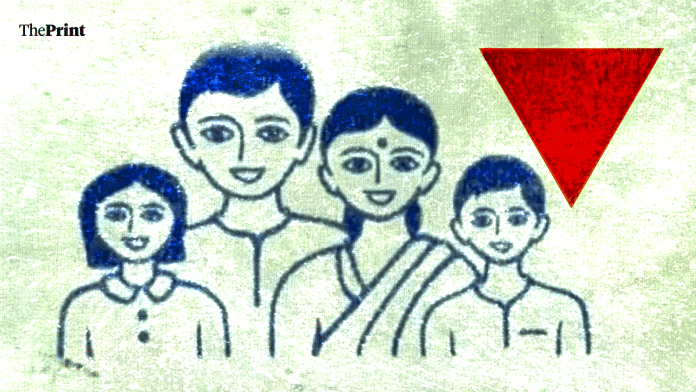


New Delhi: When the Supreme Court this week questioned the rationale behind a two-child norm linked to electoral eligibility, it revived a debate that it had itself addressed more than two decades ago when it upheld similar restrictions under state panchayat laws.
On Tuesday, a bench of Justices P.S. Narasimha and Alok Aradhe was hearing a petition filed by former Maharashtra sarpanch Mangala Bhimrao Ingle, challenging a Bombay High Court judgement upholding her disqualification from panchayat polls under Section 14(1)(j-1) of the Maharashtra Village Panchayats Act, 1959, after the birth of her third child.
The proviso disqualifies persons having more than two children from contesting or holding the office of a panchayat member or sarpanch.
The bench questioned the validity of continuing the two-child policy norm and reportedly said: “What kind of useless policy is this? Javed Vs State of Haryana needs reconsideration. The country has changed.”
With the matter being now posted for 28 July, the top court’s previous rulings in Javed vs State of Haryana (2003) and Rajbala vs State of Haryana (2015) have come into focus—where it had upheld legislative restrictions tied to family size as part of broader population-control measures.
In 2015’s Rajbala case, the court examined the constitutional validity of newly introduced eligibility criteria for contesting panchayat elections—including minimum educational qualifications, the absence of tax arrears, and the requirement of a functional toilet—basing its legal foundation on the precedent set in Javed vs State of Haryana, which had upheld the two-child policy.
At the heart of the debate is the 2003 judgement, where the court was asked to decide the constitutionality of Section 175(1)(q) of the Haryana Panchayati Raj Act, 1994, which disqualified anyone with “more than two living children” from serving as a sarpanch or panch.
The petitioners argued that the two-child norm was arbitrary and discriminatory but the court held that the classification was based on a clear “intelligible differentia” and served a rational purpose.
A bench of then Justices R.C. Lahoti, Ashok Bhan and Arun Kumar clarified that the right to stand for election is not an absolute fundamental right.
“(The) right to contest an election is neither a fundamental right nor a common law right. It is a right conferred by a Statute… Statutory creations they are, and therefore, subject to statutory limitation,” the bench had said, reasoning that just as a statute creates the right to contest, that same statute can impose “necessary qualifications” and “disqualifications which would disable a person from contesting for, or holding, an elective statutory office”.
“Persons having more than two living children are clearly distinguishable from persons having not more than two living children… one of the objects sought to be achieved by the legislation is popularising the family welfare/family planning programme. The disqualification enacted by the provision seeks to achieve the objective by creating a disincentive.”
Crucially, the court deferred to “legislative wisdom”, stating that whether the limit is two, three, or more children is a “policy decision which is not open to judicial scrutiny”.
Also read: SC’s stray dog order fails Delhi. Courtroom absolutes don’t solve bad policy
Population control as national priority
In Javed vs State of Haryana, the court justified the two-child norm by framing population growth as a national emergency that hinders socioeconomic progress.
Quoting from the National Population Policy, the court noted how the “torrential increase” in the population of the country is one of the major hindrances in the pace of India’s socio-economic progress and “India is growing at the alarming rate of one Australia every year and will be the most densely populous country in the world”.
The judgement further noted that population control assumes a central importance for providing social and economic justice and that leadership in panchayats is a vital way to “popularise” these norms.
The court also addressed attempts to bypass the law by giving a third child away for adoption. It ruled that the disqualification is triggered by the birth itself: “Disqualification is attracted no sooner a third child is born and is living after two living children. Merely because the couple has parted with one child by giving the child away in adoption, the disqualification does not come to an end.”
A major challenge came from Muslim petitioners who argued that the norm violated their religious freedom. The court rejected this, clarifying the distinction between religious faith and permissive practices.
“The Muslim law permits marrying four women. The personal law nowhere mandates or dictates it as a duty… what is permitted or not prohibited by a religion does not become a religious practice… a practice does not acquire the sanction of religion simply because it is permitted,” it said, concluding that even if a practice is followed by a community, it can be “regulated or prohibited by legislation in the interest of public order, morality and health”.
Support for two-child policy
In November 2022, a Supreme Court bench of Justices S.K. Kaul and A.S. Oka had refused to entertain a batch of pleas, including one seeking steps for enforcing the two-child norm to control rising population, saying it is for the government to look at the issue. The plea was filed by BJP member and advocate Ashwini Kumar Upadhyay.
In March 2020, Congress MP and senior advocate Abhishek Manu Singhvi moved a private member’s bill in the Rajya Sabha for enforcing the two-child norm through incentives like a preference for admission in higher education institutions and selection in government jobs, and disincentives like barring the non-compliant couple from contesting elections and receiving government subsidies.
In February 2020, Shiv Sena MP Anil Desai introduced a private member’s bill in the Rajya Sabha proposing to insert Article 47A into the Constitution as: “The State shall promote small family norms by offering incentives in taxes, employment, education, etc., to people who keep their family limited to two children and shall withdraw every concession from and deprive such incentives to those not adhering to small family norms, to keep the growing population under control”.
(Edited by Nida Fatima Siddiqui)
Also Read: Population control messages on Indian stamps from 1966 to 2005. How postal dept played key role