







New Delhi: Electors in West Bengal whose appeals for inclusion in the voter rolls are cleared by Appellate Tribunals two days before polling day will have the right to vote, the Supreme Court told the ECI Thursday, invoking its extraordinary powers under Article 142 of the Constitution.
Assembly elections in West Bengal are to be held in two phases: 23 April and 29 April.
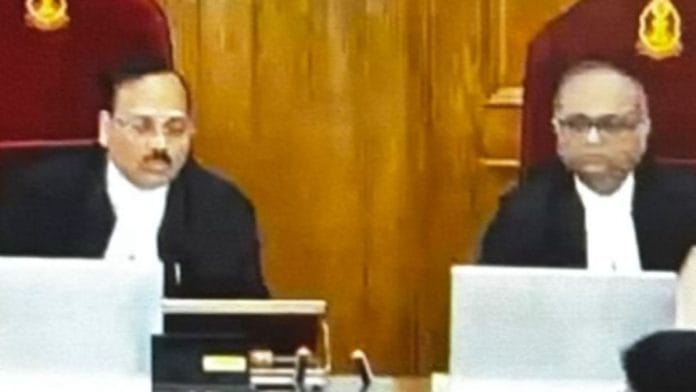
The Election Commission must publish the rulings of the Appellate Tribunals in a “supplementary revised electoral roll”, said the bench of CJI Surya Kant and Justice Joymalya Bagchi in an order released Thursday. The bench heard the matter on 13 April.
Crucially, it also said that individuals who have been excluded from the electoral list after the Special Intensive Revision (SIR) and their appeal is pending before the Appellate Tribunals till 21 April or 27 April, will not be entitled to exercise their right to vote.
The Constitution’s Article 142 grants the Supreme Court special and wide powers to pass any decree or order it deems necessary to ensure “complete justice” in any pending matter—especially under extraordinary circumstances where the existing laws aren’t sufficient.
The top court has been monitoring apprehensions over the conduct of the SIR in West Bengal, and is also hearing a suo motu case over the safety and security of judicial officers.
The court had invoked its extraordinary powers under Article 142 to put in place the system where Appellate Tribunals would hear SIR-related appeals. These tribunals are headed by retired judges of Calcutta, Orissa and Jharkhand High Courts.
The Supreme Court-constituted three-member panel has drafted a standard operating procedure (SOP) for the Appellate Tribunals. Led by Justice T.S. Sivagnanam, former Chief Justice of the High Court at Calcutta, the panel comprises Justice Pradipta Ray and Justice Pranab Kumar Deb, both former judges of the High Court at Calcutta.
The Appellate Tribunals were set-up pursuant to the 10 March order of the Supreme Court, which it said was “intended to provide a mechanism of appeal for individuals whose claims for inclusion in the electoral roll had been rejected by the Judicial Officers, as well as to afford an opportunity to those raising objections to any inclusions that had been effected”.
“Over 34 lakh appeals have already been filed, not only against alleged wrongful exclusion, but also, in a substantial number of cases, by objectors aggrieved by the inclusion of several persons in the revised electoral rolls,” the top court had said in its order.
It went on to clarify that if an individual’s name has been cleared by the Judicial Officer but has been challenged or objected to by any other individual—and the same is pending before the Appellate Tribunal—then such a person would not have the right to vote either.
This, in the court’s view, couldn’t be permitted “particularly when Judicial Officers from the State of West Bengal, duly assisted by Judicial Officers from the States of Jharkhand and Odisha, have completed what can only be described as a truly herculean task within a remarkably short span of time”.
(Edited by Amrtansh Arora)