



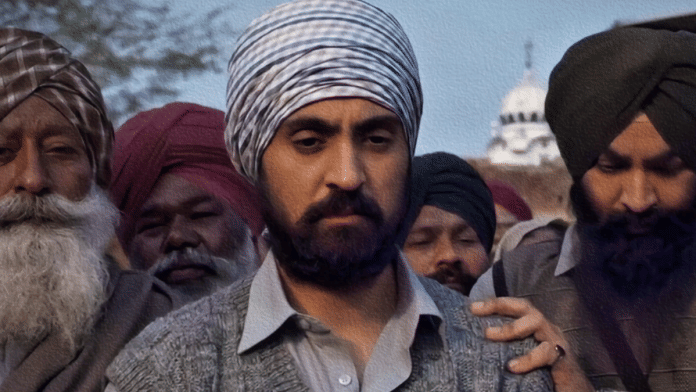
New Delhi: Two days after its release, Hindi-Punjabi film ‘Satluj’, based on the life of human rights activist Jaswant Singh Khalra and his killing, was taken down by streaming platform ZEE5.
In a public statement, the Indian OTT platform said, “In light of the current developments, ‘Satluj’ will be unavailable in India until further notice. We remain committed to exploring every appropriate avenue through due process to bring the film back to our audiences at the earliest opportunity.” ZEE5 did not give any details.
Starring Indian-born American singer and songwriter Diljit Dosanjh as Khalra, the film, earlier titled ‘Punjab ’95’, struggled for Central Board of Film Certification (CBFC) certification for nearly three years due to objections to its content, including the portrayal of the Punjab Police.
‘Satluj’ was released on ZEE5 on 3 July without any cuts before it was removed on 5 July. The film is currently available internationally on ZEE5 Global, while uncut pirated versions are also circulating in India.
ThePrint explains who Jaswant Singh Khalra was and revisits the landmark 2011 Supreme Court verdict that upheld the life imprisonment of four former Punjab Police officers for Khalra’s abduction and murder in 1995. The officers were Prithipal Singh, Satnam Singh, Surinderpal Singh and Jasbir Singh.
The 4 November 2011 judgment also severely criticised what it called the Punjab Police’s excesses during the militancy era in Punjab and reinforced the accountability of state actors.
Who was Khalra and why was he murdered?
Khalra was a bank employee-turned-human rights activist who was last seen washing his car in front of his house in Amritsar in September 1995, before he was abducted and later killed.
According to public reports, Khalra disappeared while investigating allegations that the Punjab Police had illegally cremated thousands of people who had disappeared from police custody during the 1980s and 1990s.
Khalra’s findings, based on an examination of municipal cremation records, drew national and international attention during a period of insurgency in Punjab.
After his abduction, a district court in Punjab convicted five officers—then head constable, three sub-inspectors and a deputy superintendent of police (DSP)—for his murder. They were sentenced to seven years of imprisonment.
The policemen challenged the ruling in the Punjab and Haryana High Court, which increased the term from seven years to life imprisonment in 2007. Four of the accused then challenged the decision in the Supreme Court. One of them passed away during the high court proceedings.
The top court bench of Justices B. S. Chauhan and P. Sathasivam identified Khalra as a human rights activist and general secretary of the Human Rights Wing of the Shiromani Akali Dal.
The court said Khalra was “working on abduction and cremation of unclaimed/unidentified bodies during the disturbed period in Punjab, particularly in districts Amritsar and Taran Taran”.
The court noted that Khalra had uncovered evidence that police were “eliminating the young persons under the pretext of being militants and were disposing of their dead bodies without maintaining any record and without performing their last rites”.
Khalra became a target because of his work as the “local police did not like it and hatched a conspiracy to abduct him” to stop him from exposing these illegal activities, according to the judgement.
Through the testimony of Special Police Officer Kuldip Singh, the top court reconstructed Khalra’s final days.
The court said Khalra was held in illegal detention at the Jhabal Police Station, where he became “very weak and fragile and was having scratch marks on his body” due to beatings by high-ranking officials, including then-SSP Ajit Singh Sandhu.
Describing the moment of his death, the court cited a witness who “heard slow noise of gun firing twice. The life of Shri Khalra came to an end”. It added that Khalra’s dead body was kept in the boot of a van “while blood was oozing from his body”.
His remains were subsequently “thrown in the canal” near Harike to eliminate evidence.
Indictment of Punjab Police excesses
The Supreme Court’s observations on the Punjab Police’s conduct were scathing.
The court noted a CBI report revealing that 984 bodies had been cremated as ‘lavaris’ (unidentified) in Taran Taran district. It also said that a “press note” issued by Khalra on the cremations was “found to be correct”.
The bench remarked that “police excesses and the maltreatment of detainees… encourages the men in ‘khaki’ to consider themselves to be above the law and sometimes even to become a law unto themselves”.
In Khalra’s case, the court found that the Punjab Police “united in an unholy alliance as their colleagues were involved and the case was going to tarnish the image of Punjab police”, even going so far as to implicate witnesses in “fake criminal cases” to prevent them from testifying.
Though Khalra’s body was never recovered, a concept known as corpus delicti, the court ruled that “recovery of the dead body is not a condition precedent for conviction of the accused for murder”.
The court held that since the fact of Khalra’s abduction by the police was proven, the burden of proof shifted to the officers under Section 106 of the Evidence Act.
“In such a fact-situation, the courts below have rightly drawn the presumption that the appellants were responsible for his abduction, illegal detention and murder,” the court said.
It added that tolerance of such “atrocities” would be a “systematic subversion and erosion of the rule of law”.
(Edited by Sugita Katyal)
Also read: SGPC, lawyers want Satluj back. Diljit Dosanjh asks Zee5 users to pass on the film