





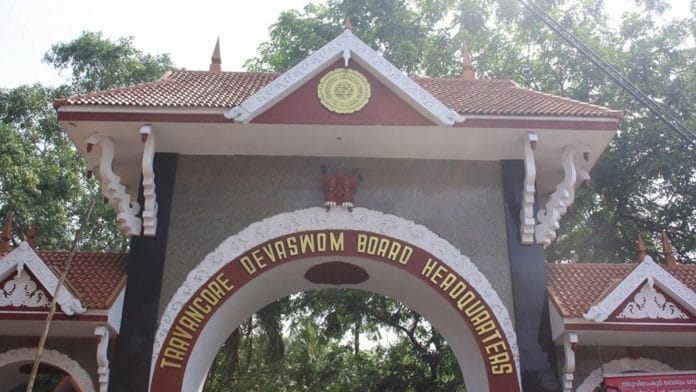


New Delhi: In a guarded approach, the Travancore Devaswom Board (TVB), which manages the Sabarimala temple in Kerala, Wednesday batted for denominational rights to be stronger than individual rights, but with a caveat.
Appearing for the board, senior advocate Abhishek Manu Singhvi told a nine-judge bench of the Supreme Court, hearing the Sabarimala reference, that individual rights should not prevail over denominational rights.
However, he did not rule out state intervention to throw open a public temple to all classes and sections of Hindus. Such an intervention, he explained, would be limited to the extent of ensuring all Hindus gain entry to the religious institution.
Inside the temple, he argued, the temple administration would decide who will perform the rituals inside the sanctum sanctorum. And, this, according to the senior lawyer, would also include who is permitted to worship.
Elaborating on the interplay between Articles 25 and 26 (Article 25 ensures individual freedom of conscience, profession, practice, and propagation of religion; Article 26 guarantees collective rights for religious denominations to manage their own affairs), Singhvi said: “I have entered, because the law is there saying you cannot keep me out. However, having entered, I say, I have the right to worship in the sanctum in a particular manner. Then Article 26 will take over, and if the collective religious belief of that denomination does not permit anybody, except one class to worship in the sanctum, then I can’t insist.”
The board’s stand is different from that of Nair Service Society and other Hindu organisations such as Ayyappa Seva Samajam and Kshetra Samrakhsana Samiti. In arguments presented last week, they asked for absolute autonomy of religious organisations, completely ruling out state intervention. They said the right of a religious denomination to determine who should enter the temple will prevail over the state’s power to make a law on it.
Led by Chief Justice Surya Kant, the nine-judge bench is hearing questions of law revolving around religious practices, to what extent the state can legislate on them and the judiciary’s powers to review them.
Articles 25 and 26 are central to this case. Article 25 is about an individual’s right to practice and profess one’s religion, faith and belief. Article 25(2)(b), which has come under focus during the on-going debate before the court, allows the state to enact law for social welfare and reform or the throwing open of Hindu religious institutions of a public character to all classes and sections of Hindus.
Article 26 is on denominational autonomy. Parties opposing state and judicial intervention in religious affairs have claimed protection under Article 26(b), which says a religious denomination has the fundamental right to manage its own affairs in matters of religion.
The pivotal argument before the court has been who has stronger rights, an individual or a religious group. And, whether the state can legislate to protect an individual’s right undermining a denomination or a religious organisation’s collective rights.
The TDB also contended that one cannot discriminate between people of the same religion or denomination in appointments to their institutions (as priests). Similarly, the temple administration cannot allow discriminatory practices such as serving of food to a particular caste or segregating the devotees caste-wise.
Singhvi explained this would be forbidden within Article 25(2)(b) as well as Articles 14 (right to equality), 15 (prohibits discrimination against citizens on grounds solely of religion, race, caste, sex, or place of birth) and 16 (equality of opportunities in matter of public employment).
On social reforms, the board maintained that the state can legislate on this account, but must at the same time ensure the religion’s essence is not lost due to the law formulated to outlaw an alleged social practice. It also advocated doing away with the ‘Essential Religious Practice’ (ERP) doctrine evolved through past judicial pronouncements.
Singhvi conceded that an extreme practice not forming part of collective, institutional and denominational belief of a group or sect belonging to religion can be rejected because it does not constitute religion at all.
According to Singhvi, courts cannot stigmatise a practice connected with religion and which can be traced back as a factual and genuine practice, unless it violates public order, health or morality.
On the ban on menstruating women entering Sabarimala temple, Singhvi said it was not gender-based exclusion, but a restriction that has a direct nexus with the identity and manifestation of the deity, who is an eternal brahmachari.
In his concluding remarks, Singhvi objected to the concept of constitutional morality, which, he said is not used in the Constitution anywhere and, therefore, cannot be a ground to invalidate a legislation or practice.
This prompted the bench to remark: “Legislation cannot be struck down on the ground of constitutional morality. It can be struck down on the ground of being violative of Part III or on the ground of legislative incompetence.”
CJI Kant observed: “The danger of constitutional morality is of the non-manageable standards of judging it. It needs complete subjectivity and individual opinion.”
To this Singhvi said: “It’s an unruly horse… a dinosaur which my lords cannot ride.”
(Edited by Viny Mishra)
Also read: How Ayyappa went from a local forest deity to Kerala’s most controversial God