





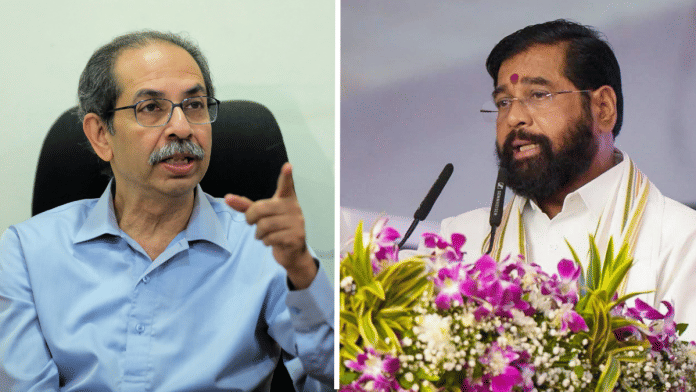


New Delhi: The six rebel MPs of Uddhav Thackeray’s Shiv Sena have questioned in Supreme Court the maintainability of the petition that seeks to invalidate the 18 July Lok Sabha Secretariat letter that allowed them to sit with Eknath Shinde’s Shiv Sena during Parliament’s Monsoon Session.
The rebel MPs, in their individual affidavits filed in response to the Uddhav Sena’s petition, state that its foundational framework rests upon the allegation that they stand disqualified under the Tenth Schedule.
The six rebel MPs in question are Bhausaheb Wakchaure, Nagesh Patil Ashtikar, Omprakash Raje Nimbalkar, Sanjay Bandu Jadhav, Sanjay Deshmukh, and Sanjay Dina Patil. In his petition, Uddhav Sena MP Arvind Ganpat Sawant has asked the top court to quash the Lok Sabha Secretariat letter, which, he argues, recognises the “change in party affiliation of six members of Shiv Sena (UBT) in Lok Sabha” and the resulting “revised party position in 18th Lok Sabha”.
Furthermore, according to Sawant, the 18 July letter recognises the merger of the six rebel UBT MPs with the Shinde Shiv Sena group by altering their seating arrangement, resulting in the increase of Shinde Shiv Sena MPs from 7 to 13. Sena (UBT) now has only three MPs in Lok Sabha. The letter specifically says that upon a change in party affiliation, the new seating arrangement was made.
Sawant’s petition argues that this virtually amounts to an approval of the rebel camp’s merger with Shinde Shiv Sena, whereas a “merger” per se is a defence that is available only when an MP faces disqualification proceedings. In the current case, Sawant has contended, there are no disqualification proceedings pending before the Speaker and, therefore, he cannot accept the plea of merger in advance.
Besides, the letter is issued by the Lok Sabha Secretariat’s Joint Secretary, and there is no clarity on who approved it, the petition added. It also raised larger legal questions on whether legislators can divorce themselves from the political party on whose tickets they had contested elections.
The rebel MPs have refrained from answering legal questions on the issue of merger. For them, any response now would amount to disclosing their defence that would be available to them if disqualification proceedings are initiated. Such proceedings only the Speaker can adjudicate, the MPs submitted in their affidavit.
What rebel MPs said
In response to Sawant’s contentions, the six rebel MPs claim that his petition seeks an “advisory” from the court and anticipatory determination on issues that may arise in the future. Despite maintaining that the rebel MPs should be disqualified, the Uddhav camp has not invoked the relevant constitutional mechanism under the Tenth Schedule, they said. By challenging the Lok Sabha Secretariat letter under Article 32 of the Constitution, Sawant is requesting premature adjudication on the merger issue, they added.
“In the absence of any decision of the Speaker passed in proceedings under Tenth Schedule, the present petition is premature and merely seeks to invert the constitutional scheme by requesting this honourable court to pronounce upon issues of merger, defection, and constitutional consequences in the complete absence of any adjudication proceedings before the constitutional authority designated,” stated the rebels MPs’ affidavit.
As for the Secretariat letter, it neither adjudicates any dispute arising under the Tenth Schedule nor records any finding of defection, the affidavit further stated, adding that at the same time, it neither alters nor extinguishes any legal rights vested in the petitioner, nor does it impose any civil disability upon them.
Speculative apprehensions made in the petition cannot constitute a violation of Articles 14 and 21, the rebel MPs stated, further claiming that Sawant has asked for a judicial review of consequences, which are neither expressed in nor result from the 18 July circular.
Touching upon the court’s power to judicially review parliamentary actions, rebel MPs maintained that such an intervention is permitted only when there is “substantive illegality” “resulting in actual constitutional violation” and not when an “administrative action is questioned”.
The rebel MPs conclude by stating that in the current case, the alleged infringement of Articles 14 and 21 is “conjectural” and based on anticipated consequences rather than any existing constitutional infringement. The court has adjourned the matter for two weeks.
(Edited by Kabir Dhami, currently interning with ThePrint)