





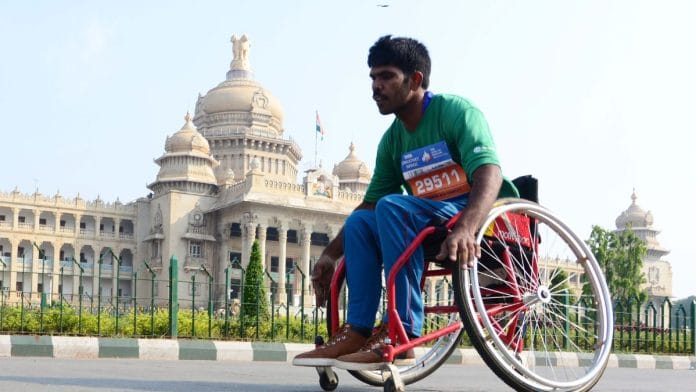


NEW DELHI: The Karnataka High Court has issued a comprehensive Standard Operating Procedure (SOP) on universal accessibility for people with disabilities, which will apply to a range of establishments—from government offices and courts, to police stations, hospitals and educational institutions.
A bench of Justice Suraj Govindraj said, in a detailed 465-page judgement on 1 June, that “reasonable accommodation” is not a matter of charity, but derives its legitimacy from Articles 14, 16 and 21 of the Constitution, which guarantee the right to equality, equality of opportunity in public employment and the right to life.
“Accessibility is NOT a welfare measure or a concession. It is a fundamental right,” the court said, referring to the Supreme Court’s landmark 2025 Kabir Paharia vs National Medical Commission judgement, which had said that “reasonable accommodation” for Persons with Benchmark Disabilities (PwBD) in medical admissions is a fundamental right.
The court said the SOP would remain operational in Karnataka until the state government framed appropriate accessibility rules under Sections 40 and 45 of the Rights of Persons with Disabilities Act, 2016, which set accessibility standards and timelines to make existing infrastructure and premises accessible to people with disabilities.
The ruling came as the court dismissed a petition by a Bengaluru-based private school which challenged a 2020 order by the State Commissioner for Persons with Disabilities, Karnataka, directing it to pay 10 lakh in compensation to a private school teacher who fell from the school building’s windowsill while trying to rescue a sixth-grade student.
As part of the directions, the court prescribed minimum physical standards for various facilities, including the width and height of ramps and corridors, accessible cinema seating in movie theatres and disabled-friendly rooms in hotels. It also provided proper dimensions for accessible toilets, specifying their appropriate width and height.
Hospitals are also required to ensure that registration for Outpatient Department (OPD) patients is accessible, with consultation rooms on ground floors, sign language interpreters and accessible examination tables and diagnostic equipment, the court said.
In malls and shopping complexes, accessible seating must be ensured with at least 1 percent of the seats designed for unobstructed viewing.
The court also emphasised the need for accessible ATMs and payment terminals at a maximum height of 900 mm.
In addition, accessible fitting or trial rooms should be available, along with accessible emergency evacuation exits, the court said.
The directions also extended to digital facilities.
The court said that all government websites, mobile applications, e-governance portals, e-office systems, court filing and case-management systems, online grievance systems, public kiosks and interactive terminals or platforms used to deliver government services are “strongly directed to adopt” these standards until proper regulations are framed.
Significantly, this order applies not just to urban establishments, but also rural ones as the court said “gram panchayat offices, primary health centres, anganwadis, rural schools, and rural transport hubs” shall also comply with simplified but meaningful accessibility protocol.
Origins of the case
The court was acting on a plea by PSBB Learning Leadership Academy challenging a June 2020 order passed by the State Commissioner for Persons with Disabilities, Karnataka.
The case arose after an accident involving a 42-year-old teacher, Barnali Rout. At the time of her appointment in 2009, she was told that her services could be terminated by giving her three months’ written notice or three months’ salary.
However, in 2013, a sixth-grade student was found changing her marks in some subjects. Out of fear of being caught, the student stepped onto the school building’s windowsill, located between the ground and first floor, and threatened to jump off.
Barnali then tried to get onto the windowsill in a bid to save the student “voluntarily without direct or indirect instructions” or the knowledge of any staff members.
However, she lost her footing and fell, getting severely injured in the process. Seeing this, the student panicked and jumped as well.
She told the court the accident left her with a permanent 90 percent locomotor disability and that she has become “traumatically paraplegic” as a result.
The school said it rushed her to a hospital immediately, paid all her expenses of a little over Rs 6 lakh at the time, and asked her to take on a retainer role, but she did not reply for about four years.
Subsequently, the Karnataka commissioner for PwDs sent a notice to the school in December 2020, asking it to pay Rs 10 lakh towards the teacher’s medical expenses and future expenses within 45 days. Challenging this, the school approached the court.
Will the SOP be enforced?
Although the SOP was issued in public interest to cater to persons with disabilities, the court said it was only transitional.
“It operates until the State of Karnataka and the appropriate Government frame comprehensive accessibility rules under Sections 40 and 45 of the Act,” the court said.
The court also made it clear that this SOP does not dilute any existing statutory obligations and operates in addition to the National Building Code of India and the Harmonised Guidelines and Space Standards for Barrier Free Built Environment, 2021, issued by the Ministry of Housing and Urban Affairs (MoHUA).
The court also noted that the SOP prescribes only minimum standards. “Establishments adopting higher standards are commended,” the court said, while adding that it sets a floor, not a ceiling.
Every provision of the SOP should be interpreted “liberally and purposively” to advance the rights and dignity of persons with disabilities, the court said. It added that in case of ambiguities, the interpretation that best advances disability rights shall be preferred.
(Edited By Sugita Katyal)
Also Read: ‘Reform over continued punishment’: Why Delhi HC ordered release of 1993 Bowbazar blast life convict