





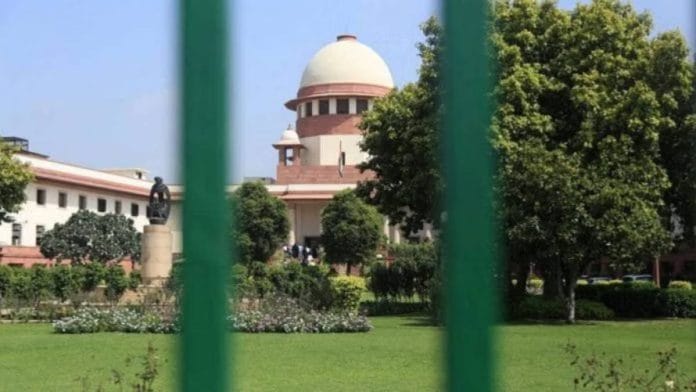

New Delhi: Prolonged and expensive arbitration proceedings have defeated the very objective of making the alternative-dispute redressal system becoming an efficient, convenient and quick bypass to civil litigation, the Supreme Court observed Monday.
A three-judge bench led by Chief Justice Surya Kant made its remarks while hearing a high-stakes arbitration dispute between HCL Infosystems Limited and Jaipur Vidyut Vitran Nigam Limited (JVVNL).
Both companies have filed cross-appeals against a 27 May Rajasthan High Court order that fixed a strict deadline for the arbitral panel, led by former Supreme Court judge Justice Deepak Verma. HCL challenged the High Court’s order to set down a timeline to conclude arbitration proceedings and deliver the award, while JVVNL argued that when the High Court had faulted the arbitrators for the delay it should have reconstituted the tribunal with new members. The tribunal has been hearing the arbitration since 2019.
Besides, the High Court asked the tribunal members to return the fee after adjusting the revised fee, fixed under its order to parties involved in the dispute. A 30-day deadline to complete the hearing and another 15 days to pronounce the final award. Aggrieved with this particular directive, the tribunal members, including Justice Verma, approached the Supreme Court to set aside the “disparaging observations” made by the HC in its order.
On Monday the bench took up all the three connected appeals together and shared its concerns over the impact of delayed arbitration hearings.
“Arbitration was supposed to be an efficient and convenient bypass, and cost-efficient. If arguments go on from 2024 to 2026, look at the fate of arbitration. The delay is too long,” remarked Justice Joymalya Bagchi, one of the three judges on the bench. Justice V. Mohana was the third bench member. Justice Bagchi clarified his observation was not against any individual arbitrator, but was to ensure an arbitration-friendly environment.
Senior advocates Shyam Divan and Nakul Dewan and counsel Kartik Sethi, representing JVVNL, told the bench that 198 hearings in the arbitration proceedings had entailed a cost of Rs 13 crore.
This prompted HCL’s counsel, senior advocate Neeraj Kishan Kaul to rebut insinuation that his client was responsible for the delay. Senior advocate Ravindra Srivastava, appearing for the Justice Verma-led arbitral tribunal, defended its members. He said the proceedings were delayed due to the sudden demise of one of the tribunal members. Subsequent to the High Court order, the tribunal conducted day-to-day hearing and despite one of the arbitrators being hospitalised in an ICU, online hearings were held to conclude the proceedings, he said
Justice Bagchi, however, felt that the present case highlighted the failure of the arbitration procedure. “Look at the fate of arbitration. We understand one arbitrator passed away, a substitute arbitrator was there, etc., and all that. But nevertheless, the delay is too long. The delay is too long,” he said.
“We talk about an arbitration-friendly environment and look at this. This is egregious. Of course, our observation is not on the individual arbitrator, but look at the process as a whole,” the judge added, further saying: “I think if the parties went to a suit, they would have got half the decree or a decree.” The bench maintained its interim order that restrained the arbitral tribunal from pronouncing its award and gave the parties 10 days to exchange its written submissions.
As reported earlier by ThePrint, former Supreme Court judge Justice Verma (Retd) has in his appeal expressed objections over what he called serious and disparaging observations in the HC’s order against the arbitrators, including himself.
The High Court had described the conduct of the arbitral tribunal as “lethargic” and called it a “casual approach,” which “undermined the very spirit of arbitration,” and demonstrated “lack of procedural discipline”. The other two tribunal members, who too have petitioned the SC, are former High Court judges justices Dinesh Chandra Somani (Retd) and N. Kumar (Retd).
The High Court judgment highlighted the case as a reflection to a “deeper” problem within the arbitration ecosystem and raised concerns over the alternative dispute redressal mechanism’s efficacy as a quick remedy to commercial litigation.
A partial vacation bench had in the last week of June stayed the operation of two High Court directions, asking the tribunal to declare the award within 15 days and return the fee.
Justice Verma’s plea in the Supreme Court raises a technical challenge to the High Court order. It says the High Court has traveled beyond its jurisdiction by fixing a timeline.
The directions to conduct day-to-day hearings and requiring the Tribunal to pronounce the award within a specific period would amount to judicial control over the arbitration process, the former top court judge has contended.
In another impermissible intrusion, Justice Verma added, the High Court also directed that the arbitral fees already paid be reduced at the rate of 5percent per month of delay until final disposal. The order also included refund of the reduced fee to the parties in proportion to their respective contribution.
There is no provision in law that authorises a court to issue such a directive, Justice Verma argued. The High Court’s conclusion that the arbitral tribunal was responsible for the delay was strongly rebutted. Justice Verma said the case file comprises more than 50,000 pages, and approximately 22 witnesses were cross-examined over 88 sessions.
Besides, more than 13 interim applications involving contentious and complex questions of law were adjudicated and an interim award was also pronounced on 25 September, 2025.
(Edited by Prakhar Agrawal)