







New Delhi: The Supreme Court ordered a wider inquiry into delays in Uttar Pradesh’s criminal justice system last month while quashing a 35-year-old criminal case against a then constable stemming from a fight over food in a mess while on Kumbh Mela duty.
The top court said the right to a speedy trial under Article 21 of the Constitution must become “meaningful and real”, rather than an “abstract or illusory safeguard”.
A bench of Justices J.B. Pardiwala and U. Bhuyan expressed frustration that previous court guidelines on speeding up criminal trials have remained “on paper” only.
“The reason is also very simple. No court bothers to follow the guidelines. They do not follow because there is no accountability. No one is made answerable,” the bench said, while ordering the audit.
The order dated 29 April was uploaded Tuesday.
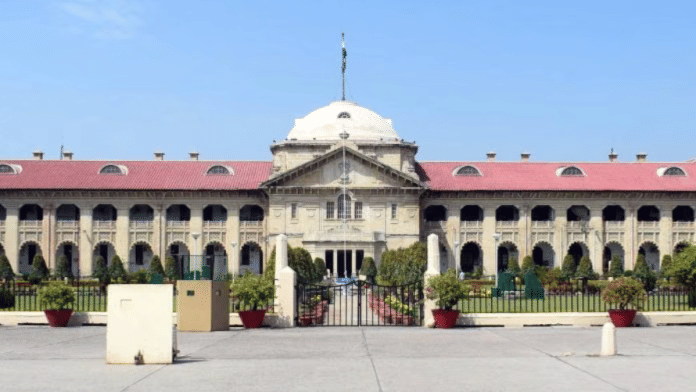
The Supreme Court directed the Allahabad High Court, which has the maximum number of cases pending and the highest number of judges, to provide data on pending criminal cases, undertrials in jail, and judicial vacancies.
More specifically, the top court asked for statistics on the number of cases pending before Judicial Magistrates and Sessions Courts, including details on how old these cases are.
It also sought details on the status of undertrials, including how many accused persons are currently in jail as undertrials and for how long.
Apart from this, the court sought details on judicial vacancies or the total number of sanctioned posts for judicial officers versus the number of vacant posts.
Lastly, it sought a tabular breakup of pending bail applications, specifically cases where undertrials have been in custody for more than 10 years, between 8-10 years, and 0-1 years.
The court said that this data was aimed at working out ways to address systemic impediments and ensure that “stale claims”, which are never favored by law, do not continue to plague the criminal justice system.
The bench directed the Registrar General of the Allahabad High Court to file a detailed affidavit by 13 July, answering several critical questions regarding the state of the judiciary in Uttar Pradesh.
Also Read: 22 judges per million, 26 lakh cases pending: India’s judicial gap widens despite years of reform
Case pending for 35 yrs
The case originated from an incident on 19 February 1991 at the GRP Rambagh police station in Allahabad, where five police constables were accused of assaulting another constable, Gajendra Singh, following a dispute in the police mess regarding food.
At the time of the incident, the appellant, Kailash Chandra Kapri, was a 22-year-old constable; he is now 59.
A charge sheet was filed, leading to a criminal case in 1991, which remained pending for over three decades. The Supreme Court noted that while the case involved charges of “simple hurt and criminal intimidation”, it resulted in Kapri being kept in “suspended animation for 35 years”.
A significant factor in the delay was the administrative aftermath of the bifurcation of Uttar Pradesh and Uttarakhand. Uttarakhand was carved out of Uttar Pradesh in 2000, following the Uttar Pradesh Reorganisation Act, 2000.
Following the creation of the new state, Kapri was transferred to Uttarakhand. The state of Uttar Pradesh informed the court that because he had left the state, “no summons could be served upon him” for decades, and no summons were issued by the trial court until 2021.
Meanwhile, the trial for the co-accused proceeded separately.
Two of the co-accused passed away during the pendency of the case. The remaining two were finally acquitted on 1 February 2023, because the prosecution failed to produce even a single witness in 33 years, despite all witnesses being police personnel themselves.
The trial court in 2023 observed that “the prosecution cannot be given endless and unlimited opportunities to produce evidence”.
When Kapri approached the Allahabad HC to quash the proceedings, citing the 35-year delay as a violation of his fundamental right to a speedy trial, it declined to quash the case, saying that the submissions related to “disputed questions of fact” which could not be adjudicated under its inherent powers.
The order was passed in February. Kapri then appealed in the Supreme Court.
On 29 April, the apex court overturned this decision and quashed the 1991 proceedings entirely.
It said that “35 years for a trial for simple hurt and criminal intimidation is too long a time” and that the High Court should not have hesitated to exercise its power when a proceeding amounts to a violation of Article 21, which guarantees the fundamental right to life and personal liberty.
(Edited by Sugita Katyal)