


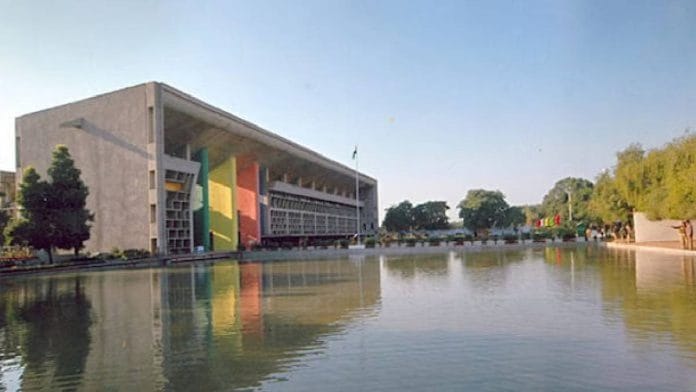
Chandigarh: This is one for the books, if not just cheque-books. Aparna Puri, an employee with a company, was asked to sign cheques by her employer. When they bounced, she was named in more than 120 complaints under Section 138 of the Negotiable Instruments Act, 1881.
Each complaint meant a separate court. Each court meant a separate bail bond and a separate surety. Puri could not arrange so many sureties. On 27 October, the Punjab and Haryana High Court stepped in.
Justice Sanjay Vashisth ruled that the bail bonds and surety bonds she has already furnished, worth Rs 10 lakh, will hold good in all her remaining cases before the trial courts at Kaithal, Kurukshetra and Karnal. The relief comes with a condition. The courts must still pass separate orders granting her bail in each case.
Represented by senior advocate P.S. Ahluwalia, Puri had moved the High Court, seeking a common personal bond and surety bond for all complaints against her and Amira Pure Foods Private Limited. The company is the main accused in the cases. The matter had already come up on 12 May 2025 when the High Court said that if she gets bail in any one case and furnishes bonds, those could be treated as common for the other cases too.
On 4 October 2025, Puri appeared before the Kaithal court in a complaint filed by M/s Sat Narain. The offence under Section 138 is bailable. She was released on bail bonds of Rs 2 lakh with one surety of the same amount.
In another Kaithal complaint, filed by M/s Mansa Devi, the trial court noted the High Court’s earlier order. It also noted that she had already furnished bonds in the Sat Narain case. Even so, it asked her to furnish fresh common surety bonds of Rs 1 crore.
That is where she was stuck. Her counsel told the High Court that she faces about 120 complaints, of which 85 are pending in the Kaithal Sessions Division. He said it was not feasible for her to furnish so many bonds and sureties. Arranging that many sureties, he said, was almost impossible for anyone. The remaining cases are in Kurukshetra and Karnal.
Justice Vashisth relied on the Supreme Court’s 22 August 2024 judgment in Girish Gandhi v. State of Uttar Pradesh (2024 INSC 617). In that case, the accused had got bail in many cases across several states but remained in custody. He could not find a separate surety for each case.
The Supreme Court had said that sureties matter because they secure the accused’s presence. But it also said that excessive bail is no bail. Where an accused cannot find sureties in multiple cases, the court must balance this need against his or her right to liberty under Article 21 of the Constitution. A condition that is impossible to meet, it said, defeats the very object of release.
The Supreme Court had also referred to its earlier order in Hani Nishad v. State of Uttar Pradesh. There, a single personal bond of Rs 30,000 and two sureties were allowed to cover all 31 cases against the accused. It also noted its January 2023 directions in the suo motu case on bail policy. These say courts may not insist on a local surety.
Applying this, the High Court said conditions of bail must be reasonable and proportionate. They must not be so heavy that compliance becomes practically impossible. Asking Puri for separate and substantial sureties in each of the cases, it said, would put an onerous burden on her.
Ahluwalia appeared with advocate H.S. Randhawa for Puri. Additional Advocate General Ruchi Sekhri appeared for the state of Haryana.
The court also dealt with a practical problem, the proof of the surety’s fitness. It pointed to Section 441(4) of the Code of Criminal Procedure, now Section 485(4) of the Bharatiya Nagarik Suraksha Sanhita (BNSS). This allows a court to accept affidavits as proof that a surety is sufficient and fit, or to hold an inquiry if it thinks necessary.
Using this power, the High Court directed that the surety whose bonds are to remain valid in the remaining cases will file one common affidavit. It must give all relevant particulars and the surety commitments. The trial courts may accept it without asking for a separate affidavit in each case.
The order does not give Puri a free pass. The High Court made it clear that she must still appear before every trial court, as the law requires. If she is absent in any one case, that court is free to start proceedings to forfeit her bail bonds and surety bonds, following the procedure laid down by law.
The High Court has asked for copies of the order to be sent to the trial courts at Kurukshetra, Karnal and Kaithal for compliance.
(Edited by Nardeep Singh Dahiya)
Also Read: Co-accused’s death ends joint trial, says Punjab & Haryana HC, quashing FIR in 2021 NDPS case