





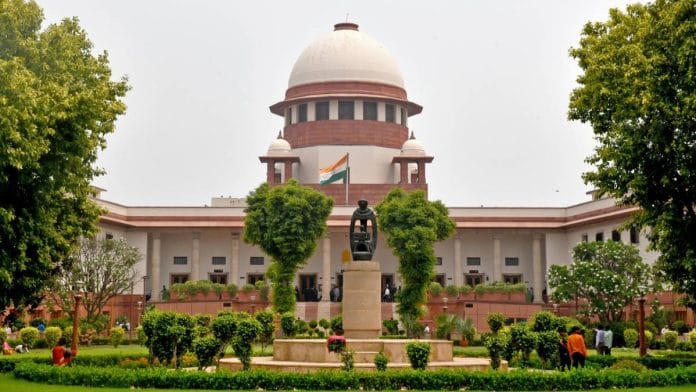

New Delhi: In a significant ruling for the rights of long‑serving casual labourers, the Supreme Court Monday recognised pension as a constitutional right, while restoring pension benefits to three former casual workers employed by the government.
In the 1 June judgement, a bench of Justices Augustine George Masih and Sanjay Karol set aside a 2019 Patna High Court decision denying pension to the three state Department of Posts workers, saying the long‑serving temporary‑status casual labourers could not be denied pension because the department had failed to formally regularise them.
“Pension is not a matter of grace dependent upon the financial convenience of the employer, but a deferred wage earned through long years of service,” it said.
Citing the right to equality under Article 14, the court reiterated that any classification resulting in the denial of any benefits to a class of employees who perform duties and responsibilities identical to regular staff “would fall foul of constitutional ethos”.
The ruling is expected to provide relief to thousands of non-regularised workers, who have served in government jobs for decades and still don’t get pension benefits for not being permanent employees.
The three casual labourers were appointed as night guards with the department between 1971 and 1981. They worked continuously for decades, received temporary status under the Casual Labourers (Grant of Temporary Status and Regularisation) Scheme, 1991, and were even treated at par with temporary Group D employees for pay and service benefits.
However, when they sought pension after retirement, the department rejected their claims, arguing that formal regularisation was mandatory for pension under the Central Civil Services (Pension) Rules, 1972.
The Central Administrative Tribunal ruled in favour of the workers in 2018, holding that their long service and temporary status entitled them to pension.
But the Patna High Court reversed this in 2019, citing the absence of a formal regularisation. Thereafter, the labourers filed an appeal before the top court in 2019.
What court said
This week, the Supreme Court rejected the Patna High Court’s reasoning and restored the tribunal’s orders.
Relying on previous SC judgements, the court held that “pension is not a bounty but a vested right”. It emphasised that pension is a constitutional right protected under Article 300A, which guarantees that no person can be deprived of property except by the authority of law.
The court said once pension is recognised as a constitutional right, it cannot be taken away except by authority of law. Administrative inaction cannot defeat a constitutional right, and the government cannot deny pension to temporary-status workers simply because it failed to regularise them.
The court emphasised that the 1991 Casual Labourers Scheme was designed to integrate casual labourers into the structured service framework and that the scheme clearly recognises the pensionable character of such service.
Alfreza Ahmed is an alum ThePrint School of Journalism and an intern.
(Edited by Sugita Katyal)
Also Read: Victim protection, consent, rehab & more: Making sense of SC’s ruling on rights of sex workers