



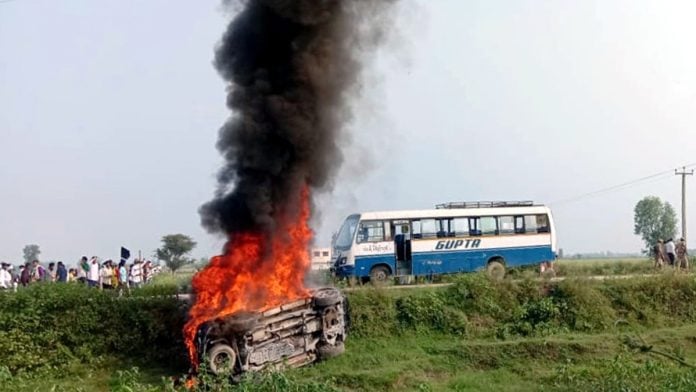
New Delhi: An eyewitness in the 2021 Lakhimpur Kheri violence case has filed an application in the Supreme Court raising concerns over the conduct of the presiding officer of the trial court hearing the case.
The trial court is hearing the case arising from the killing of eight people in Uttar Pradesh’s Lakhimpur Kheri district on 3 October 2021, when vehicles linked to Ashish Mishra, son of former Union minister Ajay Mishra Teni, ran into a group of farmers. In December 2023, the trial court framed charges against Mishra and 12 others, including murder, criminal conspiracy and other offences, paving the way for the trial in the main case.
The applicant, Jagjeet Singh, sought transfer of the trial from the court of the present district and sessions judge, Lakhimpur Kheri, to another competent sessions court. Relying on a series of orders issued by the presiding officer between April and July this year, Singh said there was a reasonable apprehension that a fair trial may not be conducted before the present judge. The application clarified that this did not amount to a finding against the sessions judge.
One of the serious concerns raised in the application, filed by advocate Prashant Bhushan on the complainant’s behalf, was the manner in which the trial judge discharged four of five prosecution witnesses within two days. Singh also pointed to the judge’s failure to order an inquiry into a missing page of a crucial site plan and to a list of cases requisitioned by the judge from other sessions courts, including matters that were at the final-arguments stage.
A three-judge bench of the Supreme Court, led by Chief Justice of India Surya Kant, took cognisance of the application on Tuesday and asked the Chief Justice of Allahabad High Court to examine Singh’s allegations and send a report to the top court in a sealed cover.
Also Read: 2 sentenced to life imprisonment for Dalit minors’ gang rape & murder in UP’s Lakhimpur Kheri
Allegations against presiding officer
The principal ground cited in Singh’s application concerns the trial court’s treatment of four prosecution witnesses in the hit-and-run case.
It said one of the witnesses, Sher Singh, could not appear before the trial court on 17 April due to illness, and the prosecution had submitted an adjournment application along with a medical document. Despite this, the trial court issued a non-bailable warrant against him.
The police team that went to serve the warrant also warned him of severe consequences if he remained absent at the next hearing. Distressed and anxious, he appeared in court on 22 April. The court cancelled the warrant, relying on the same medical documents submitted earlier, but Sher Singh said he was unwilling to testify.
The prosecution subsequently sought his discharge, which was allowed. Three other prosecution witnesses—Sukhpal Singh, Paramjeet Singh and Angrez Singh—were also discharged later after being summoned at extremely short notice to appear the following day. Before summoning them, the court had rejected the prosecution’s objection that such short notice was impractical.
Another concern raised in the application was a missing page of the site plan prepared during the investigation. The document formed part of the judicial record but was not exhibited when the investigating officer was extensively questioned about its contents during cross-examination.
According to the application, the missing page contained material details about the location and movement of vehicles involved in the October 2021 incident. Since it was unavailable during the cross-examination, the investigating officer was not questioned about those details.
The missing page was subsequently produced by the police and placed in the case file. However, Singh’s application said no inquiry was ordered to determine how and why it had gone missing. It also alleged that the trial court did not follow the procedure for reconstructing the record, as laid down in a Supreme Court judgment.
The application further alleged that after taking over as district and sessions judge in October 2025, the presiding officer requisitioned several pending sessions trials from additional sessions courts, including cases that had reached the stage of final arguments.
It cited one case in which presentation of evidence had concluded and final arguments were pending when the matter was requisitioned following which the accused were subsequently acquitted. The application cited other cases as well to allege that the judge disposed of them with undue haste.
Singh also cited cases in which the presiding judge granted bail after requisitioning matters from other courts. In one case under the Narcotic Drugs and Psychotropic Substances (NDPS) Act, the judge requisitioned the matter from a designated special court and granted bail to the accused within a week.
In an SC/ST Act case, the application alleged that the judge heard the bail plea and granted anticipatory bail to the accused without issuing notice to the complainant. It further alleged that bail was granted even though the accused had been arrested and produced in custody the same day. The application said the bail plea had thereby become infructuous.
The applicant also flagged the appointment of a much junior prosecutor to conduct the trial. The district government counsel, who had been representing the prosecution, retired on 10 July. An additional district government counsel with 10 years’ experience was appointed on 13 July but was replaced the following evening by an officer with only four months’ experience.
(Edited by Chingkheinganbi Mayengbam)