





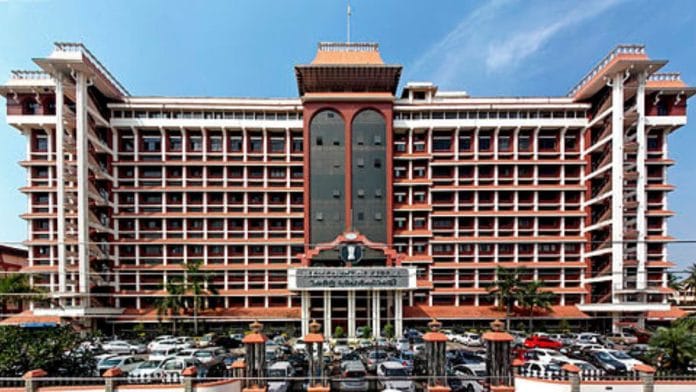


New Delhi: The Kerala High Court Friday upheld the Enforcement Directorate’s (ED) power to initiate inquiries and issue summons under the Prevention of Money Laundering Act (PMLA) even before an FIR is registered for a scheduled offence, while dismissing an appeal filed by Cochin Minerals and Rutile Limited (CMRL) against a single-judge order passed last week.
A division bench of Justices Raja Vijayaraghavan V. and K. V. Jayakumar Friday agreed with single judge T. R. Ravi’s reasoning last week, lifting a stay on an ED probe in a case where daughter of former chief minister Pinarayi Vijayan was one of the alleged beneficiaries.
The case originated from a search conducted by the Income-Tax Department in January 2019 at the premises of CMRL, a public limited company.
The search allegedly unearthed “evidence” that the company had inflated its expenditure by Rs 133.82 crore between 2012 and 2019 through fictitious cash expenses for transportation and sludge handling. The I-T Department concluded that this allegedly unaccounted cash was used for illegal payments to politicians, media houses, and public servants.
Central to the controversy were payments totaling Rs 1.72 crore allegedly made to M/s Exalogic Solutions Private Limited, a company owned by Pinarayi Vijayan’s daughter Veena Vijayan. While CMRL claimed these were for genuine software services, the IT Settlement Commission later upheld findings that the payments were fictitious and made without any actual services being rendered. Following these revelations, the Serious Fraud Investigation Office (SFIO) was also tasked with investigating the company’s affairs under the Companies Act.
After the company claimed that the payment of Rs 1.72 crore to Veena Vijayan’s firm was genuine, the Settlement Commission passed an order concluding the matter in June 2023.
Months after this settlement of the income tax case, Kerala BJP leader Shone George approached the Ministry of Corporate Affairs seeking an investigation into the affairs of CMRL, later petitioning the high court with a similar request.
Before the HC, CMRL sought to quash the Enforcement Case Information Report (ECIR) and related proceedings initiated by ED regarding money laundering allegations. The HC dismissed this plea reaffirming that the ED’s power to inquire into money laundering activities is broad and can commence the moment “sufficient credible information” suggests the existence of proceeds of crime, regardless of whether a formal police case has been registered. With the appeal being dismissed, ED has authority to pursue its investigation into the financial affairs of CMRL.
The high court’s reasoning
In this backdrop, ThePrint explains the case and the reasoning given by the high court division bench for upholding the ED’s powers on 3 legal questions: The ECIR’s nature, the difference between the civil and penal limbs under the PMLA and the necessity of a prior FIR for a Section 50 inquiry.
The Kerala HC made a “nuanced distinction” between civil and penal limbs of the PMLA. The bench explained that the Act serves dual roles: The civil limbs of inquiry, attachment, and confiscation and the penal limb of prosecution.
While civil and penal limbs are served by the same body of evidence, the court said, they operate under different jurisdictional pre-requisites.
On one side, the civil action of attachment may be initiated on the basis of material suggesting the existence of proceeds of crime, even without a registered scheduled offence, but, the other side of penal action of prosecution requires the registration of a scheduled offence as a foundational prerequisite, since the very definition of ‘proceeds of crime’ under Section 2(1)(u) of the PMLA requires that “the property be derived or obtained as a result of criminal activity relating to a scheduled offence”, said the court.
Another aspect dealt by the court relates to Section 50 of issuing summons—which it said is an inquiry power, not prosecution.
Regarding the challenge to the summons issued under Section 50, the court ruled that this power is primarily an instrument of the civil limb of the Act, in the event when there is no ECIR under PMLA or FIR under the penal code. The bench emphasised that at the stage of issuing summons in such a scenario, the process “is not an investigation for initiating prosecution in respect of an offence of money laundering”.
The court reasoned that the ED is empowered to summon any person—even witnesses—to ascertain the existence of ‘proceeds of crime’. At this stage, the recipient “does not assume the character of an accused” as there is no formal accusation. Therefore, the “existence of a prior registered scheduled offence is not a jurisdictional prerequisite for the exercise of this power,” held the court.
Next, the court rejected CMRL’s argument that immunity granted by the Income-Tax Settlement Commission should halt the ED’s probe. Citing the second proviso to Section 245H of the I-T Act, the bench noted that the commission has no jurisdiction to grant immunity for offences under the IPC or any Central Act other than the I-T and wealth-tax Acts.
PMLA ‘independent statute’
The bench concluded that the PMLA is an “independent statute” with its own distinct legal regime. Therefore, a tax settlement focusing on the concealment of income, “cannot extinguish the offence of money laundering or the ED’s jurisdiction to inquire into the transactions leading to the proceeds of crime”.
Lastly, the court also highlighted Section 66(2) of the PMLA as a mechanism that acts as a “bridge”. When the ED initiates civil action without a prior FIR, it is mandated to share that information with the jurisdictional police – and if the reported offence is a scheduled one, only then does the property recovered “partake the colour of proceeds of crime” for further action. However, the “non-registration of an FIR by the jurisdictional police… does not, however, render the civil action already initiated by the ED illegal”.
The HC also addressed the legal status of the ECIR—clarifying that it cannot be equated with a FIR under the Code of Criminal Procedure as the bench noted that while an FIR is a statutory requirement for police, there is “no corresponding provision in the PMLA requiring registration of offence of money laundering”.
Thus, the court held that an ECIR is merely an “internal document created by the department before initiating penal action or prosecution” and since the registration of an ECIR is not a legal prerequisite for the ED to act, its quashing would have no legal effect. This means ED can take on an anti-money laundering probe even in the absence of an ECIR.
(Edited by Viny Mishra)
Also read: ED can attach properties bought with ‘proceeds of crime’ before PMLA came into force, says Delhi HC