



New Delhi: The Karnataka High Court (HC) has upheld the constitutional validity of a law prohibiting new construction within 100 metres of centrally protected monuments, ruling that restrictions on the use of private land do not, by themselves, entitle property owners to compensation.
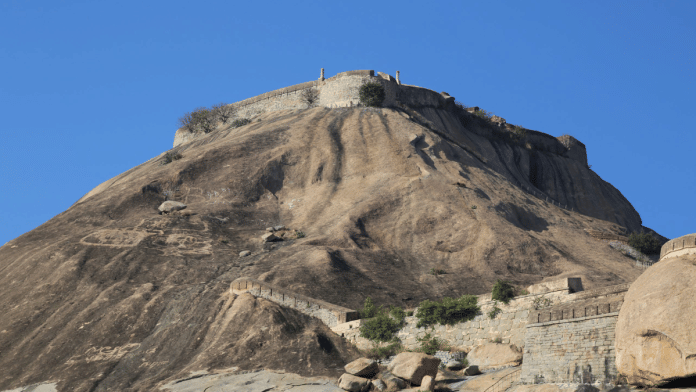
Justice M.G.S. Kamal delivered the judgment on 9 October while hearing a writ petition filed in 2018 by B.R. Ramakrishna, who sought to build a house on a vacant portion of his property near Madhugiri Fort in Tumakuru district. The fort, associated with the Vijayanagara and Nayak rulers, stands on and around a massive monolithic hill and is protected by the Archaeological Survey of India (ASI).
Ramakrishna disputed the ASI’s claim that his proposed construction site was 59 metres from the monument, arguing that it was approximately 200 metres from the southern side of the fort wall.
The court rejected his constitutional challenge to the Ancient Monuments and Archaeological Sites and Remains (AMASR) Act, 1958, as amended in 2010. However, it directed the authorities to conduct a fresh survey to establish whether his plot falls within the prohibited zone or the regulated area.
Also Read: Home owners living next to protected monuments can’t build, extend. Files at NMA pile up
Why owner challenged law
Ramakrishna challenged Sections 20A and 20B of the AMASR Act. Section 20A prohibits new construction within 100 metres of a protected monument, subject to limited statutory exceptions. Section 20B designates the area extending a further 200 metres beyond the prohibited zone as a regulated area, where construction requires ASI permission.
Pointing to existing structures nearby, including a government school and a police station, he argued that the restrictions were arbitrary and that his proposed construction would not damage the monument.
He invoked Article 14 of the Constitution, which guarantees equality before the law, contending that the distinction between prohibited and regulated areas lacked a reasonable basis. He also cited Article 300A, which protects property rights against deprivation except by authority of law, arguing that the restrictions rendered his vacant land unusable without compensation.
The government countered that the law regulated land use to protect monuments rather than depriving owners of their property.
Why court upheld restrictions
Relying on the Supreme Court’s ruling in ASI v. Narendra Anand (2012), the high court examined the legal framework governing monument protection and the need to prevent construction that could damage heritage sites.
It held that the classification of land into prohibited and regulated zones was neither arbitrary nor vague.
“Considering the object and purport of the Act and the constitutional mandate of Article 49 of the Constitution of India,” the court observed, the classification “cannot be found to be unreasonable, ambiguous or vague”.
Article 49 directs the state to protect monuments and places of national importance, while Article 51A(f) establishes a fundamental duty of citizens to value and preserve India’s composite cultural heritage.
On the compensation claim, the court distinguished between restrictions on land use and the acquisition of property. “Reduction in the utilisation of the land also cannot be equated with expropriation of the land,” it observed.
Since Ramakrishna retained ownership of the property, the court held that restrictions on construction alone did not entitle him to compensation.
Fresh survey ordered
While upholding the law, the court found that the dispute over the plot’s distance from the fort remained unresolved.
The ASI had placed the proposed construction site 59 metres from the monument, but the court observed that its report did not explain how the measurement had been arrived at. Ramakrishna maintained that the site was approximately 200 metres from the southern side of the fort wall.
The court also took note of existing buildings and a 40-foot-wide road near the property. It directed the authorities to conduct a fresh inspection to determine whether the plot falls within the prohibited or regulated area.
The court ordered the exercise to be completed within three months, with the decision communicated to Ramakrishna in writing.
Aditya Edara is a TPSJ alum, currently interning with ThePrint.
(Edited by Chingkheinganbi Mayengbam)
Also Read: Odisha has money to invest in monuments. It lacks a Rajasthan-like blueprint