





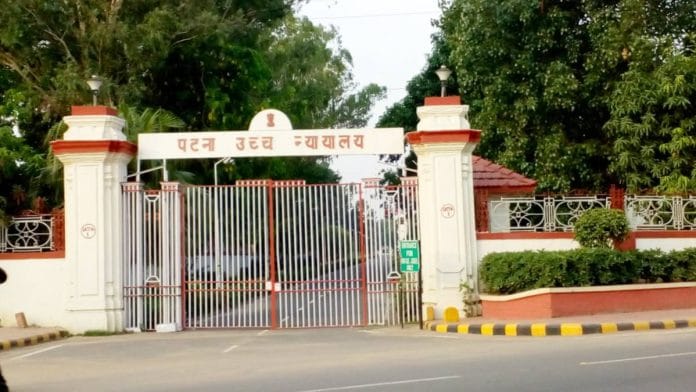


New Delhi: Reinforcing a judicial philosophy that prioritises the restoration of juveniles to their families over state-mandated detention, the Patna High Court has granted bail to two “children in conflict with law” (CICL) accused of rape in separate incidents.
In both cases, decided by Justice Arun Kumar Jha last week, the court emphasised that the gravity of an offence cannot be the sole reason to deny bail to a minor, asserting that institutionalisation must remain a “step of last resort”.
Dealing with serious allegations in Bihar’s districts of Munger and Purnia, the judge clarified that for juveniles, the legal system must act as a protective guardian rather than a purely punitive one.
The first case is from Munger, where a boy aged 17 years, 9 months and 23 days (at the time of the offence) stands accused of establishing physical relations with a 12-year-old, giving her “allurement of marriage, making her pregnant and later on, refusing to marry her”. He has been in custody since June 2024 and denied bail by the Juvenile Justice Board (JJB) and the sessions court.
Justice Jha, however, granted the minor bail and explicitly said that the purpose of the Juvenile Justice Act, 2015, is “reformation of the child” and “institutionalisation of a CICL is a matter of last resort and could not be resorted to thinking that such custody would be for betterment of the child and would psychologically make him a good citizen”.
“This is possible only under the guardianship of the parents and other family members”, he added, highlighting the “principle of repatriation and restoration”: that children have a right to be reunited with their families to develop their full potential.
In the second case from Purnia, a boy aged 13 years, 1 month and 9 days stands accused of rape and assault of a six-year-old girl. The teenager has been in custody since February 2025.
When the defence argued that the case stemmed from a land dispute and the prosecution pointed to the “perverse nature” of the act, the high court found that the trial court was focused too heavily on the “nature and gravity of the offence”.
Pointing to a social investigation report that showed the boy had clean antecedents and received favourable opinions from his neighbours, Justice Jha noted that keeping the child in custody would not necessarily serve his best interests compared to returning him to parental guardianship.
Also Read: India is reeling under ‘bail burden’. Denial begins at district courts and clogs high courts
Interest of the child ‘supreme’
A common thread in both rulings, Justice Jha emphasised that the Juvenile Justice Act is designed to be inherently “child friendly” and, quoting Section 3 of the Act, he noted that “the central theme is that the interest of child is supreme” and that all judicial decisions must be based on the primary consideration of helping the child “develop full potential”.
The court used the “principle of best interest” to challenge the findings of the trial courts, which had kept the minors—in separate cases—in custody based on the perceived severity of their alleged crimes.
The high court observed that Section 3(xii) makes it “abundantly clear that a child shall be placed in institutional care as a step of last resort”.
A critical takeaway from both orders was the court’s stance on bail for minors: Justice Jha pointed out that under Section 12 of the Act, bail is the rule, and it can only be denied if there is clear evidence that release would expose the child to known criminals, moral danger, or otherwise defeat the ends of justice.
The court explicitly stated that “the nature and gravity of the offence is immaterial for grant of bail to a child in conflict with law”.
Justice Jha further invoked the doctrine of parens patriae, asserting that the courts have a duty to act as the “parent of the state” to protect the best interests of the minor. This includes upholding the “principle of repatriation and restoration”, which mandates that a child has the “right to re-unite with his family and be restored to the social, cultural and the economic background that he came from”.
Consequently, Justice Jha ordered both petitioners to be released to their parents, stipulating that the families must give an “undertaking that he/she shall keep proper care and upkeep of the petitioner” to ensure their successful reformation.
Ordering the release of the minors on bail bonds of Rs 10,000 each, the court applied the strict condition of parental responsibility—one bailor must be a parent, and the other a relative with no criminal record, both of whom must undertake to provide proper care for the minor.
(Edited by Nida Fatima Siddiqui)
Also Read: Work on rehabilitation, health infra to protect children orphaned in Covid, NHRC tells states