



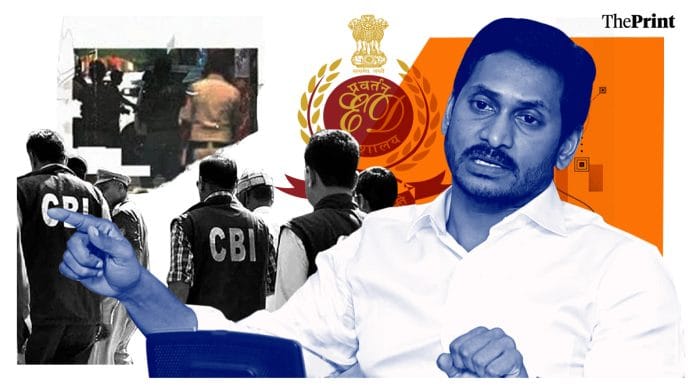
New Delhi: The Enforcement Directorate (ED) has informed the Telangana High Court that 141 discharge applications are pending in multiple cases involving former Andhra Pradesh chief minister Y.S. Jagan Mohan Reddy, and sought an expeditious trial.
In a writ petition filed on 23 September, the ED said 55 of the discharge applications, filed between 2020 and 2024, pertain to its nine prosecution complaints before the CBI special court in Hyderabad, while the remaining 86 relate to 11 chargesheets filed by the Central Bureau of Investigation (CBI).
The petition is listed for hearing on Tuesday.
The agency attributed the delay partly to frequent transfers of special judges, which it said had led to hearings restarting from scratch each time a new judge took charge. It added that arguments in its money-laundering cases could begin only after the hearings in the corresponding CBI cases concluded, further delaying the proceedings.
ThePrint reported in August 2024 that more than 10 years after Jagan’s arrest on charges of amassing disproportionate assets, the trials had yet to begin despite clear directions from the Supreme Court and the High Court.
The CBI arrested Reddy in May 2012 after registering a case against him and 73 others on the Andhra Pradesh High Court’s orders. The allegations centred on a quid pro quo arrangement in which individuals and companies were granted land, mining rights and licences in return for investments in firms linked to Reddy, while his father, Y.S. Rajasekhara Reddy (YSR), was Andhra Pradesh Chief Minister from 2004 to 2009.
The CBI has filed 11 chargesheets in the cases, alleging offences including cheating, criminal conspiracy and violations of the Prevention of Corruption Act. The ED has filed nine prosecution complaints alleging money laundering in connection with the same set of cases. A total of 29 criminal cases against Reddy remain pending.
The YSR Congress Party (YSRCP) chief has been out on bail since September 2013. The CBI filed its 11th chargesheet in September 2014.
Asked to comment on the ED’s writ petition, YSRCP MP and senior advocate S Niranjan Reddy told ThePrint: “The matter is subjudice so I cannot comment on the merits. However, the writ petition is misconceived and unimaginative.”
He added: “Misconceived as the special court is already hearing the matters on a day-to-day basis in view of the directions given by the Telangana High Court and the Supreme Court. Unimaginative, as no new relief is prayed for and the writ petition is filed against the special court when the Supreme Court says that no writ petitions can be filed against any court.”
‘Expeditious administration of justice’
In its petition, the ED said the accused, including Reddy, began filing discharge applications under CrPC Section 227 in 2020. The provision allows a sessions judge to discharge an accused before charges are framed if there is insufficient ground to proceed with the case. Hearings began in 2022, while the last discharge application was filed in 2024, the agency said.
The ED noted that Reddy and other accused, including former YSRCP Rajya Sabha MP V. Vijay Sai Reddy, had filed discharge applications in all the pending money-laundering cases. It said a similar pattern had emerged across all 11 CBI cases before the special court.
The agency clarified that it was not seeking to curtail the accused’s statutory right to seek discharge or asking the court to rule on the merits of any pending application. Its plea was limited to ensuring that the applications were heard and decided expeditiously, in accordance with the law, so that the prosecution was not held indefinitely at the pre-charge stage.
“The pendency of the discharge application has the effect of keeping the Prosecution Complaints filed under PMLA, 2002 at a preliminary stage and consequently postpones the subsequent stages of the criminal proceedings, including framing of charge, examination of prosecution witnesses and conclusion of trial,” the ED argued.
The agency also identified frequent transfers of special judges as a major obstacle to the disposal of the applications. It said one judge had completed hearings on all the discharge applications and listed the matter for consideration on five occasions but was transferred in April 2024 without passing an order.
The transfer, the ED argued, resulted in further delays as the incoming judge restarted hearings from the first CBI case. The ED’s applications could be taken up only after arguments in the CBI cases were concluded, as its money-laundering cases stemmed from the CBI’s investigations.
The agency said the next judge also had a short tenure and could not dispose of the pending applications before retiring. Following the appointment of another presiding officer, hearings restarted with the first CBI chargesheet, with the CBI cases being taken up before the corresponding ED matters.
The ED argued that this cycle of transfers and repeated hearings had prolonged the pre-charge stage, preventing the cases from progressing to the framing of charges and trial.
This report has been updated to incorporate remarks of YSRCP MP and senior advocate S Niranjan Reddy, who ThePrint reached out to for comment.
(Edited by Chingkheinganbi Mayengbam)
Also Read: $92 mn to $609 mn: Andhra FDI inflows surged after Jagan-era slowdown, TDP credits policy reset