


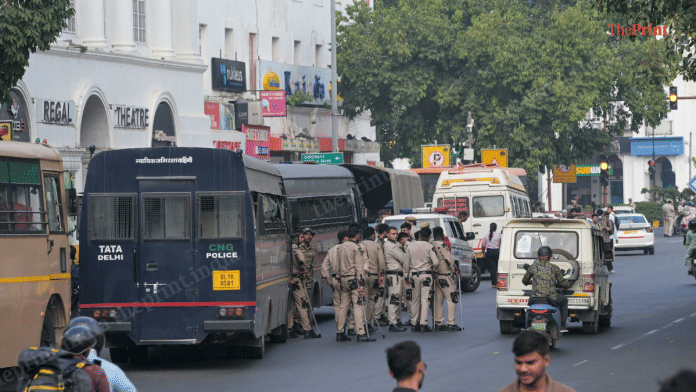
New Delhi: The decision to denotify Jantar Mantar as a designated protest site was taken in the larger public interest, after a Ministry of Home Affairs (MHA) committee found the area was unsuitable for holding public protests. In an affidavit before the Supreme Court, Delhi Police Commissioner Anurag Kumar submitted that the decision by him to denotify Jantar Mantar was taken on the recommendation of the MHA committee.
The affidavit argued that Jantar Mantar is not a site, but a public road meant for free movement and to designate it as a protest venue was contrary to the public interest.
Commissioner of Police Kumar denied the claim that the denotification happened pursuant to the 9 October order of the Supreme Court. The top court had directed police authorities, Indian Railways and the Delhi Metro Rail Corporation (DMRC) to not take extreme prohibitory measures in the wake of the Cockroach Janta Party’s call for a protest on 10 October to demand the resignation of Chief Election Commissioner Gyanesh Kumar.
The Delhi Police chief said the proposal to look for alternative protest sites was under consideration for a considerable period, and that the MHA committee and its report both pre-date the Supreme Court order.
The affidavit was filed in response to a petition, filed by advocate Swati Singh, challenging the denotification of Jantar Mantar. The petition, part of a batch of cases filed in connection with mass preventive detentions that followed the 10 October protest, was filed soon after the Delhi Police on 14 October announced its decision to denotify Jantar Mantar.
The affidavit lays out the sequence of events, besides giving reasons behind the decision.
According to it, the MHA constituted the committee on 26 August to examine whether Jantar Mantar should continue as a protest site, and to suggest alternatives. The MHA received its report in September and forwarded it to the Commissioner on 14 September.
Thereafter, on 9 October, the Supreme Court suggested that the authorities consider suitable alternative sites with basic amenities for public protests. However, it left the decision with the competent authority. On the same day, the affidavit said, the Commissioner of Police took a considered decision to denotify Jantar Mantar.
However, the process began much earlier, the affidavit asserted.
This step was taken despite a 2018 Supreme Court judgment, which had upheld Jantar Mantar as a designated protest site. The affidavit added that the ground realities had since changed and, hence, a review was necessary, along with “more comprehensive, practical and clearly enforceable” regulatory framework.
As for the 2018 judgment, the affidavit clarified that it recognised protest as a right to free speech and expression, but at the same time also held that there was no fundamental right to protest at a particular place.
In the era of social media, the Police Commissioner submitted, proximity to the seat of government has ceased to be relevant. He also brushed aside the criticism that denotification of Jantar Mantar undermined democracy.
Proximity to new Parliament
The committee constituted by the MHA had examined public safety concerns, traffic management, emergency response, protection of vital installations, convenience of residents, and heritage and commercial areas before unanimously concluding that Jantar Mantar road was unsuitable for protests, said the affidavit.
It added that the committee named Ramlila Maidan, CBD Ground and Burari Ground as sites that balance the right to peaceful protest with public order and safety. The Commissioner said he too took the relevant factors into consideration before denotifying Jantar Mantar and designating the three alternatives.
The affidavit provides reasons for the denotification. The area, the affidavit said, can hold about 1,500 people. However, CJP’s 20 July protest far exceeded this number, creating a serious law and order situation, the affidavit said, adding that every year more than 1,300 protests are held on the Jantar Mantar road, creating a constant fear of a stampede and possible friction between police and protesters.
Within roughly three to four kilometres, the affidavit said, there are 78 embassies and missions and 99 central government offices, including that of the Reserve Bank Of India (RBI). The area witnesses a daily footfall of about 1.46 lakh. Also, there are 64,500 residents in private and government housing, besides shops and the state-run Ram Manohar Lohia Hospital. Protests of large-scale obstruct emergency services to these residents as well as the hospital, it said.
The area’s proximity to the new Parliament building was also cited as one of the reasons for the de-notification of the area.
The affidavit also provided crime and misuse data to support the denotification order. It said that between 1 and 27 August 2026, the Jantar Mantar stretch recorded about 250 distress calls, 109 theft FIRs, 10 vehicle-theft FIRs, 23 FIRs for public-order violations, rioting and defacement. As many as 14 Delhi Police Act cases were also registered during this period, it added.
Affidavit on Mamata’s detention
In a separate affidavit, the Delhi Police defended its action to detain Mamata All India Trinamool Congress (MAITC) leaders, including former West Bengal chief minister Mamata Banerjee. It said the leaders had defied the prohibitory orders imposed on 10 October in New Delhi district.
Two senior Delhi Police officers had personally informed them about those orders and when they insisted on moving ahead, they were detained at 2 pm and taken to Dwarka North police station where they were made to sit in the office of the station house officer (SHO), the affidavit said. According to it, the leaders were asked to leave between 5:30 pm and 6 pm. During their detention period, the affidavit claimed, basic amenities such as tea and food were provided to them.
In a third affidavit, Delhi Police submitted multiple prohibitory orders that were issued under section 163 of BNSS, which bars assembly of more than five persons in notified areas. Records show that these orders were issued between 19 and 24 August for multiple places falling in the New Delhi area and remained in effect for a period of two months since the date of issue.
(Edited by Amrtansh Arora)
Also Read: I walked into Jantar Mantar a nervous student. I walked out a citizen