





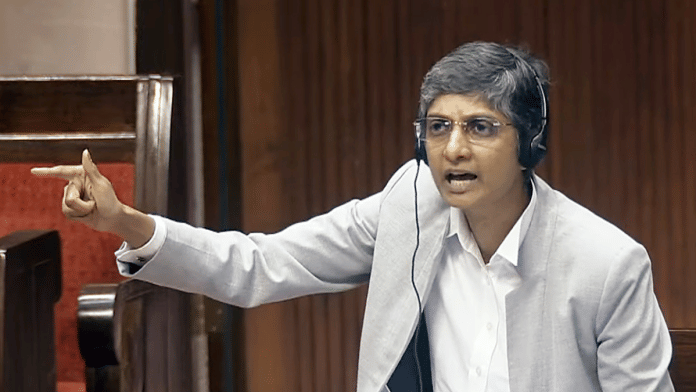


New Delhi: The judiciary’s problems won’t be solved by appointing more judges; the problems lie in the Centre’s failure to appoint women, Scheduled Castes, Scheduled Tribes, religious minorities or gay people to the judiciary, India’s first openly queer Member of Parliament (MP) and senior advocate Menaka Guruswamy said in her maiden speech in the Rajya Sabha Wednesday.
“This is not about bringing in four more judges. You solve issues when you work with the Constitution,” Guruswamy, who is the All India Trinamool Congress (TMC) MP from West Bengal said in the Upper House. The problem is with Central government not appointing women judges, Scheduled Castes or Tribes, religious minorities or gay persons to the judiciary, she added.
The remarks were made by Gurswamy during a discussion on the Supreme Court (Number of Judges) Amendment Bill, 2026, which seeks to increase the number of judges of the Supreme Court of India by four.
The Bill, which was passed by the Lok Sabha Monday, but awaits assent from the Rajya Sabha, seeks to increase the number of judges in the Supreme Court from 33 to 37, excluding the Chief Justice of India.
Significantly, this was the first time that Guruswamy, the country’s first openly queer MP spoke in the Parliament.
Pointing out that due to the time she had spent as a senior advocate in the Supreme Court, she was speaking with “some experience”, Guruswamy told the Rajya Sabha. “The problems of the judiciary are not going to be solved by the passing of an Ordinance and the increase of four more judges in the SC,” she said.
Guruswamy is a senior advocate of the Supreme Court and was among the lawyers representing petitioners in the landmark constitutional challenge that led to the decriminalisation of homosexuality in India through the reading down of Section 377 of the IPC in 2018.
Present state of judicial vacancies & the Bill
Underlining how over 30 percent of sanctioned judges’ posts across the country’s high courts still remain vacant, Guruswamy said that as of now, 14 percent of all HC judges are women.
On the other hand, women from the scheduled castes or scheduled tribes are just under 20 percent of the judiciary, she said.
In the past eight years, from 2018 to 2026, the Centre appointed only 3 percent SC judges and 2 percent ST judges, Guruswamy said. As for judges belonging to the Other Backward Classes this figure stood at 12 percent, she said.
“These are the issues in my hometown in the capital of India where the Constitution was made,” Guruswamy pointed out.
Guruswamy’s comments centred around the Supreme Court (Number of Judges) Amendment Bill, 2026, which was passed by the Lok Sabha Monday, without much debate as Opposition members chanted slogans over the NEET paper leak and alleged theft of Ram temple donations.
Prior to this in May this year, President Droupadi Murmu had promulgated an Ordinance to increase the number of Supreme Court Judges from 33 to 37, soon after the Union Cabinet had cleared the Bill. After the Ordinance, five judges were appointed to the SC based on the upgraded sanctioned strength. Both houses of Parliament have to pass the Bill before 6 months of the Ordinance being promulgated.
The Bill was listed in the agenda almost every day since its introduction on 20 July but could not come up for consideration and passage.
According to the Bill, the volume of litigation in the Supreme Court has consistently been on the rise due to a persistent gap between institution and final disposal of cases in the court.
As on 1 January, there were 92,101 cases pending in the top court, prompting the Bill. The Centre has said that an increased judicial strength is one of the most viable solutions for tackling pendency in the top court.
(Edited by Viny Mishra)
Also read: Behind every Supreme Court petition is a waiting game
How can a female be gay
Check your headline