





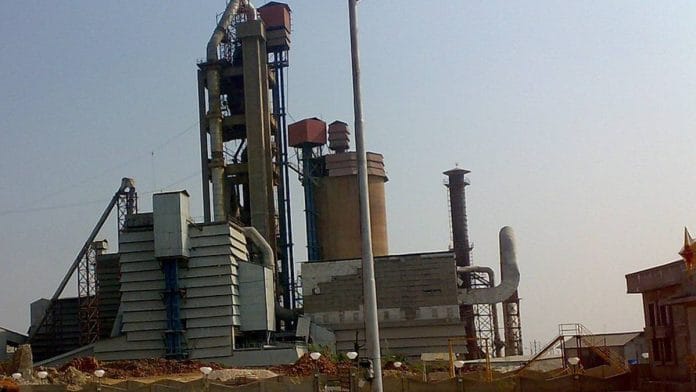



New Delhi: Environmental harm, once caused, is often irreversible, the Supreme Court has noted, granting relief to 93-year-old farmer Harbinder Singh Sekhon, alongside other agriculturalists, and to Vasant Valley Public School in their fight against setting up of an industrial cement unit on 47.82 acres, in close proximity to their agricultural lands and residential houses in Punjab’s Sangrur.
Flagging public health consequences, degradation of air quality and long-term ecological damage as possible repercussions, the court said that environmental regulation is designed to be preventive rather than reactive, and set aside the Punjab and Haryana High Court order that in 2024 upheld the change in use of land for setting up the cement unit.
A group of agriculturists residing in and around Sangrur had moved court two years ago, saying that a cement manufacturing company had purchased land measuring about 47.82 acres for setting up a “cement-related industrial unit” in close proximity to their homes and agricultural lands.
These farmers had also joined hands with Vasant Valley Public School, which claimed that its premises were located in the immediate vicinity of the proposed site, asserting that such proposed activity could adversely affect the health and safety of students and staff.
A two-judge bench of the Supreme Court Friday granted relief to these farmers while emphasising the need to strike a balance between development and environmental protection.
Justices Vikram Nath and Sandeep Mehta on the bench said that although economic development and industrial growth are legitimate and important objectives of the State, “in a constitutional framework founded on the rule of law, development is not an abstract or absolute goal. It is conditioned by the non-derogable obligation to protect life, health and environmental integrity”.
Development that undermines these foundational values ceases to be constitutionally permissible development, the court also noted, adding that when developmental activity poses a risk to human health or environmental safety, regulatory frameworks must err on the side of protection.
Underlining that there cannot be a “trade-off” when civilian life and health are exposed to foreseeable harm, the bench added that Articles 14 and 21 of the Constitution, which relate to the right to equality and life, do not tolerate “a regulatory calculus that treats environmental safety as negotiable”.
The court in strong remarks further said that if “regulatory dilution” of the kind challenged by farmers in the present case were to be accepted, it would mark a fundamental shift in environmental governance.
Looking back
The issue first arose in December 2021, when the Punjab Bureau of Investment Promotion issued a Change of Land Use (CLU) in favour of the cement company. CLU refers to formal, legal conversion of land from one designated purpose like agriculture to another, like industrial use, following government approval.
The company was soon after also granted a no-objection certificate following consideration of the Punjab Pollution Control Board. However, the farmers objected to this and said the NOC was granted in a manner which did not align with the Punjab Regional and Town Planning and Development Act, 1995.
The farmers argued that the area where the cement unit was being set up fell in the rural agricultural zone under the Master Plan for Sangrur, and that a “red category” polluting industry cannot be allowed there.
The farmers first moved the Punjab & Haryana High Court (Chandigarh bench), which in February 2024 rejected their plea and upheld the changed use of land, while granting relief to the cement company.
In doing so, the high court noted that the Punjab Regional and Town Planning and Development Board had granted approval to the changed land use in January 2022, which was seen as an amendment of the Master Plan by the court.
SC observations
Regarding the HC order, the Supreme Court noted that the high court had “proceeded on the premise” that the competent authorities had considered all relevant aspects and that the CLU itself contained conditions and restrictions, which if violated would give a chance to the affected parties to pursue appropriate remedies.
In their 63-page ruling, Justices Nath and Mehta said the question before the bench was whether the CLU could be granted for the cement factory when the Master Plan for Sangrur had labelled the site under the “rural agricultural zone” category.
They said the Master Plan was not just a policy document, or an internal administrative guideline, but rather a “statutory instrument which governs how land in the planning area is to be used and regulated”. Such plans also identify and allocate land into different zones for specific purposes. The law mandates that once prepared, the Master Plan must be brought into the public domain, so the public can offer its objections within the given time.
“This is not a procedural formality. It is a statutory safeguard intended to ensure transparency, participatory planning, and reasoned decision making, particularly because zoning and land use decisions have a direct bearing on property rights, local habitations, public amenities, and environmental and health concerns,” the apex court said.
The Punjab Regional and Town Planning and Development Act, 1995, also states that once published, the Master Plan comes into effect and binds the authorities and the public.
Interestingly, the top court pointed out that the Act does not allow land norms to be altered informally or on a case-to-case basis through the review mechanism.
Significantly, the court also cautioned that if allowed, this action of the Punjab government would not just remain confined to the present case, but instead operate as a precedent, allowing the progressive erosion of preventive safeguards across regions, with irreversible consequences. “The law does not permit environmental protection to be weakened incrementally until harm becomes inevitable,” the court said.
(Edited by Nida Fatima Siddiqui)
Also Read: Why Supreme Court quashed Bombay HC ruling on ‘private forests’ & flagged judicial indiscipline