





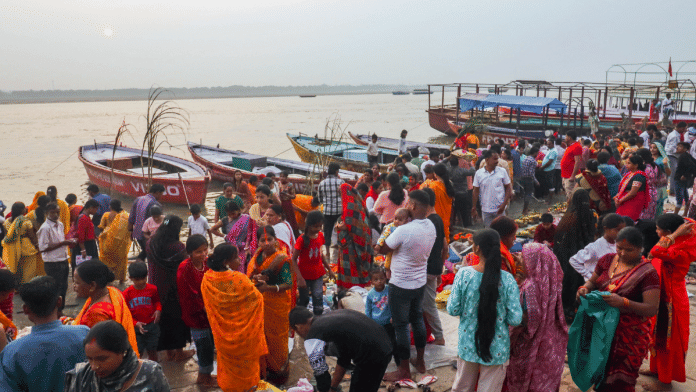

New Delhi: A bail order by the Allahabad High Court in the ‘Ganga Iftar’ case, which said throwing non-vegetarian food into the Ganga hurts religious sentiments, has drawn attention to how wide and elastic India’s judicial understanding of what amounts to “hurting religious sentiments” has become.
The high court on Friday granted bail to five of 14 Muslim weavers arrested for organising an Iftar party on a boat in the middle of the Ganga in Varanasi in March, allegedly eating non-vegetarian food and throwing leftovers into the river. On Monday, the court granted bail to another six accused. With three already granted bail, all 14 are out now, while the case remains pending.
While granting bail, Justice Rajiv Lochan Shukla’s Friday order also said that the alleged act “in the dispassionate opinion of the Court could rightly be said to hurt religious sentiments of the Hindu community.”
At the centre of these prosecutions lies Section 295A of the Indian Penal Code (IPC), now Section 299 of the Bharatiya Nyaya Sanhita, which criminalises “deliberate and malicious acts intended to outrage religious feelings”.
Legal experts say that judicial and police interpretation of the provision has expanded over the years to allow criminal proceedings on a range of cases involving art, comedy, films, food practices, and online speech.
The legal basis for the provision stems from the Ramji Lal Modi v. State of Uttar Pradesh (1957) ruling that upheld Section 295A as constitutionally valid, but stressed that the law applies only to “aggravated forms” of insult carried out with deliberate and malicious intent.
Also Read: Can WhatsApp message alleging religious targeting amount to promoting enmity? Allahabad HC weighs in
How courts have applied the law
The law has been applied differently over the years.
In 2017, the Supreme Court quashed a criminal case against cricketer M.S. Dhoni, who was accused of “hurting religious sentiments” when he was depicted as Lord Vishnu on a magazine cover.
Then, a three-judge bench clarified that insults to religion offered “unwittingly or carelessly or without any deliberate or malicious intention to outrage the religious feelings of that class” should not be seen as hurting religious sentiments and warned that this section cannot be invoked for “every act disliked by a section of society”.
However, in 2021, stand-up comedian Munawar Faruqui was jailed for 37 days based on police complaints that presumed and anticipated he was going to crack an offending joke, rather than a joke he actually performed publicly at a cafe in Indore.
This was after a politician’s son and a vigilante group stopped the show and filed a complaint alleging that they “overheard” Faruqui’s unperformed jokes during a rehearsal.
Similarly, multiple criminal complaints were filed against painter M.F. Husain over nude depictions of Hindu goddesses, alleging obscenity and saying that his paintings hurt religious sentiments.
The Delhi High Court in 2008 quashed the proceedings and emphasised that “there should be freedom for the thought we hate”. The artist went into self-exile before passing away in 2011.
In another 2025 ruling related to one of Husain’s paintings, the Delhi High Court emphasised that an offence related to outraging religious feelings must be found to have a direct impact on the complainant himself.
The law requires that the person alleging such an offence must themselves have experienced the injury or hurt caused by the material in question. A complaint cannot be filed in a representative capacity on behalf of an entire community or class.
The law has often been used in cases involving social media posts.
One FIR filed during Operation Sindoor time involved Kolkata resident Sharmistha Panoli, who, in a Twitter video, allegedly used “abusive and communally charged language that targeted Islam and the Prophet Muhammad”.
She also heavily criticised Bollywood celebrities and online personalities for their perceived soft stance on Pakistan.
The video was deleted after she issued an unconditional public apology, saying she had not intended to hurt anyone.
However, a formal complaint linked to promoting enmity between religious groups, deliberate acts intended to outrage religious feelings, and intentional insult to provoke a breach of peace led to an FIR and Panoli’s subsequent arrest.
Shortly after Panoli’s arrest, her accuser, Wazahat Khan, faced intense counter-backlash. Multiple complaints and FIRs were filed against him across different states (including West Bengal and Assam) for posting derogatory, inflammatory, and sexually explicit language targeting Hindu deities. Khan was on the run and was eventually arrested by the Kolkata Police on 9 June 2025.
In a separate case in October 2024, the Karnataka High Court ruled that shouting ‘Jai Shri Ram’ inside a mosque did not amount to outraging religious feelings.
Many Bollywood movies have also been embroiled in controversies over allegedly “hurting religious sentiments”.
Films including Padmaavat, PK, The Kashmir Files, Adipurush and Oh My God! have all faced allegations of offending religious sentiments, leading to protests, FIRs, demands for bans, and court proceedings.
Annapoorani, released in 2023, was removed from its streaming platform after Hindu groups objected to a scene and dialogue implying that Lord Ram, Sita, and Lakshman consumed non-vegetarian food during exile.
Even Deepika Padukone’s bikini colour in Pathaan’s song ‘Besharam Rang’ prompted complaints alleging hurt religious sentiments.
Journalist Rana Ayyub faced repeated police complaints and FIRs alleging that her tweets relating to the Indian Army and Hindu deities hurt religious sentiments.
Last month, acting on Supreme Court advocate Amita Sachdeva’s plea, the Delhi High Court said that Ayyub’s tweets were “highly derogatory” and ordered the Delhi Police to take them down.
In her detailed petition seeking the removal of “offending content”, Sachdeva, who described herself as “a devout follower of Sanatan Dharma” who was “directly aggrieved”, referred to six posts by Ayyub between 2013 and 2017.
Earlier, in 2012, the Rashtriya Goraksha Sena petitioned the Delhi High Court seeking a ban on “serving of beef or pork or anything which will hurt the religious sentiments of the people in general” at Jawaharlal Nehru University (JNU). The petition was prompted by a proposed beef and pork festival at the university..
The court directed the central university and Delhi Police to ensure that no beef and pork festival took place in the future.
What legal experts say
Nipun Saxena, an advocate practicing at the Supreme Court, said that Section 295A was introduced into the IPC in colonial India in 1927 amid concerns around inflammatory speech targeting religious communities and “His Majesty’s subjects.”
He said that one significant change in the BNS from the IPC in this provision is the inclusion of acts committed “through electronic means”, which was not mentioned under the IPC, though courts often interpreted the earlier law broadly enough to cover digital communication.
However, he emphasised that the heart of the provision still lies in proving “malicious intention”.
Advocate Urja Pandey, empanelled for the Central government in the Supreme Court, said that social media outrage has transformed the provision into “a tool of intimidation where viral campaigns, hashtags, and manufactured anger often dictate police action more than constitutional principles”.
An advocate from Allahabad, Areeb Uddin Ahmed, told ThePrint that an objective threshold for invoking these provisions must be based on the “deliberate and malicious intent” to outrage the religious feelings of a class of citizens, rather than the offence taken by an individual.
Saxena cited a July 2025 Rajasthan High Court judgement refusing to criminalise criticism of the Babri Masjid demolition judgment in a law university examination paper merely because a student claimed it offended his religious sentiments.
“The high court said what is missing here is malicious intention. Schools and universities are places of learning. Criticism is always invited and welcome,” he said, adding that criminalising critique would “turn the provision on its own head”.
To illustrate how intent is assessed even in acts, and not just in speech, he cited the 2024 Sheikh Tariq Mohammad v. State of Maharashtra case, where construction debris accidentally fell on graves adjoining a burial site.
He said the Bombay High Court refused to treat the incident as hurting religious sentiments or defiling a place of worship because there was no malicious intent involved.
At the same time, Saxena pointed to what he described as “structural problems” with the law itself. Although the maximum punishment under the provision is only three years, the offence remains cognisable and non-bailable.
He added that prolonged investigations and delayed trials often create a chilling effect on artistic and political expression.
Saxena also stressed that Section 295A is fundamentally a “class-based offence” rather than an individual grievance provision, as “what is outrageous for one section may not necessarily be outrageous for another.”
“Comedians and artists are meant to evoke satire and humour. They challenge the conscience of society,” he said. “When you challenge the conscience of society, you will inevitably say things that cause discomfort to some section of the public.”
Saxena said there has been a sporadic increase in case registrations recently, primarily due to changes in the digital landscape and social media use. However, invoking these provisions is also having a chilling effect on performers, artists, satirists, painters and comedians.
Today, FIRs are frequently filed not because the law’s strict ingredients are satisfied, Pandey said, but because authorities fear online backlash and street pressure, which is “dangerous for a constitutional democracy”.
She said that if mere emotional offence becomes the standard, free speech will survive only at the mercy of the loudest mob. So, constitutional morality must prevail over digital majoritarianism; otherwise “liberty itself becomes conditional upon public anger”.
She emphasised that this legal provision was enacted to punish deliberate and malicious attempts to provoke communal hatred, not to become a legal shield for every offended sentiment.
Ahmed said that arresting someone before a judicial assessment of malicious intent violates the presumption of innocence and Article 21 of the Constitution.
“There must be a preliminary judicial inquiry before arrest for speech offences,” he added. “Selective enforcement violates constitutional guarantees.”
“Constitutional courts must act as guardians of liberty, not as instruments for validating collective outrage masquerading as legal injury,” Pandey told ThePrint.
“Courts should apply a reasonable follower test: what would a reasonable, level-headed member of that religion, not an overly sensitive person, find offensive? Context matters: a comedy club differs from a religious sermon. Criticism, academic discussion, or historical analysis of religion cannot be equated with malicious insult,” Ahmed said.
(Edited by Sugita Katyal)
Also Read: Telangana HC directs state to come up with policy regulating sale of meat around places of worship