





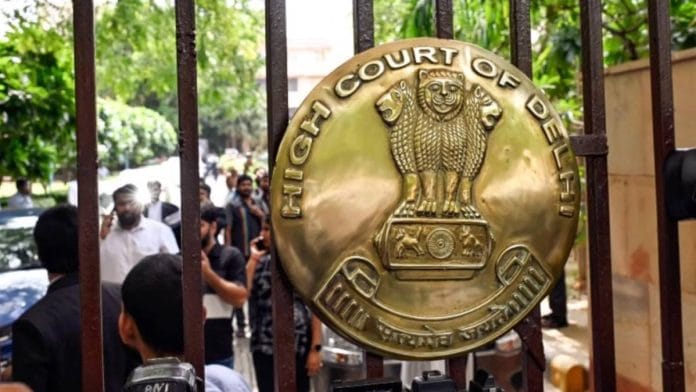


New Delhi: Failure by the Directorate of Revenue Intelligence (DRI) to comply with mandatory procedural safeguards while seizing one kg of heroin more than a decade ago under the Narcotic Drugs and Psychotropic Substances Act, 1985 (NDPS Act) on the Singhu border between Delhi and Haryana has led the Delhi High Court to set free a convicted man. The DRI’s non-compliance was with regard to the sampling and certification of the seized narcotic.
In a very strongly worded judgement, Justice Chandrasekharan Sudha slammed the “extreme carelessness” and “lackadaisical approach” of law enforcement officials, noting that while there was a recovery of one kg of heroin—a “dangerous drug” capable of destroying generations—the prosecution’s case was riddled with fatal procedural infirmities, leading to the acquittal of Sunil Sharma.
The most significant breach involved Section 52A of the NDPS Act, which mandates that the drawing of samples from seized contraband must be conducted in the presence of a magistrate.
In this case, DRI officials drew two samples of five grams each at their own office rather than before a magistrate. Furthermore, the mandatory application to the magistrate for the certification of these goods was moved on 16 October, 2012—a full five months after the seizure on 18 May, 2012. Justice Chandrasekharan Sudha noted that the prosecution provided “no explanation” for this inordinate delay.
The judgement said, “… it appears that the officials of the DRI have not assigned the importance that this case so greatly deserved. It also appears that it was only because of such lackadaisical approach and extreme carelessness on the part of the officers concerned that the benefit has gone to the appellant/accused… strict compliance of the formalities is necessary because of the stringent punishment that is provided under the NDPS Act. Whether the mistake was intentional or unintentional, the result is disastrous.”
The court further identified a “major anomaly” regarding the weight of the drugs. While officials testified that they had drawn 10 grams for sampling, the subsequent inventory prepared by the DRI and malkhana records continued to list the total weight as a full 1 kg. The court observed that “the packet containing the residue could never have contained 1 kg heroin… as 10 grams had already been taken as samples”.
Also Read: High time India, the land of bhang, legalises marijuana
The conviction
The Special Judge (NDPS), Saket had originally convicted Sunil Sharma in February 2016 based on the recovery of a commercial quantity—1 kg—of heroin found under the bonnet of a Honda Civic at Singhu border area.
The DRI examined 15 witnesses, including the Intelligence Officer and a witness who testified to the interception and search. Also, in the initial conviction, a crucial factor was a statement—under Section 67 of the NDPS Act—made by Sharma himself, admitting to carrying drugs.
It is important to note that once possession is established under the strict provisions of the NDPS Act, the law presumes that the accused has a culpable mental state unless proven otherwise.
Thus, in March 2016, Sharma was sentenced to 10 years of rigorous imprisonment and a fine of 1 lakh for possession of a commercial quantity of heroine by the trial court.
Scathing rebuke
Upon appeal, the high court dismantled the trial court’s reliance on the confession, noting that following the Supreme Court’s landmark ruling in Tofan Singh vs State of Tamil Nadu (2020), such statements to DRI officers are “inadmissible in evidence and hence, cannot be relied on”. Sharma testified that during his custody, he was “beaten and threatened” by DRI officials and claimed that he was forced to write a statement that was dictated to him by the officers.
Because the statement was legally inadmissible and its voluntary nature was compromised, the high court concluded it could not be relied upon as proof of guilt.
The judgement emphasised that the burden on the prosecution is “more onerous” and requires a “heightened scrutiny test” because the NDPS Act carries such stringent punishments. Justice Sudha remarked that “suspicion, however strong, cannot take the place of proof. Strict compliance of the formalities is necessary because of the stringent punishment that is provided under the NDPS Act”.
The court expressed deep frustration that such a high-stakes case, involving a quantity of heroin valued at over Rs 3,00,000 in 2012, was compromised by avoidable errors. The order stated, “Whether the mistake was intentional or unintentional, the result is disastrous… the culprit goes scot-free only because of the defects/anomalies committed by the officials.”
Concluding that the evidence was “unsatisfactory”, the court granted Sunil Sharma the benefit of the doubt and ordered his immediate release.
(Edited by Nardeep Singh Dahiya)
Also Read: Aryan Khan isn’t a show to enjoy. NDPS is a weapon vengeful state could use on you or your kids