



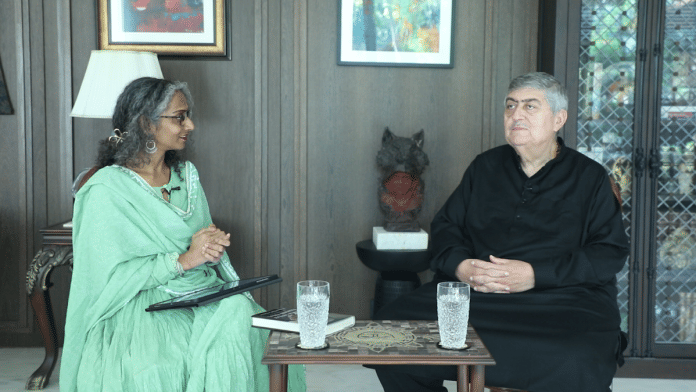
New Delhi: “India is not ready for it (abhi desh tayyar nahin hai).” This is what the Centre told the Supreme Court collegium when some members recommended appointing Saurabh Kirpal as a high court judge.
Speaking to ThePrint on his memoir ‘Without Fear or Favour’, which will be launched on 25 November, former Supreme Court judge Justice Sanjay Kishan Kaul said the collegium under former Chief Justice of India (CJI) D. Y. Chandrachud had reiterated Kirpal’s candidature for judgeship, rejecting the government’s objection to his elevation. Officially, the government had told the collegium that it had reservations over Kirpal’s partner who is a foreigner.
When, despite reiteration, Kirpal’s name remained pending, Justice Kaul said, both he and former CJI Chandrachud, asked the government what the issue was.
“I, Dhananjay (former CJI Chandrachud), everybody did take it up and we were told ‘desh abhi tayyar nahin hai’ for an openly gay judge,” the former judge said, adding: “…this came out in the discourse because he (Kirpal) did not have any other negatives.”
Justice Kaul further said though Kirpal’s name was not the only reiterated name that was blocked during his tenure in the collegium, it was only in Kirpal’s case that the government gave no intrinsic caveat.
“Somehow we were not on the same page on his appointment. The fact that his partner is Swiss was known as also that he had been living in India… neither of them hid their relationship. I would say, if he would not have been gay I believe he would have been appointed,” he said, indicating that the government believed Indian society had not reached a stage where it could accept a gay judge.
Non-appointment of Kirpal as a judge, opacity of the collegium system, a tweaked NJAC system for judicial appointments—Justice Kaul writes about all this and more in his memoir.
The memoir captures Justice Kaul’s journey from the Bar to the Bench. The judge has shared his thoughts about multiple events that transpired during his judgeship in three high courts and the Supreme Court as well as the judgements he authored.
Justice Kaul also said he was surprised there was no unanimous judgement by the constitution bench on petitions related to same-sex marriage. He believes if the five judges would have interacted more with the chief justice rather than the chief justice deciding to pen down the judgment on this issue, perhaps a path would have been found.
CJI Chandrachud and Justice Kaul had delivered a minority view in the case, with the other three—justices Ravindra Bhat, Hima Kohli and P. S. Narasimha rejecting the petitions that sought legal validity for same-sex marriages.
Justice Kaul said other judges, including him, did not know that CJI Chandrachud was writing the verdict. “Justice Bhat asked me, he said he was going ahead with the judgment. I did not know whether it’s realistic or not but maybe a path could have been found. Ultimately, we were not giving it a status of marriage, but a status of a union. I was surprised because Justice Bhat is a liberal judge, so is (Justice) Hima. But on this issue, we differed,” he said.
On the collegium system, Justice Kaul said though the mechanism worked well when it was introduced through a judicial order, over a period of time it has become a CJI-centric body.
In his memoir, he talks about how his elevation to the Supreme Court was not pushed by the then CJI even though he was in the zone of consideration.
When asked whether he became a victim of what he describes as a flawed collegium system and appointment politics, Justice Kaul said appointment to SC is a matter of chance and he “can’t say whether it was delayed or not”.
“The proposal has to emanate from CJI and if he is not inclined for good, bad or different reasons to promote you, the others cannot really push you and that seems to have happened to me also. At some stage I think many collegium judges thought I was worth elevating,” he said.
On why he did not accept former CJI H. L. Dattu’s advice to speak with collegium members, Justice Kaul said he felt that would “belittle” him. “To keep requesting for this (elevation to SC) is not in my line of thinking.”
When asked whether he regrets not becoming the CJI since his delayed elevation hampered his chances to be at the top post, Justice Kaul, in a candid admission, said: “Everybody who comes into the system cannot say that he would not like to occupy the highest position. Dhan (CJI Chandrachud) was appointed as a judge before me. I was appointed as the chief justice before him, so in some way I was one of the persons maybe in the running.”
However, he said, there can only be one CJI like in the army where one person can be the head, or the government where there can be only one cabinet secretary. “That’s a matter of choice and nobody doubts the ability of Dhananjay to handle things,” the former judge said.
On his work experience with CJI Chandrachud, whom he has known since his college days —both went to St Stephens, Delhi University, before studying law at the Centre Law Campus (CLC)—Justice Kaul said that he agreed with the former CJI on judicial matters. He, however, had differences on the administrative side, particularly when it came to appointments.
Justice Kaul said he did not approve of the methodology followed in approving names and clarified that he never opposed or had problems with the candidates that were cleared.
According to him, the CJI should first discuss the proposed names with the collegium members and then the government and not the other way round. But, he said, pre-approval consultation with the government became a pattern after the NJAC verdict and CJI Chandrachud continued.
He said it would not be correct to say the government, irrespective of the party in power, does not have a say in judicial appointments and pointed out how names for high courts get blocked. Justice Kaul, however, believes it is important for the judiciary to have a dialogue with the government on appointments and recalls how he, when asked by CJI Chandrachud, talked to the government on ending the stalemate over a judge’s appointment as a Chief Justice.
After his personal experience of the collegium system, he is of the strong view that NJAC should have got a chance, if not in the original form then in a tweaked format. According to him, the collegium members could have been a part of the commission and across-the-table deliberations could have happened with the government. As of now, it is only the CJI who talks to the government, leaving the other collegium members in the dark, he said.
His disagreement with CJI Chandrachud was over the methodology he followed and when Justice Kaul confronted him, he was told that this was the practice.
The former judge also feels the roster system requires an overhaul. The manner in which two cases were withdrawn from his bench suddenly, without any explanation, left Justice Kaul unhappy. However, since judicial orders have fortified the CJI as master of the roster, it is not possible, he said, to alter the system now.
(Edited by Viny Mishra)
Also read: How UU Lalit changed the Supreme Court forever in just 2 months as CJI