


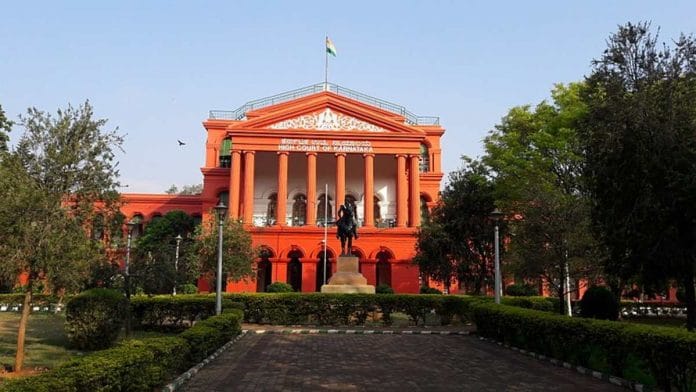
New Delhi: In a ruling which defines the Directorate of Enforcement (ED)’s powers and territorial limits, the Karnataka High Court held that the federal agency possesses strictly “derivative and not original” powers—meaning it cannot initiate criminal investigations or act as an independent law enforcement body.
The ED, the court ruled, cannot file a criminal complaint before a magistrate, seeking a direction to the local police to register an FIR, in case the latter refuses to do so.
Delineating ED’s limits under the Prevention of Money Laundering Act (PMLA), 2002, the high court asserted that “the ED is not a super cop to investigate anything and everything which comes to its notice”.
The court was hearing five writ petitions filed by Y. B. Ashwathanarayan, K. Y. Nanje Gowda (former chairman of the Malur Land Grant Committee and chairman of KOMUL), K. N. Gopala Murthy (managing director of KOMUL), Nagesh N and Dr Raju Krishna C. seeking quashing of all the seizures and summons issued to them. They argued that the ED cannot continue money laundering proceedings or file independent criminal complaints without an active predicate (scheduled) offence.
Justice M. I. Arun wrote in his 30-page judgment delivered last week that under India’s constitutional framework, “maintaining law and order is the responsibility of the state and not the Centre”, and any attempt by the ED to bypass local law enforcement agencies violates statutory restraints and destroys essential constitutional checks and balances.
The legal battle originated from a local political controversy involving K. Y. Nanje Gowda, former chairman of the Malur Land Grant Committee in Kolar District. Allegations surfaced that Gowda, abusing his official position, “illegally” recommended the allotment of approximately 80 acres of land to 38 individuals, leading to a criminal case in 2022, alleging offences under the Indian Penal Code (IPC).
Treating this “land scam” as a predicate offence, the ED initiated a money laundering investigation and registered an ECIR in November 2023.
During subsequent search operations, the ED allegedly uncovered documents suggesting irregularities in recruitment processes at the Kolar and Chikkaballapur Milk Union Ltd. (KOMUL), forming a secondary narrative termed the “job scam”.
ED’s attempted legal workaround
The foundation of the ED’s case cracked when the original predicate case regarding the land grant collapsed before the jurisdictional trial court. Following a police closure report, the trial court dismissed the primary criminal complaint because mandatory state government sanction to prosecute the public servant was never granted.
Seeking to sustain its proceedings, the ED shared its findings regarding the milk union recruitment “scam” with local authorities under Section 66(2) of the PMLA. Section 66(2) mandates that if the ED director forms an opinion—based on information or material in their possession—that the provisions of any other active law have been contravened, they must share that information with the concerned agency for necessary action.
However, when the Lokayukta Police and local law enforcement chose not to file criminal charges, the ED took the unprecedented step of filing a private criminal complaint in 2024 directly before the Special Court under Section 200 of the CrPC, attempting to manufacture an independent scheduled offence. Section 200 of the CrPC deals with the examination of a complainant by a magistrate when taking cognisance of an offence on a private complaint.
Addressing the ED’s claim that it can file private criminal complaints under general criminal law, the high court warned that such power would destroy statutory checks and balances: “The ED is not a super cop to investigate anything and everything which comes into its notice… Section 48 of the PMLA envisages the authorities under the Act”.
“Once appointed under the PMLA, they are bound by the restraints imposed on them by the PMLA… Maintaining law and order is the responsibility of the state and not the Centre. It is the duty of the concerned agency to examine the same and to take a decision whether to prosecute the matter further or not,” the court said.
The court also noted that allowing the ED to file private complaints whenever state police choose not to prosecute would presume that state authorities are guilty of dereliction of duty while placing the ED on an unauthorised “higher pedestal”.
Mandatory requirement of a predicate crime
Analysing the statutory scheme, the high court ruled that PMLA proceedings cannot exist in a vacuum. Citing landmark Supreme Court rulings in Vijay Madanlal Choudhary v. Union of India and V. Senthil Balaji v. Deputy Director of the Directorate of Enforcement, the court reiterated that “the existence of a scheduled offence is sine qua non for alleging the existence of proceeds of crime”.
“The role of ED under PMLA commences only after a primary law enforcement agency registers an FIR or a formal criminal complaint regarding a scheduled/predicate offence. The power of the ED is derivative and not original. It cannot initiate an investigation suo motu based on a standalone suspicion of money laundering,” Justice Arun observed.
Justice Arun explained that when a predicate case is terminated—whether on merits or technical grounds such as want of prosecution sanction—the allegation of “proceeds of crime” legally vanishes.
Consequently, PMLA investigations cannot be sustained once the foundational crime is extinguished. Furthermore, the court rejected the ED’s claim that it could file private criminal complaints when state police refuse to act, clarifying that Section 66(2) obligates the ED to share information with state authorities but confers no power to usurp their prosecutorial discretion.
Allowing all five writ petitions, the high court quashed the 2023 ECIR, the adjudicating authority’s seizure order dated 6 June 2024, all issued summons and show-cause notices, as well as the private complaint of 2024. The court also directed the ED to immediately return all seized property and articles to the petitioners.
(Edited by Viny Mishra)