



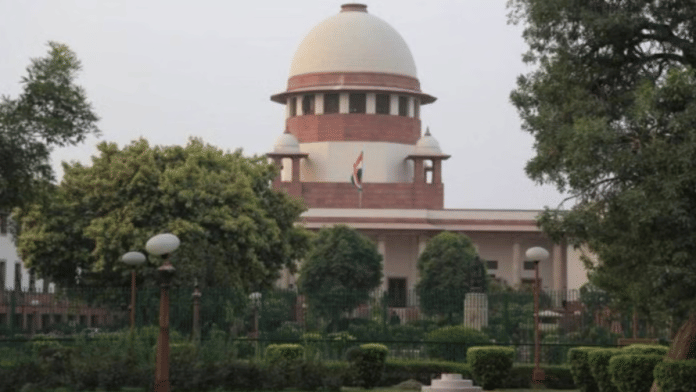

New Delhi: Tamil Nadu’s ruling Dravida Munnetra Kazhagam (DMK) has approached the Supreme Court, challenging the constitutional validity of the Special Intensive Revision (SIR) of the electoral rolls in 12 states, as announced by the Election Commission of India (ECI) last week.
The move came a day after a multi-party meeting, attended by 44 political parties, chaired by Tamil Nadu Chief Minister M.K. Stalin Sunday.
After completing the SIR in poll-bound Bihar, the ECI had announced last week its next phase of the exercise in 12 states and Union Territories. This includes West Bengal, Kerala, Tamil Nadu and Puducherry—which have assembly polls due next year.
Challenging the exercise, DMK’s petition asserts, “The SIR and the Orders, if not set aside, can arbitrarily and without due process, disenfranchise lakhs of voters from electing their representatives, thereby disrupting free and fair elections and democracy in the country, which are part of the basic structure of the Constitution.”
The petition, seen by ThePrint, was filed Monday by DMK’s Organisation Secretary and senior leader R.S. Bharathi, and asserts that the role of the ECI is to prepare and revise electoral rolls for the conduct of elections.
“By imposing citizenship-like burdens of proof, the SIR appears to be acting beyond its statutory purpose, effectively functioning as a de facto National Register of Citizens (NRC),” the petition alleges, adding, “The orders even allow Electoral Registration Officers (“EROs”) to refer cases of ‘suspected foreign nationals’ to the competent authority under the Citizenship Act, 1955, without due process. Whether a person is a foreigner i.e., non-citizen is a question of fact and has to be determined by the Union government under the Citizenship Act, 1955.”
It points out that a special summary revision had already been conducted in Tamil Nadu between October 2024 and January 2025, addressing issues such as migration, death and deletion of ineligible voters.
Raising questions similar to the ones raised by the petitioners challenging the SIR exercise in Bihar, DMK’s petition asserts that the SIR’s “rigid and arbitrary document requirement fails to accommodate the realities of disadvantaged communities who face chronic under-documentation.”
The petition, therefore, demands a direction quashing the notification issued by the ECI on 27 October, alleging that it violates Articles 14 (equality before law), 19 (freedom of speech and expression, among others), 21 (right to life and personal liberty), 325 (no person to be ineligible for inclusion in, or to claim to be included in a special, electoral roll on grounds of religion, race, caste or sex) and 326 (adult suffrage) of the Constitution of India, and various provisions of the Representation of People Act 1950 and Registration of Electors Rules 1960.
It also demands a direction to call for records pertaining to the order passed by the ECI on 27 October directing the SIR exercise in Tamil Nadu.
(Edited by Shashank Kishan)
Also Read: Bihar beyond Buddha and Mandal—why the 2025 polls are critical for Indian democracy