



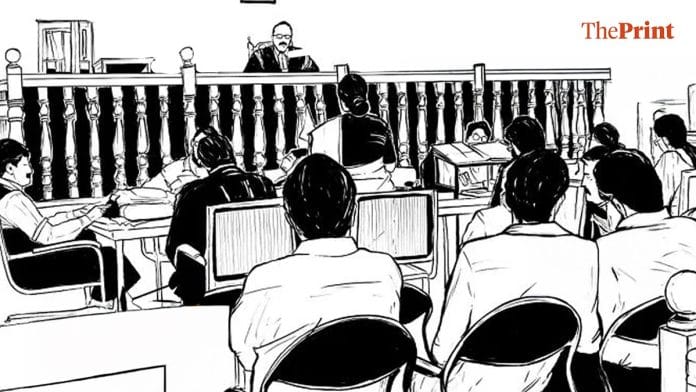
New Delhi: For lawyers empanelled by the Delhi government, the fight does not end with a favourable ruling. They then have to run from pillar to post to get their dues cleared. The Delhi High Court has now issued seven binding directives after hearing from advocates who pointed to their bills being unpaid for years, and an online system they said fails to address the status of their claims.
“At the end of the day, you need money,” said Advocate Anjana Gosain, one of the lawyers who had approached the High Court seeking relief.
Acting on a clutch of writ petitions by Gosain, among others, the High Court has taken strong exception to persistent administrative delays and procedural hurdles in clearing the outstanding legal fees of advocates representing the Government of NCT of Delhi (GNCTD), particularly within its Revenue department.
Petitioners ThePrint spoke to said bills had remained pending for years, with some getting stuck even before they reached the concerned department for processing. They also said repeated queries and uncertainty over the final amount payable had made the process difficult to navigate, landing them in financial troubles.
Empanelled government counsels submit their fee bills digitally through the GNCTD’s designated online single window system. While the portal was established to digitise disbursements, lawyers appearing before the High Court highlighted that the Revenue department has turned the process into an ordeal of indefinite delays.
On 9 September, Justice Mini Pushkarna issued seven binding directions aimed at streamlining administrative workflows and restoring transparency in the fee clearance process. In response, the counsel appearing for GNCTD, Tushar Sannu, presented two status reports and noted that high-level meetings chaired by the Secretary-cum-Divisional Commissioner (Revenue) were underway.
Deputy Commissioner (HQ) Ajay Kumar also assured the court, appearing via video conferencing, that steps were being taken to rectify bill deficiencies. Kumar has been made personally responsible for coordinating with the Revenue department officials to ensure BTFs are issued based on order sheets.
The single-window portal came in after a Delhi High Court order in 2021, noting, “Under no circumstances should a counsel who has been engaged by the government/department be forced to sue his/her own client, especially a government or its agency, and seek legal remedies for seeking clearance of his/her professional fee.”
Also Read: Supreme Court proposes stipend for young lawyers, better court infra for women advocates
‘Online system doesn’t work’
One of the petitioners, Advocate Rishikesh Kumar has now informed the High Court that, of the 500 bills he submitted, queries were raised on approximately 250. He pointed out that as soon as one query is answered, department officials raise another, preventing the bill from actually being cleared.
Furthermore, advocate Udit Malik, who has now resigned from the panel, highlighted a structural flaw involving Brief Transmission Forms (BTFs) before the court. Under the portal’s design, the online single-window system automatically rejects bill submissions unless a BTF is attached. Because the department frequently fails to issue BTFs—even in matters where lawyers have actively represented GNCTD in court—advocates are unable to submit bills for completed work.
Compounding the issue is the portal’s failure to reflect real-time status changes. Advocate Divyam Nandrajog told the High Court that while a fraction of bills are occasionally passed, the vast majority remain stalled.
Crucially, the system fails to update bill statuses, leaving lawyers unaware of which invoices have been cleared and which remain pending.
Advocate Anjana Gosain said that the online system had not resolved the payment delays and, in some cases, had created another layer of procedural difficulty.
“It’s just not moving. It’s staggered. Earlier, we used to physically submit bills, and they would eventually get cleared, sometimes in two or three years. Now they say there is an online system, but the online system itself doesn’t work. You are asked to register, but then you cannot upload the bills. If you have made it online, then the system should work,” said Gosain.
Gosain said she herself approached the High Court over non-payment of government fees and that the problem could require lawyers to spend considerable time simply pursuing their dues.
“I am the litigating type, so I have already had to file two petitions. Because of my petition, other lawyers are also joining in and asking for the payment to be cleared. But what happens is that you keep adding lawyers while the budget remains the same. They say the allocation has increased, but where is the payment?” she said.
She said the delays could be particularly difficult for lawyers who depend on government briefs for professional income. “Sometimes I say I am a senior citizen; sometimes I have to say I will write it in my will. It is a very bad situation. If the system is online, it should be fixed. Instead, half of my staff is only doing the work of chasing payments,” she said.
“They ask for a double copy, a copy of the order, whether you appeared or not, whether it is as per the terms. There is a laid-out format, and it is pretty cumbersome. Sometimes you have to write things and then duplicate them,” she added.
Gosain said the delays could continue even after a bill had been submitted because of questions over whether it had actually been received. “The bill is not received. If you send it by post, they can say, ‘We did not receive the bill’.” She said she received part of a payment this year after waiting around two-and-a-half years, while another dispute involving the GNCTD required litigation after a much longer delay.
Gosain also pointed to a larger problem for lawyers who take up government work: they may have to choose between continuing to take briefs and spending time pursuing unpaid fees.
“Some people accept these appointments because they think it is a good opportunity or gives them exposure. But at the end of the day, you need money,” she said, noting that the administrative burden of pursuing payments could itself become a drain on law offices.
‘Bill stuck at very first stage’
Another petitioner, who resigned from the Delhi government’s panel after the ruling party changed in 2025, told ThePrint on condition of anonymity that his payments had been pending for more than two years. He said he submitted the bills and ultimately had to file an application to have them processed.
The problem, he said, was simply that the bills were not moving through the system.
Explaining the process, the petitioner said that bills first enter a central diary, are then marked to the concerned department, and finally to the jurisdictional office for which the advocate had worked.
“There is a central diary. From there, the bill is marked to the concerned department—it could be Revenue, Health, Irrigation or any other department—and then further to the jurisdictional office for which you had worked. The problem was that the bill was getting stuck at the very first stage, at the central diary. It was not being passed on to the department,” he said.
Adding, “Money is money. If you don’t get it, you don’t get it. It’s tough. Nobody is doing this as charity. The government notification itself specifies the fee structure and the entitlement for the work. That is the amount you are assured you will be paid against the invoices you raise.”
The delay, the petitioner said, also affects the wider functioning of a lawyer’s office. “I have to ensure that my clerks and juniors get their salaries on the first of every month because I know they have their own payment obligations. It is a systemic cycle. When your own payments are delayed, it becomes difficult to manage that cycle.”
The High Court has now directed Delhi government to update the online portal to explicitly display all pending bills against each counsel’s name. Administrative action is to be taken to issue missing Brief Transmission Forms (BTFs) wherever court order sheets confirm the advocate’s appearance for the Delhi government.
The High Court also ordered the formulation of a mechanism allowing counsels to upload bills even where BTFs have not yet been issued. It also requested the government to consider appointing a Nodal Officer from the Department of Law and Justice to coordinate the resolution of queries directly with counsels.
Officials are now barred from seeking physical copies of BTFs if BTF numbers are already cited in the bill, and the High Court order notes that all pending bills be cleared expeditiously and directs the Delhi government to file a compliance status report before the next hearing on 4 November.
(Edited by Sugita Katyal)
Also Read: Luxury cars, big deals & 6-figure fees, evolution of the boardroom lawyer in India