





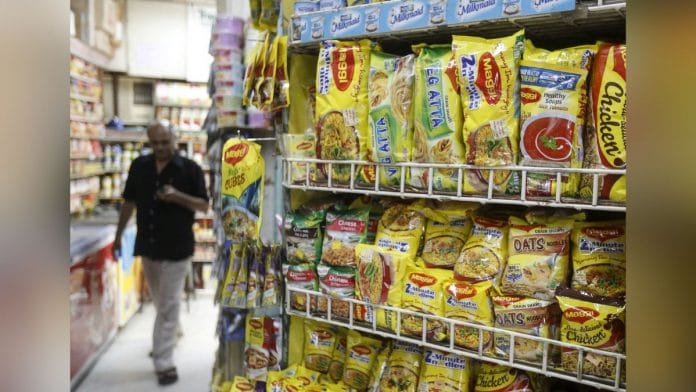


New Delhi: The decade-old controversy around Maggi noodles being allegedly unsafe due to its high lead content—which emptied supermarket shelves and sparked panic in households across India—has finally reached its legal conclusion in Delhi High Court.
Marking a significant victory for Nestlé India and its distribution partners, the Delhi High Court Wednesday quashed criminal proceedings initiated against them. Justice Madhu Jain ruled that continuing the prosecution would constitute an “abuse of the process of Court”, citing that the scientific basis for the original complaints has been fundamentally undermined by subsequent testing and judicial findings.
The Maggi case dates back to 25 May 2015, during a highly publicised nationwide sampling exercise. In Delhi, food safety officers collected samples of Maggi noodles from various retail outlets, including M/s Gupta Store in Gole Market and an establishment owned by Virender Narula.
The prosecution was launched after a food analyst’s report dated 2 June 2015, claimed the Maggi samples were “unsafe”. Specifically, the analyst alleged that the lead content in the ‘masala tastemaker’ exceeded the maximum limit of 2.5 ppm and that the product was “misbranded” due to the label declaration ‘No Added MSG’.
Following these reports, the Department of Food Safety obtained consent to prosecute the manufacturer, distributors, and retailers under the Food Safety and Standards (FSS) Act, 2006.
The petitioners—including Dharmendra Hansraj Kotak and others associated with the distribution chain—approached the high court seeking to quash the summoning orders issued in late 2015 and early 2016. Their primary contention was that the Delhi Government’s food laboratory, which provided the basis for the prosecution, lacked the necessary legal sanctity at the time of testing.
They also argued that the laboratory was neither accredited by the National Accreditation Board for Testing and Calibration Laboratories (NABL) nor notified by the food authority under Section 43 of the FSS Act when the samples were analysed.
They further highlighted the landmark 2015 Bombay High Court judgment, which had already set aside the ban on Maggi noodles, noting that the laboratories used for those tests did not satisfy statutory requirements.
A pivotal turning point in the ‘lead’ case was the intervention of the Supreme Court of India, which had directed fresh analysis of Maggi samples by the Central Food Technological Research Institute (CFTRI) in Mysore. The CFTRI, a recognised referral food laboratory, found that the lead content was within permissible limits, effectively clearing the product of the safety concerns raised by state-level analysts.
The Delhi High Court noted that the Supreme Court had accepted these referral reports as conclusive. Under Section 46(4) of the FSS Act, a referral food laboratory report supersedes the initial findings of a food analyst.
Consequently, the petitioners argued that the reports forming the foundation of the Delhi prosecution had “lost all evidentiary value”.
The state’s defence
The Delhi Government argued that the criminal complaints were independent proceedings that should be allowed to go to trial. The state contended that the petitioners had missed their “statutory opportunity” to seek a referral analysis at the relevant stage in 2015 and therefore could not challenge the reports now.
Furthermore, the govt maintained that existing laboratories were permitted to function during a “transitional period” under Section 98 of the FSS Act, even before obtaining formal NABL accreditation.
Court’s verdict
Justice Madhu Jain rejected the state’s arguments, emphasising that the high court cannot remain “oblivious” to developments in constitutional courts. The judgment noted that the Delhi complaints arose from the exact same nationwide sampling exercise that was scrutinised and ultimately dismissed by higher courts and the National Consumer Disputes Redressal Commission (NCDRC).
The court stated: “Once the original analytical reports became the subject matter of judicial scrutiny and fresh testing was directed through a referral food laboratory recognised under the statute, the evidentiary value of the earlier reports necessarily stood diluted.”
In its concluding remarks, the Court observed that forcing the petitioners to undergo a protracted criminal trial would serve no useful purpose when the “very scientific foundation” of the prosecution had eroded.
By allowing the petitions, the Delhi High Court officially quashed the complaints, the 2015/2016 summoning orders, and all consequential proceedings, bringing a definitive end to this chapter of the Maggi food safety saga in the national capital.
(Edited by Viny Mishra)
Also read: Why NCDRC ruled in favour of Maggi Noodles — ‘undue harassment, testing at manufacturing stage’