





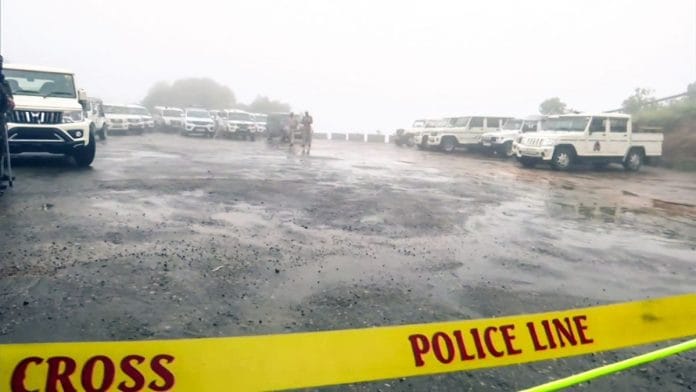


New Delhi: Upholding the validity of re-enacting a scene during investigations concerning heinous crimes, the Supreme Court Tuesday said that such techniques cannot be rejected as unconstitutional simply because the accused is made to participate in them.
Crime scene re-enactment is a technique that is gaining prominence in the investigation of heinous offences, a two-judge bench of Justices M.M. Sundresh and Satish Chandra Sharma said.
In a 95-page ruling, the bench also said that if the re-enactment is merely based on a direction to walk or to act a certain way or to imitate a visual sequence, and does not necessarily involve any physical manifestation or disclosure of personal knowledge of the accused, it will not amount to giving a personal testimony, or be a violation of Article 20(3) of the Constitution.
Article 20(3) deals with the accused person’s right against self-incrimination, essentially guaranteeing the right to remain silent and protects individuals from forced confessions. The provision states that no man can be compelled to be a witness against himself.
In doing so, the court set aside a 14 June, 2024 ruling of the Madras High Court, which had declared such crime scene re-enactments as unconstitutional, and dubbed them as a violation of Article 20(3) of the Constitution.
The case dates back to September 2013, when the body of Dr Subbiah, a renowned Chennai physician was found near a water body. According to the prosecution’s case, he was hacked to death with a sickle owing to a land dispute over his property. He had ended his shift when attacked by three men, who, it later turned out, were paid to do the job.
In a nutshell, the 2024 Madras High Court ruling had said that by re-enacting the occurrence, the accused conveys information based on his personal knowledge and becomes a witness against himself.
“It is not merely an identification data,” the high court had said while pointing out that re-enacting the occurrence certainly leads to revelation of facts which are within the personal knowledge of the accused.
Also Read: Bail jurisprudence in India slow, not short on principle. SC & its latest push for solving pendency
The conviction
A disputed piece of land with contesting claims over it, a prolonged litigation, a reputed Chennai doctor and a land-grabbing mafia are among the elements of a murder over a disputed property, where all the accused were convicted by a trial court. This was, however, reversed by the Madras High Court in 2024.
After the investigation began, the police found out that there was a prolonged dispute between the late physician and another family, which was later accused in the murder case, about the title or ownership of a land parcel of two acres in Anjugramam Village, Kanyakumari District, Tamil Nadu.
It was also alleged that the accused’s family members had previously caused damage to the fencing of the property, and back then a criminal case was registered against them.
This frustration gave rise to motive for the crime, which ultimately culminated into the commission of murder of the deceased, the apex court noted, adding that the accused persons thought that after killing Subbiah, they would be able to enjoy or dispose of the disputed property without any hindrance as he was survived only by his wife and two daughters. “That’s how the foundation of the criminal conspiracy to eliminate the deceased was laid down,” the ruling noted.
Taking note of the surveillance footage and the Call Detail Records (CDRs) from the telecom companies, the apex court said that the accused persons were in contact with each other, and that they were present near the crime scene and its surrounding areas.
Not only this, the court also found that money had exchanged hands and was transferred from the bank accounts of the accused to the hitmen.
Reversing the Madras High Court’s 2024 ruling acquitting the convicts, the top court also proceeded to answer whether re-enactment of a crime scene would amount to personally incriminating testimony barred by Article 20(3). The Supreme Court said the case was a “classic illustration” of how humans tend to surpass all limits of sound human behavior and even go to the extent of crushing human lives in the pursuance of their greed.
Are re-enactments valid?
The Supreme Court said that the core test in resolving this question is if the re-enactment merely required the accused person to act in a certain manner or to perform an act, without giving any personal testimony. In such cases, the act of re-enactment is constitutionally valid as it simply amounts to assisting the investigation.
However, if the re-enactment compelled the accused to disclose incriminating information about himself, from his personal knowledge, it will become constitutionally impermissible as it effectively compels an accused to be a “witness against himself”.
On its own, a re-enactment exercise does not constitute any direct form of evidence of the offence, as it is essentially in the nature of recreated evidence, the court said while adding that it serves the limited purpose of explaining the physical attributes of the occurrence. These attributes include the place of occurrence, lighting conditions at the relevant point of time, and visualising the manner of the commission of the offence, the court said.
Although such re-enactment may not directly assist the court in reaching any conclusion, it may help in the appreciation of the evidence on record, especially the visual evidence of events, it added.
The re-enactment or demonstration of an occurrence by an accused is often based on eyewitness accounts of the offence or on the basis of surveillance footage extracted from nearby cameras installed in public spaces, the court said.
The court stopped short of giving any general or blanket rule on the admissibility of re-enactments as evidence. However, it did say that if the accused is somehow led into demonstrating the incriminating acts committed by him from his own knowledge, it would amount to testimonial compulsion and a violation of the Indian Evidence Act which renders confessions made to a police officer or in police custody as inadmissible in law.
(Edited by Nardeep Singh Dahiya)
Also Read: Two judgments, no single standard: Why terror law UAPA’s bail threshold isn’t a straight line