





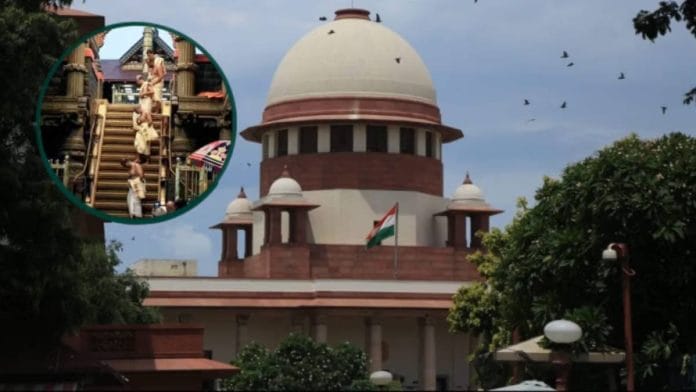


New Delhi: Can secular judges decide on religious practices? Will constitutional morality override centuries-old faith traditions? Is female genital mutilation an essential religious practice? Can Muslim women enter mosques? A nine-judge bench of the Supreme Court has over the last five weeks grappled with such questions in the Sabarimala reference hearings, with arguments showcasing sharply divergent understandings of the Constitution.
One argues that courts must maintain the autonomy of religious communities and cannot “rewrite religion”, and the other insists that practices rooted in exclusion, purity and gender hierarchy cannot be deemed constitutional merely because they are religious in character.
The arguments in the case culminated Thursday, the 16th hearing, with the bench reserving its verdict.
The nine-judge bench consisted of Chief Justice of India (CJI) Surya Kant along with Justices B.V. Nagarathna, M.M. Sundresh, Ahsanuddin Amanullah, Aravind Kumar, Augustine George Masih, Prasanna B. Varale, R. Mahadevan and Joymalya Bagchi. They heard arguments from the Centre, states, temple bodies, religious organisations, intervenors, and women’s rights advocates—examining a batch of questions which upon adjudication could redefine how India looks at religious freedom under the Constitution.
The reference arose after review petitions were filed following a five-judge bench decision in 2018 which, by a 4:1 majority, allowed women of menstruating age into the Sabarimala Ayyappa Temple in Kerala, holding that the exclusionary practice violated constitutional guarantees of equality and freedom of worship.
Attached to this reference were disputes involving Muslim women’s entry into mosques, Parsi women married to non-Parsis entering fire temples, the practice of female genital mutilation among Dawoodi Bohras, and the rights of religious denominations.
It is important to note the reference is not on the merits of the case; rather it is to lay down a broader judicial policy for the interpretation of religious freedom under the Constitution of India—answering questions about the interplay between the religious freedom rights under Article 25 and rights of religious denomination under Article 26 of the Constitution.
It will outline the scope and extent of the word “morality” under Articles 25 and 26 and whether it is meant to include constitutional morality.
Importantly, the scope of judicial review in religious practices and whether a person not belonging to a religious denomination or religious group can question a practice of that religious denomination or religious group by filing a PIL will also be answered.
Who said what
The central government emerged as one of the strongest critics of expansive judicial review during the hearings, cautioning the court against entering what it described as the “domain of faith”.
Solicitor General Tushar Mehta argued that judges are constitutional experts, not religious authorities, and therefore, courts cannot sit in appeal over matters of religion by branding practices as superstition or social backwardness merely because they may appear inconsistent with contemporary values.
During the hearings, the Centre argued that many religious institutions across India impose distinct conditions relating to age, gender, attire, rituals or modes of worship for both men and women, and such practices cannot automatically be equated with discrimination.
One of the sharpest aspects of the central government’s submissions concerned the doctrine of “constitutional morality”, which had played a central role in the 2018 Sabarimala judgment.
The Centre criticised constitutional morality as a “vague” concept lacking a clear constitutional definition. Also, Mehta argued that the Hindi text provides a more accurate understanding of indigenous concepts, such as using sampradaya for “denomination” and sadachara for “morality”.
Lastly, the Centre went on to say that the 2018 judgment in Joseph Shine vs Union of India, decriminalising adultery, was bad law because the separate concurring judgment of Justice Chandrachud not only invoked “constitutional morality” as a standard of review, but did so while making law under Article 141 based on specific academic journal articles, feminist theory texts and a minority dissenting view of the US Supreme Court. Article 141 establishes that the law declared by the SC is binding on all courts within the territory of India.
The Travancore Devaswom Board, that manages temples including Sabarimala, told the Supreme Court it opposes women of reproductive age entering the temple, citing that courts shouldn’t interfere in faith matters and that the restriction is a “classification”, not discrimination.
The board’s primary justification for the restriction was the specific character of the deity, Lord Ayyappa. Unlike other Ayyappa temples, according to it, the Sabarimala deity is worshipped in the form of a “Naishtika Brahmacharya”, or a perennial celibate student.
The board contended that the deity’s “great powers” are derived from “ascetic endeavours” and a strict “abstention from sexual activities”. This religious requirement extends to the devotees, who must undergo a rigorous 41-day “vratham” (penance) involving abstinence and self-denial to “purify the human mind and body” before the temple pilgrimage.
One of the most politically significant aspects of the hearings was the change in position of the Kerala government.
The Left Democratic Front’s Pinayari Vijayan-led government, which had strongly supported the 2018 judgment permitting women’s entry, informed the court during the reference hearings (amid assembly elections) that it would leave the issue to be decided by the judiciary, marking a moderate shift in its previous stand.
Senior advocate Rajeev Dhavan, who argued the case in person, argued for a fundamental shift in how the Indian State interacts with faith, and that requiring a believer to prove a total transformation of their faith just to merit protection was an overly restrictive standard that failed to account for the actual lived experience of religious devotion.
Dhavan critiqued the elevation of “constitutional morality” from a guiding value to a formal legal limitation on religious freedom.
Appearing for Ayyappa temple bodies, senior advocate J. Sai Deepak said Article 26 guarantees an independent sphere of collective religious autonomy, limited only by considerations of public order, morality, and health. Extending Article 25(2)(b) to override denominational rights, he contended, would undermine the constitutional protection afforded to religious institutions in managing their own affairs. Article 25(2)(b) empowers the State to regulate or restrict secular activities associated with religious practices and to make laws for social welfare and reform.
He further argued that judicial scrutiny of such practices would effectively amount to courts “rewriting” religious norms.
Senior advocate Shyam Divan, for intervenors representing various Hindu, Jain, and Christian faith-based organisations, referred to the “golden triangle” of Articles 14 (right to equality), 19 (right to freedom) and 21 (right to life and liberty), and suggested that the court may consider whether the time has come to expand this triangle so that the right to freedom of religion is also seen as part of the core constitutional structure.
Senior advocate M.R. Shamshad, appearing for the All India Muslim Personal Law Board, submitted that the petition, seeking permission for Muslim women to enter the main prayer area of mosques, is framed as a PIL alleging violation of Articles 14, 19 and 21, with no reference to Article 26.
He said it proceeds on the footing that women are not allowed to enter mosques and that there is “no quarrel across the religious denominations in Muslims that women cannot enter into mosque and that too for prayer”, adding that women can be part of the congregation, though “certain discipline has to be followed” and explaining that “if everyone from the house goes, then who will take care of the children?”
Also Read: Sabarimala administration is stuck in the 1960s
Arguments of respondents
Starting from the 10th hearing, the court heard arguments from the respondents—the ones supporting the 2018 Sabarimala verdict.
Senior advocate Indira Jaising, representing two women who had successfully entered the Sabarimala temple in 2019 following the 2018 court ruling, differentiated between access and practice.
Entry into a temple, she argued, flows from Article 25(1) as a matter of conscience, while ritual remains protected. She explained that the court has protected ritualistic practices but not exclusion from access.
According to her, while a person cannot dictate how puja is to be performed, that protection of ritual cannot extend to denying entry into the temple itself. She rejected the argument that religious matters are beyond judicial review and maintained that “custom cannot override my fundamental right”.
Jaising argued that untouchability is not confined to caste but extends to notions of “pollution, purity and defilement.” She argued that there is parity between exclusion and the treatment of women as “impure”.
For the Indian Young Lawyer’s Association, the original petitioners behind the 2018 Sabarimala verdict, advocate Ravi Prakash Gupta attacked the maintainability of the reference arguing that it was “made to unsettle a settled law”.
Senior advocate Darius Khambata, appearing for a Parsi woman, argued that the collective rights of a denomination cannot trample upon the individual rights of a believer and that a faith-believing woman should not be stripped of her faith or right to worship simply because she married outside her community.
The court observed that practices excluding people based on marriage (or caste) cannot be sustained under the guise of religious custom, and such exclusion is unconstitutional.
Senior advocate Sidharth Luthra, for the intervenors, argued that the practice of female genital mutilation (FGM) is performed on 7-year-old girls, who are minors incapable of giving consent. The court was also told that FGM is not ordained by holy books and cannot claim protection as an essential religious practice.
Appearing for three women who were denied entry into the Sabarimala temple, senior advocate Vijay Hansaria argued that Article 26 does not have supremacy over other constitutional provisions, as a “notwithstanding” clause is absent.
Appearing in an intervention application filed by Swami Agnivesh, senior advocate Menaka Guruswamy said the State is religiously agnostic, but “it also reforms”, she argued, describing India as a “classical welfare state”.
Quoting Constituent Assembly debates, she submitted that conscience must sometimes support reform even where “a large majority” may disagree. Guruswamy argued “civilisations are reformed when balance is upset”.
On the 16th and last hearing of the reference, amicus curiae senior advocate K. Parameshwar made concluding submissions that critiqued the current judicial approach to religious freedom.
Parameshwar argued that religious freedom represents a form of “swaraj” or personal identity, and urged against applying strict, culturally insensitive definitions to identify religious denominations.
Furthermore, he argued that devotees should not have to prove a unique identity to protect their traditions, and that constitutional morality should be applied carefully to avoid subjective interpretations.
(Edited by Nida Fatima Siddiqui)
Also Read: ‘Judges must uphold constitutional morality, not be swayed by popular opinion’—retd SC judge AS Oka