



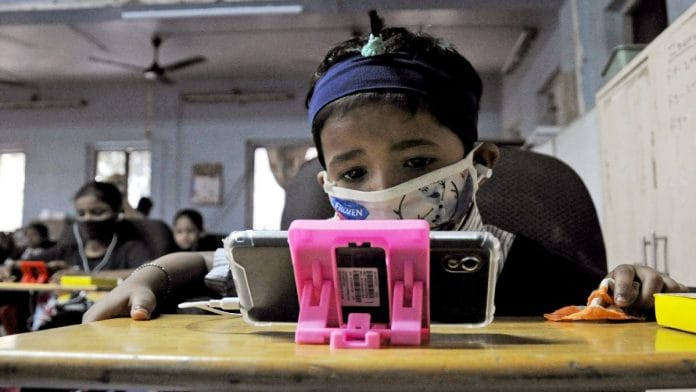
New Delhi: The right to access and use the internet is a fundamental right, including for children, and protecting them from online abuse cannot mean shutting them out of the digital world, the Supreme Court has said. The top court has instead called for a coordinated system between the government and social media platforms to identify and remove child sexual exploitation and abuse material (CSEAM).
“The safety of our children and their freedom are not at odds with each other. Our children are entitled to both,” a bench of Justices J.B. Pardiwala and K.V. Chandran said on 15 October.
The court directed the Union government to create a national database of verified digital identifiers and URLs linked to such material. The database may be housed within the Indian Cyber Crime Coordination Centre’s Sahyog Portal or operate as a separate repository.
The order came on a plea by NGO Just Rights for Children Alliance and follows the court’s September 2024 judgment in Just Rights for Children Alliance v. S. Harish, which addressed the circulation of child sexual abuse material and online intermediaries’ legal obligations.
Expressing concern over continuing gaps in compliance despite its 2024 judgment, the bench issued a series of directions to strengthen the existing framework for detecting, reporting and removing CSEAM.
Why SC wants common database
Platforms often maintain separate lists of known abusive material. When one platform identifies and removes content, others do not automatically receive that information, allowing the same material to continue circulating elsewhere. Links shared on social media can also direct users to external websites hosting such content, sometimes behind paid subscriptions.
The proposed database aims to address these gaps by allowing platforms to identify known material across services. It will contain verified digital identifiers, known as hashes, and URLs linked to CSEAM.
Hash identifiers are digital fingerprints generated from images or videos, allowing platforms to detect matching content, including copies uploaded by different users. URL listings identify web addresses hosting such material, helping platforms block links to known sources.
The court clarified that the database would contain only hashes and URLs, not the abusive material itself. At least three trained human analysts must independently verify the material before its identifiers are added. Platforms must immediately remove content matching a verified entry, while material not already listed must undergo appropriate checks before removal.
The database must be used exclusively to detect and remove CSEAM and cannot be repurposed to target other kinds of content, said the court.
It also directed platforms to provide a dedicated grievance category for CSEAM complaints, accessible within two steps, and appoint trained grievance officers. Platforms must scrutinise advertisements and links that could lead children to harmful material, including promotions for applications that manipulate children’s photographs into sexually exploitative images.
Reporting and accountability
For relevant complaint-based cases involving material of unknown origin, the order specifies a two-hour reporting window. Reports may be submitted to the Special Juvenile Police Unit, local police or the cybercrime portal under Rule 11 of the Protection of Children from Sexual Offences Rules.
Platforms must also submit weekly consolidated reports on content removed after matching entries in the database.
They must explain the reasons for removing content and provide a mechanism to challenge such decisions. The court clarified that safe-harbour protection under Section 79 of the Information Technology Act does not, by itself, excuse non-compliance with applicable reporting duties under child-protection law.
The court asked the government to consider exemplary penalties for intermediaries that repeatedly fail to comply with the framework. It also asked it to consider recovering revenue earned through the misuse of paywalls or subscriptions to circulate prohibited material. The order does not prescribe a uniform fine for every violation.
Safeguards without blanket restrictions
Rather than restricting children’s access to the internet, the court suggested proportionate safeguards, including dedicated child modes, private accounts by default, restrictions on contact from unknown adults, and stronger moderation of advertisements and content accessible to children.
Notably, a NALSAR–IGAP report on age restrictions and online harm has argued that age limits alone cannot adequately protect children without safer platform design and stronger safeguards.
The court also called for age-appropriate education on consent, grooming and digital safety, along with awareness programmes for parents and teachers. It said victims should have access to counselling, psychological support and therapy, with follow-up care to safeguard their wellbeing.
The Union government, through the Ministry of Electronics and Information Technology and the Ministry of Law and Justice, must report on progress in implementing the framework before the next hearing on 10 December.
Aditya Edara is an alum of ThePrint School of Journalism, currently interning with ThePrint.
(Edited by Chingkheinganbi Mayengbam)
Also Read: Meta agrees to report child sexual abuse cases to Indian law enforcement amid Centre’s crackdown