



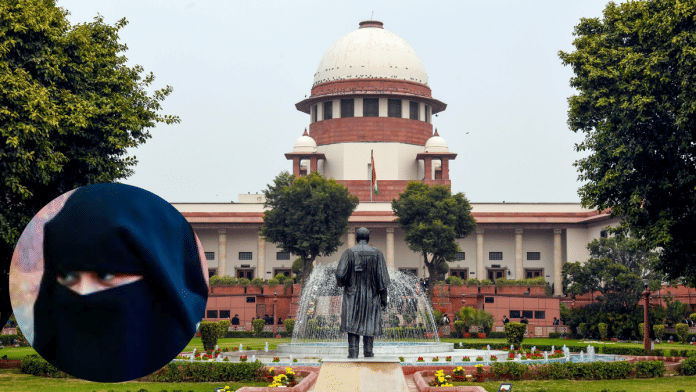
New Delhi: The Sharia (Islamic strictures) in the Muslim personal laws structurally assign women a smaller share than men and deny them full inheritance in various situations, resulting in systemic gender-based deprivation of property rights: That’s what a petition before the Supreme Court has argued. On Thursday, the Supreme Court issued a notice to the Centre, asking for its response.
Tagging this petition with a bunch of pleas seeking similar relief, the SC set a date to examine the civil rights of Muslim women, specifically focusing on their freedom to opt out of religious mandates in favour of secular laws. At the heart of this legal struggle is the tension between traditional religious statutes and the fundamental rights guaranteed under Articles 14 (right to equality), 15 (right to non-discrimination), and 21 (right to dignity) of the Constitution.
The article 32 (right to move the SC for enforcement of Fundamental Rights) petition filed by Poulomi Pavani Shukla, an advocate, and Nyaya Naari Foundation seeks Section 2 (governing intestate succession, special property of females, marriage) of the Muslim Personal Law (Shariat) Application Act, 1937 to be declared unconstitutional and violative of Articles 14, 15, and 21.
The advocate for the petitioner Nihal Ahmad argues that the rules for inheritance and testamentary succession under Sharia are not “essential religious practices” under Article 25 (right to practise religion). They are, in fact, civil and economic arrangements, not fundamental rituals of faith.
During the hearing Thursday, senior advocate Prashant Bhushan for the petitioners before a SC bench of CJI Surya Kant, justices Joymalya Bagchi and Vipul M. Pancholi, argued that since Article 25 of the Constitution does not protect personal law, if any personal law is “discriminatory, it needs to be struck down”. Once it’s struck down, the Indian Succession Act can apply.
It is crucial to note that the Indian Succession Act, 1925 governs succession for Christians, Parsis, and other non-Muslims. It excludes Muslims, whose inheritance is governed by the Personal Law by establishing uniform procedures for wills, probate, and intestate succession across India. However, the Muslim succession law is uncodified and women receive half the share that men do, with widows receiving 1/4 (if childless) or 1/8 (with children) of the husband’s property. The petitioners want Muslims to enjoy the same autonomy over property that is enjoyed by other Indian citizens.
“I often tell my Muslim friends not to oppose the Uniform Civil Code,” Bhushan told the court, to which CJI Kant replied, “Uniform civil code is a constitutional ambition… it has nothing to do with religion.”
This petition also seeks to address the “constitutional anomaly” where a Muslim woman’s rights depend on her place of residence. With the enactment of the Uttarakhand Uniform Civil Code, Muslim women in that state have equal inheritance rights, while those in the rest of India do not. The petition seeks to resolve this disparity, arguing that identical religious identity should not result in different civil consequences based solely on geography.
To avoid a “legal vacuum” if the discriminatory Sharia provisions are struck down, the petition proposes an immediate remedy—reading down the portion of the Indian Succession Act that currently excludes Muslims, allowing them access to a secular and equal system of inheritance.
The top court bench also asked Bhushan to bring some aggrieved persons on record. Agreeing to that, Bhushan also added later in the hearing that Muslims fear the UCC will become “de facto the Hindu Civil Code”—emphasising that the Hindu civil code also relies on customs and isn’t uniform. Hence, the UCC, he said, mustn’t be discriminatory.
Also read: In Assam ‘Sankalp Patra’, BJP promises UCC, war on ‘love and land jihad’ if voted to power again
Pleas seeking similar relief pending
The longest-pending petition before the SC on this issue is one by the Khuran Sunnath Society (a Kerala-based NGO) since 2016.
In 2015, after the Kerala High Court ruled that matters of personal law reform fall under the legislature’s mandate, not the judiciary’s, they approached the top court in appeal.
The society challenged the constitutional validity of Muslim personal law (Sharia) on inheritance, arguing that it discriminates against women and violates fundamental rights guaranteed under Articles 14, 15, and 21 of the Indian Constitution. The society argues that under Sharia, a female child inherits only half the share of a male child.
Furthermore, if a deceased person has only daughters and no sons, the daughters receive only two-thirds of the property, with the remainder going to more distant male relatives. The petitioners seek a declaration that these inheritance practices are unconstitutional and want Muslim citizens to have the option to be governed by the Indian Succession Act, 1925, which is secular.
A writ petition registered in 2024 by Sufiya P.M. is pending. Filed by a Kerala-based woman who identifies as a non-believer, the petition specifically seeks a declaration that she should be governed by the Indian Succession Act, 1925, rather than Muslim Personal Law. The petition urges the SC to exempt non-believing Muslims from the mandatory application of the Shariat Act, 1937, arguing that individuals who no longer adhere to the faith should not be bound by its religious civil mandates. The central government has argued that such changes fall within Parliament’s domain, not judicial intervention.
Another recent petition filed by Naushad K.K. has been pending since 2025. Unlike the Sufiya case, this petition was filed by a practising Muslim man seeking inheritance rights under the Indian Succession Act, 1925, instead of Muslim Personal Law. The core of his legal argument is that the forced application of religious inheritance laws violates his fundamental rights to equality, life, and religious freedom guaranteed under Articles 14, 21, and 25 of the Constitution.
(Edited by Viny Mishra)
Also read: Indian Muslims are hiding their dowry practice in a Sharia loophole