





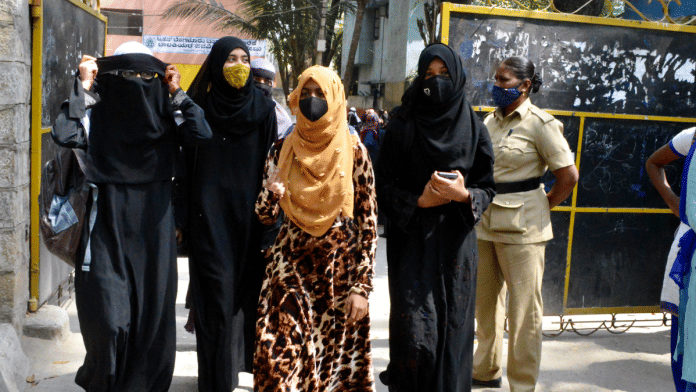

New Delhi: The Allahabad High Court has held that wearing a hijab is not an essential religious practice under Article 25 (right to religion) of the Constitution, and dismissed a petition seeking a writ of mandamus compelling a school to allow a student to wear a hijab with uniform.
Echoing the positions taken by other HCs on the question of essential religious practice, the Allahabad HC held that a rule requiring students to wear a uniform promotes a religion-neutral atmosphere as it applies to students professing different faiths without singling out any one on the basis of his/her faith.
“We are of the opinion that so long as the dress code is uniform, bona fide, non- discriminatory and intended to maintain discipline and institutional identity, the choice of the prescribed uniform primarily lies within the domain of the School,“ said a bench of justices Indrajeet Shukla and J.J. Munir.
The case is linked to the Tagore Public School, Prayagraj, where a student from the Shia Muslim community was denied Class XI admission this year on account of her insistence on wearing the hijab. There had been no written order on it from the school, but the stand taken by the authorities was clear.
She moved applications twice before the district magistrate—on 14 May and 10 June.
In a statement recorded before the DM, the school principal stated that the school is affiliated with the CBSE and is self-financed, therefore, it has the freedom to enforce their internal discipline and determine the dress code.
The student then moved the high court, through her mother, for issuing a mandamus directing the school authorities to permit the petitioner to wear a headscarf.
She asserted that her right to wear a headscarf is protected under the Constitution. She argued that it falls within the ambit of the freedom of expression guaranteed by Article 19(1)(a) and the right to equality under Article 14.
Also read: The rise of Hijabi influencers. They don’t need your rescuing
Court’s reasoning
The court applied the essential practices doctrine, a judicial test evolved in constitutional jurisprudence to determine whether a religious practice is integral to the faith and, therefore, protected under Article 25 that guarantees the freedom of conscience and the right to freely profess, practice and propagate religion.
Citing other HC references, the court noted, “There is absolutely no material placed on record to prima facie show that wearing of hijab is a part of an essential religious practice in Islam and that the petitioners have been wearing hijab from the beginning.
“This apart, it can hardly be argued that hijab being a matter of attire, can be justifiably treated as fundamental to Islamic faith. In view of the above discussion, we are of the considered opinion that wearing of hijab by Muslim women does not form a part of essential religious practice in Islamic faith.”
The court also noted that there shall be two categories of girl students—those who wear the uniform with hijab and those who do it without. “That would establish a sense of social separateness, which is not desirable.”
It also offends the feel of uniformity which the dress code is designed to bring about amongst all the students regardless of their religion and faiths, it said, adding the object of prescribing uniform will be defeated if there is non-uniformity in the matter of uniforms.
With this the court dismissed the petition, holding, “We have perused the photographs from various classes relating to the petitioner. Except for her, no other girl student is donning the headscarf, even those belonging to the same religious community, as the petitioner.”
“Wherever this issue has arisen, the High Courts have been unanimous in opinion that wearing a headscarf is not essential part of the Islamic faith for a woman to don, in the absence of which, faith would be jeopardised,” it added
The hijab question in SC
In the judgment, the court observed that the question of whether wearing the hijab in educational institutions is protected as a religious practice remains pending before the Supreme Court for final determination.
In the Aishat Shifa v. State of Karnataka (2022), a division bench delivered a split verdict on the question.
Justice Hemant Gupta reasoned that the right to dress, though connected to identity and dignity under Articles 19 and 21, must yield to institutional discipline and equality before law. He emphasised that students of state schools cannot subordinate their freedom of choice in dress to religion rather than to the uniform code prescribed by the state.
Equality, he held, requires treating all citizens alike irrespective of caste, creed, sex, or religion and such equality cannot be breached by permitting religious attire in state institutions. Justice Gupta, therefore, concluded that the wearing of the hijab is not an essential religious practice protected under Article 25.
Justice Sudhanshu Dhulia did not agree to this point of view.
“The question of Essential Religious Practices was not at all relevant in the determination of the dispute before the Court. I say this because when protection is sought under Article 25(1) of the Constitution of India, it is not required for an individual to establish that what he or she asserts is an ERP. (essential religious practice.)
“It may simply be any religious practice, a matter of faith or conscience! Yes, what is asserted as a Right should not go against ‘public order, morality and health,’ and of course, it is subject to other provisions of Part III of the Constitution.”
Justice Dhulia further mentioned that the “question this Court would therefore put before itself is also whether we are making the life of a girl child any better by denying her education, merely because she wears a hijab!”
“All the Petitioners want is to wear a hijab! Is it too much to ask in a democracy? How is it against public order, morality or health? or even decency or against any other provision of Part III of the Constitution. These questions have not been sufficiently answered in the Karnataka High Court Judgement.” He added
Justice Dhulia warned that “schools, colleges are the perfect institutions where our children, who are now at an impressionable age, and are just waking up to the rich diversity of this nation, need to be counselled and guided, so that they imbibe our constitutional values of tolerance and accommodation, towards those who may speak a different language, eat different food, or even wear different clothes or apparels!
“This is the time to foster in them sensitivity, empathy and understanding towards different religions, languages and cultures. This is the time when they should learn not to be alarmed by our diversity but to rejoice and celebrate this diversity. This is the time when they must realise that in diversity is our strength.”
The matter is now pending before a larger Bench of the Supreme Court, which will decide the cases relating to the wearing of the hijab in educational institutions.
(Edited by Ajeet Tiwari)